
 USA
/
S&P Global
Investment Manager Index
About
Latest Releases
12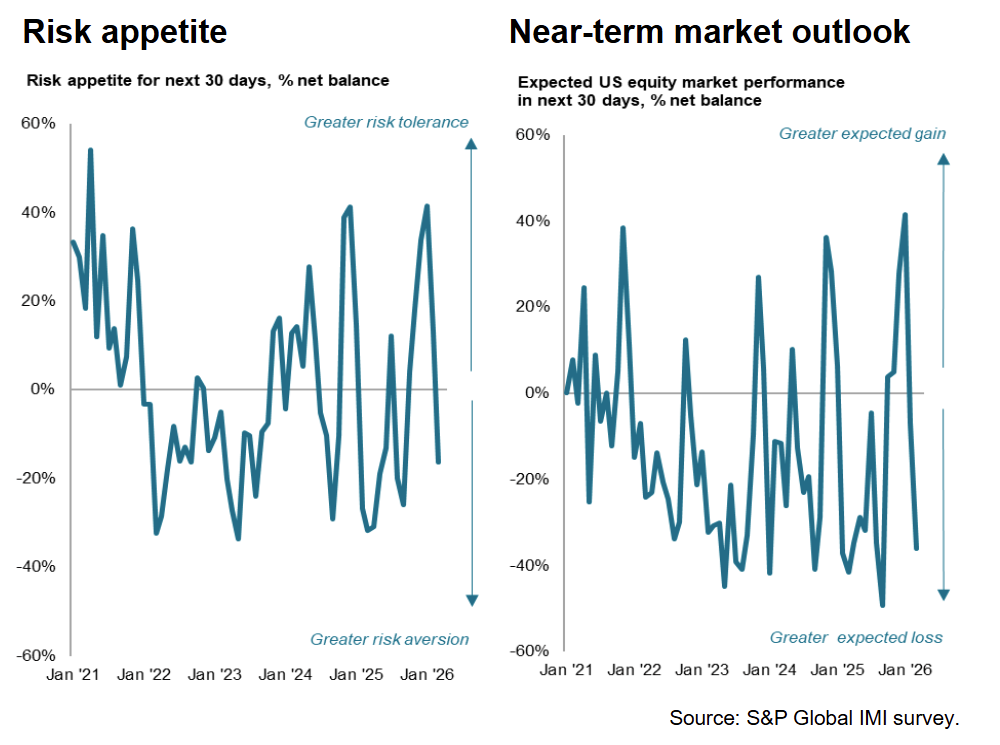
The S&P Global IMI Risk Appetite Index fell to -16% in March from +13% in February, marking a sharp deterioration in investor sentiment and the first shift into risk-averse territory since September.
-
The headline Risk Appetite Index declined to -16% (-29 ppts MoM), indicating that institutional investors turned net risk-averse following the outbreak of war and rising geopolitical uncertainty.
-
Expectations for U.S. equity returns over the coming month deteriorated further and moved deeper into negative territory, reaching the most pessimistic level since September after hitting a survey high in January.
-
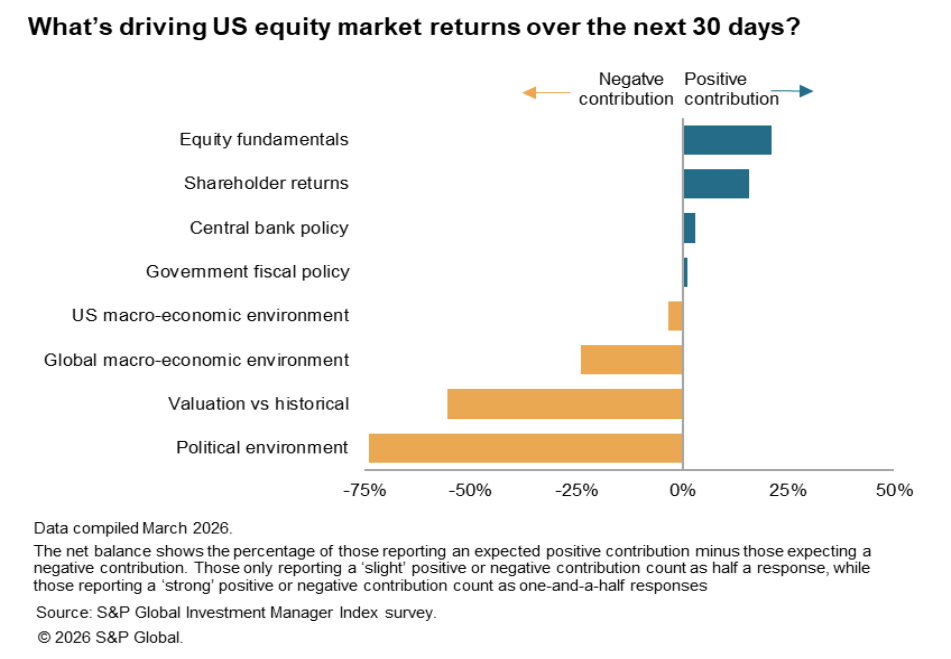
Political risks emerged as the largest drag on investor sentiment, with concerns rising to their highest level since the U.S. tariff announcements in April of the previous year.
-
The macroeconomic environment is now viewed as a near-term drag on equities for the first time since October, reflecting weaker global economic expectations and the impact of higher energy prices.
-
Expectations for monetary policy support weakened, with anticipated benefits from central bank easing falling to the lowest level since August, while perceived fiscal policy support for equities also declined to near-neutral levels.
-
Sector preferences shifted sharply toward defensive positioning, with energy sentiment rising to its highest level in four years and improving views on healthcare, utilities, basic materials, and consumer staples.
-
Cyclical sectors fell out of favor, with consumer discretionary dropping to the bottom of the rankings, while sentiment toward financials recorded the largest negative shift in nearly two and a half years and technology sentiment turned negative for the first time since April of last year.
-
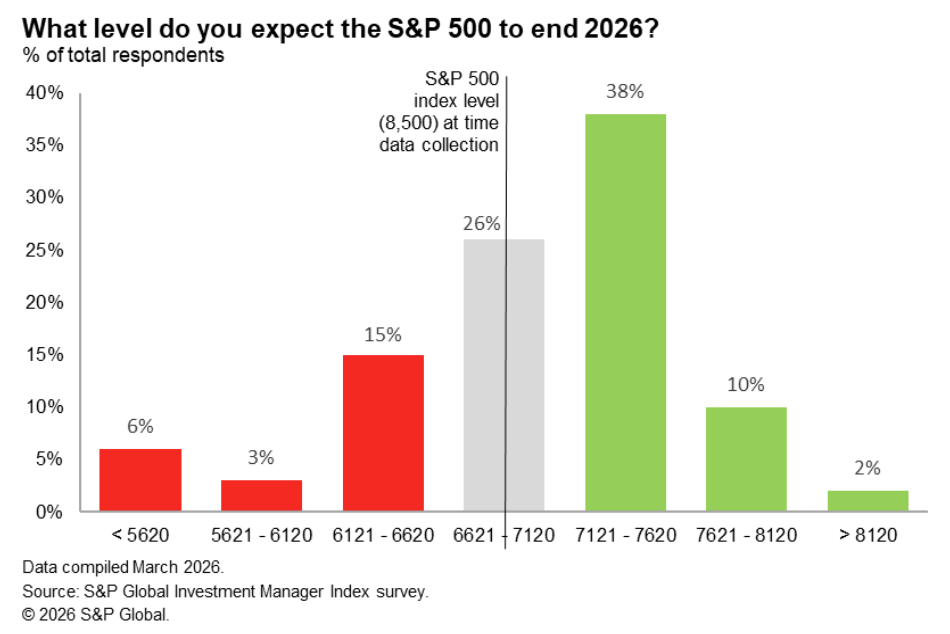
Despite the weaker near-term outlook, longer-term expectations remained resilient, with the median forecast placing the S&P 500 at 7,500 by year-end and investors still expecting mild U.S. economic growth alongside reduced recession probabilities.
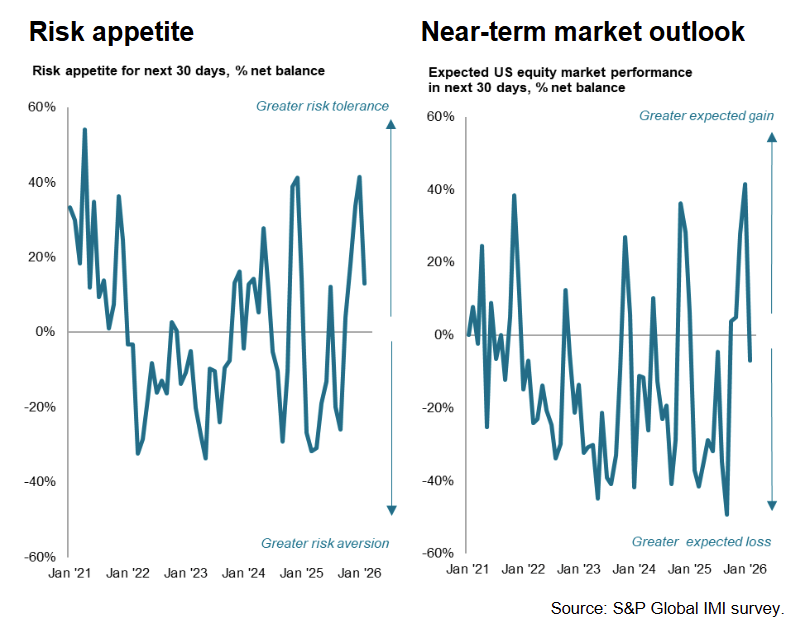
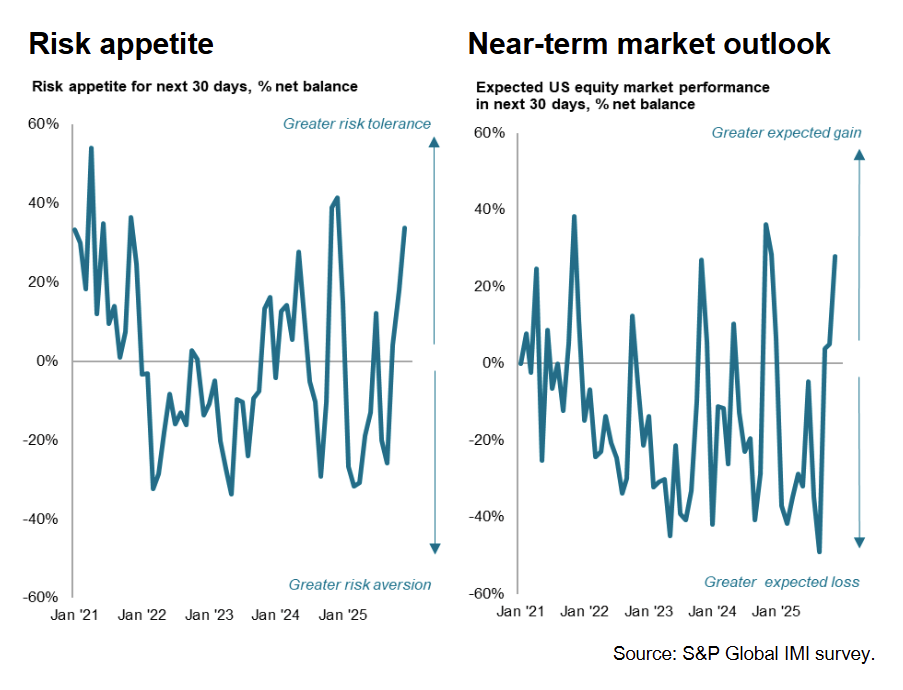
The S&P Global IMI Risk Appetite Index fell to +13% in February 2026 (from +41% in January), signaling a sharp pullback in near-term equity optimism despite remaining positive.
-
Risk appetite declined sharply from January’s 13-month high, reaching its lowest level since October, though staying in positive territory for a fifth consecutive month.
-
Expectations for U.S. equity returns over the coming month turned negative for the first time since September, reversing the survey-high optimism seen at the start of the year.
-
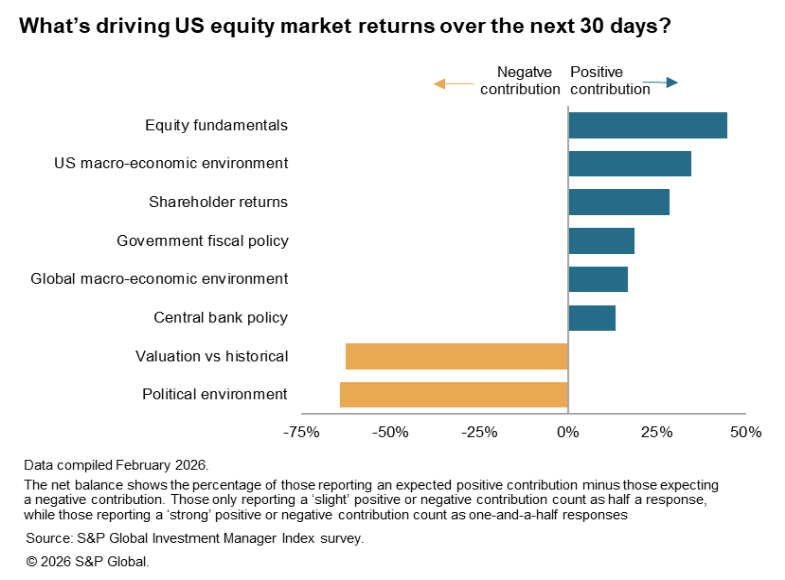
Political concerns intensified, with worries about their impact on equities rising to joint-highest levels since June and surpassing valuation concerns as the largest drag on sentiment.
-
Expectations for central bank policy support weakened further, falling to their least optimistic level since August as investors anticipated fewer imminent rate cuts.
-
Fiscal policy and the global macro environment remained net positives for U.S. equities, but their perceived support cooled from the elevated levels recorded in January.
-
In contrast, equity fundamentals became the strongest positive driver for the first time since July, with optimism around earnings rising to a four-year high.
-
Sector preferences shifted toward industrials, energy, and basic materials, while investor favor fell for financials and technology; real estate and consumer discretionary remained the least favored sectors.
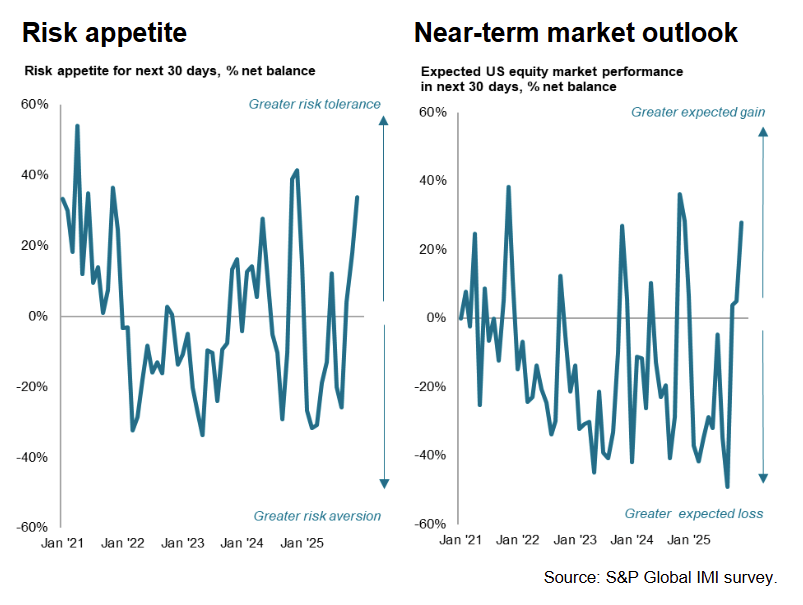
The S&P Global IMI Risk Appetite Index rose to +41% in January 2026 (from +34% in December), reaching a joint-high since April 2021 and signaling a stronger “risk-on” tone tied to improving market expectations for 2026.
-
The Risk Appetite Index has now increased for four consecutive months, reaching its strongest level since April 2021, consistent with a broad rebound in investor sentiment entering 2026.
-
Near-term expectations for U.S. equities strengthened further, with 58% of respondents expecting gains over the coming month versus 16% expecting declines, marking the most optimistic one-month return outlook since the survey began in October 2020.
-
The report attributes the improvement partly to a brighter macro backdrop, with the U.S. economy viewed as a positive driver of equity returns to the strongest degree since just before Trump’s inauguration a year ago, and global growth influence seen as the strongest in just over four years.
-
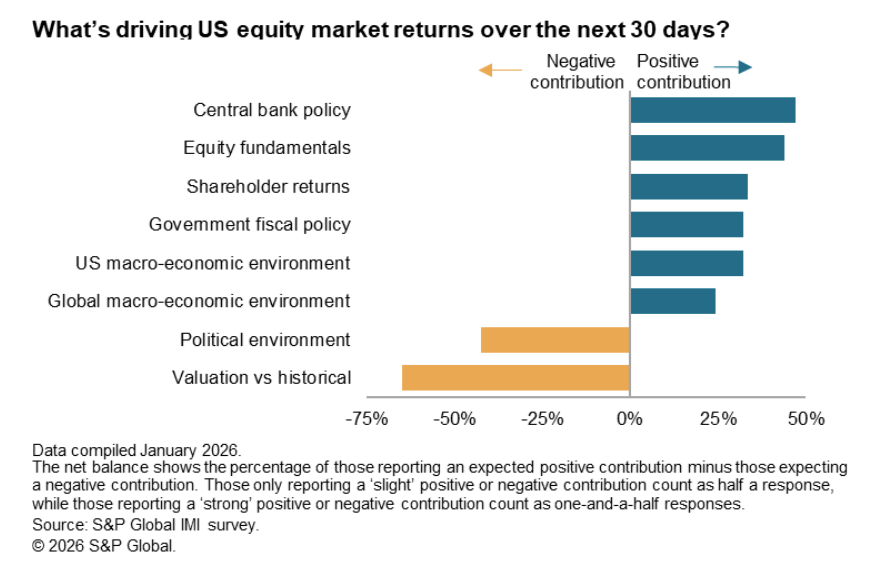
Policy expectations remained supportive: the market contribution from lower interest rates was still described as among the highest since 2021, while fiscal policy was viewed as a positive equity driver to the greatest extent since August 2021.
-
Fund managers also reported improving views of equity fundamentals, with expectations for shareholder returns (dividends) the most positive in a year and earnings / fundamentals seen as the most positive in three years.
-
Valuations and politics remained the main drags on sentiment, but the negative impact of valuations eased to its lowest since June, while geopolitical concerns were described as less widespread than through much of 2025 despite renewed flare-ups.
-
Optimism broadened across asset classes, with sentiment improving for global equities (most bullish, highest since April 2021) and commodities (highest since April 2022), while sentiment also moved back into bullish territory for both corporate and sovereign debt.
-
Sector preferences in the near-term U.S. equity outlook were strongest for financials and healthcare, with industrials and basic materials moving sharply higher in rankings amid improved growth prospects; real estate and consumer staples remained bearish, while energy turned bullish for the first time in nine months.
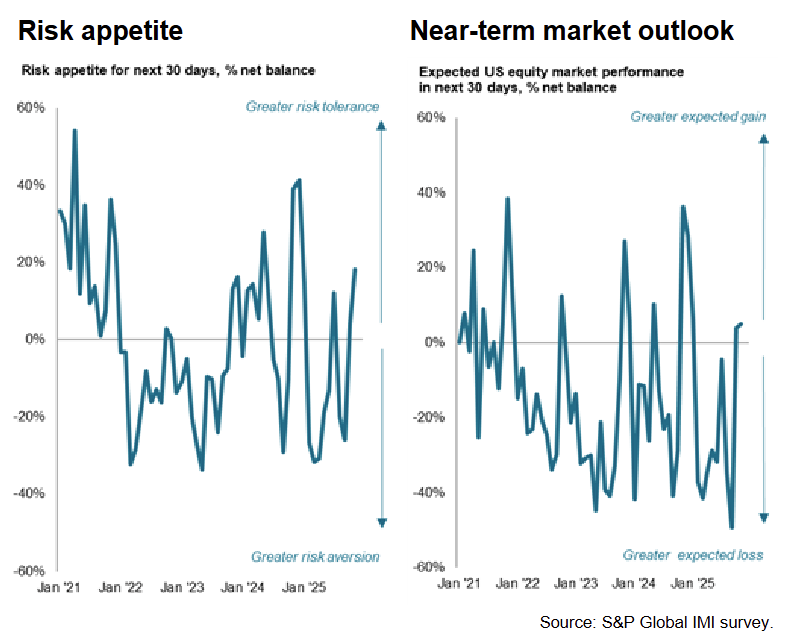
The S&P Global IMI Risk Appetite Index surged to +34% in December from +18% in November, marking its strongest reading since December 2024 and extending a three-month rebound driven by expectations of lower interest rates and improving economic and earnings prospects.
-
Near term market return expectations also reached their highest since December 2024, reflecting one of the most bullish investor outlooks in the survey’s history as both U.S. and global growth views improved.
-
Risk appetite strengthened most among U.S. based investors, while non U.S. respondents showed little change; excluding mutual fund managers, risk appetite is the highest since the survey began in 2020, underscoring broad-based optimism among discretionary managers.
-
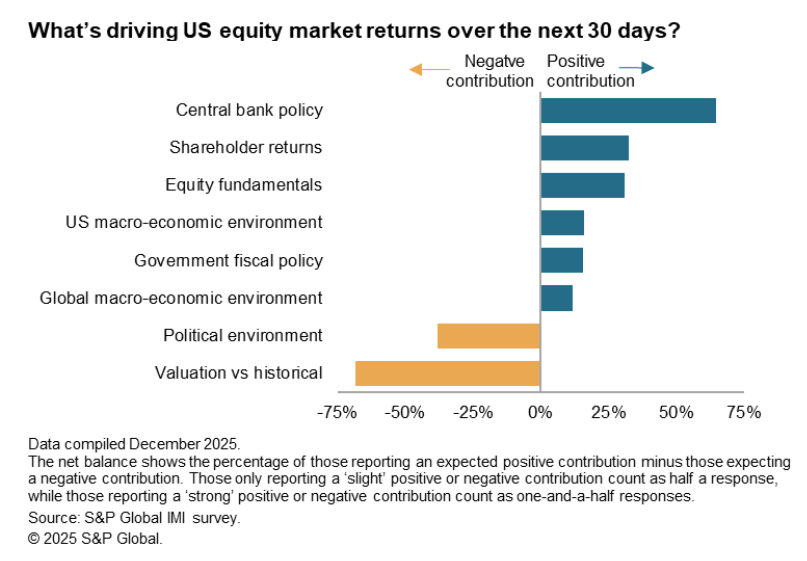
Central bank policy remained the dominant driver for a fourth straight month, with the anticipated equity boost from lower rates at its strongest since April 2021; roughly 80 percent of respondents expect another FOMC cut in December.
-
Macro conditions are seen increasingly supportive, with the U.S. macroeconomic contribution to equity returns at its highest since January and global macro trends viewed as most favorable since January 2022; growth expectations for 2026 are among the strongest of the past three years.
-
Fiscal policy expectations improved following the end of the government shutdown, lifting its perceived market contribution to a one-year high and reducing the political drag to its lowest since January.
-
Valuation concerns remain the largest headwind, but their perceived negative impact has eased to the lowest since June, even after equity markets rebounded from the November selloff.
-
Sector sentiment remains most positive for healthcare and financials, with continued strength in communication services and tech; meanwhile, sentiment toward consumer discretionary turned positive for the first time since January, reflecting rising expectations for improved consumer spending.
-
Real estate remains the least favored sector, though negative sentiment toward consumer staples and energy has softened compared with prior months.
The S&P Global Investment Manager Index (IMI) Risk Appetite Index rose to +18% in November from +4% in October, marking its highest level since December 2024 and signaling improved investor optimism for a second straight month amid lower rates and better earnings expectations.
-
Investor sentiment has strengthened for a third consecutive month, driven by expectations of accommodative central bank policy, stronger fundamentals, and easing macro concerns.
-
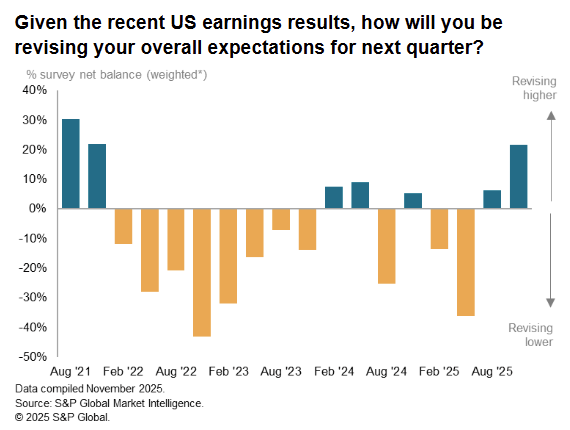
Earnings expectations were revised upward by the largest margin in four years following the recent earnings season, with improved views on both U.S. and global growth.
-
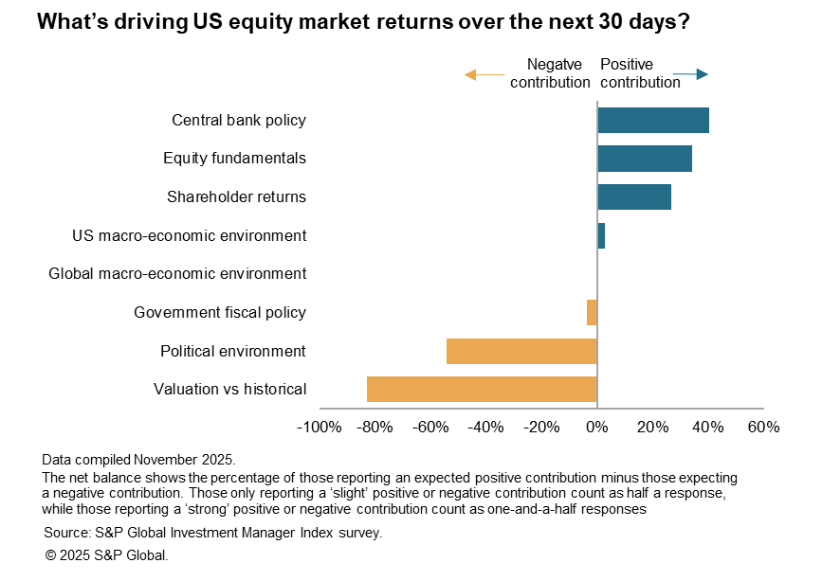
The U.S. economy is now viewed as a driver of equity value for the first time since February, while global conditions are seen as neutral after a 16-month drag.
-
Valuations remain the biggest perceived headwind, with their negative impact intensifying to the second-highest level since late 2020; political concerns have eased to the lowest since January despite the government shutdown.
-
Tech sentiment turned most bullish in a year, supported by strength in fundamentals, with healthcare, financials, and industrials also improving. Real estate, consumer discretionary, and consumer staples remain least favored, though bearishness has softened.
-
Shareholder return preferences have shifted toward buybacks, now at their strongest since 2022, while dividend growth faces pressure from tariff-related uncertainty and rising AI investment costs.
-
S&P Global noted that investor optimism is underpinned by improving fundamentals and policy support, though elevated valuations continue to cap broader market enthusiasm.
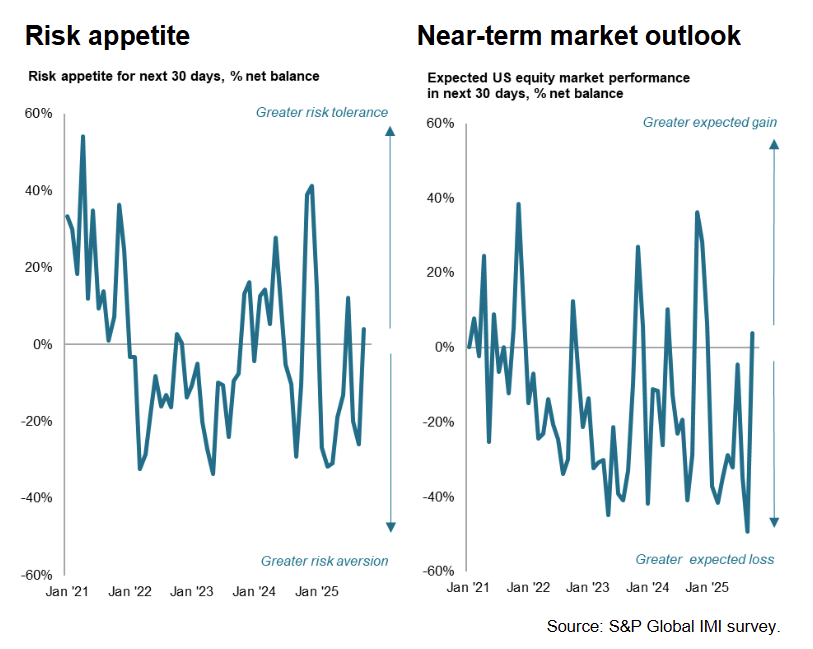
The S&P Global Investment Manager Index (IMI) Risk Appetite Index rebounded to +4% in October from -26% in September, reflecting renewed investor optimism following the Federal Reserve’s first rate cut of the year.
-
The rate cut drove a broad improvement in sentiment, though optimism remains well below levels seen early in 2025 amid lingering concerns over valuations and political uncertainty.
-
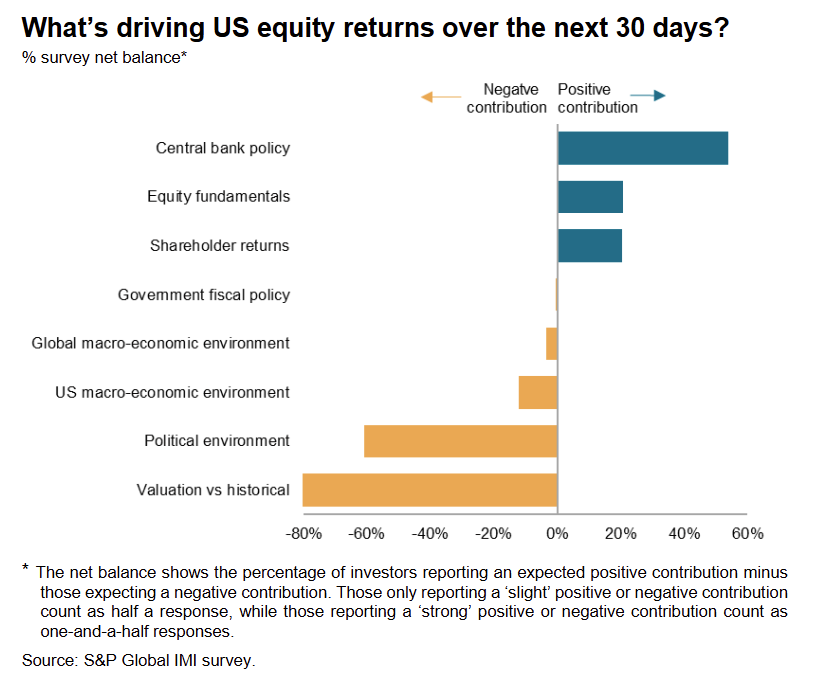
Equity fundamentals were viewed more favorably, with U.S. macroeconomic conditions exerting the smallest perceived drag since February.
-
Sector sentiment shifted toward cyclicals, with technology stocks seeing the sharpest rebound, now the second-most favored sector behind financials, while materials, communication services, and industrials also improved.
-
Bearishness in consumer discretionary moderated, while sentiment turned more negative for real estate and weakened sharply for consumer staples.
-
Globally, equities became the most favored asset class since April 2021, followed by commodities, which saw their most bullish sentiment since April 2022.
-
Regionally, Japanese and Chinese equities led investor preference for expected year-end performance, while the UK and Latin America ranked lowest.
-
Fiscal policy was no longer viewed as a drag for the first time in nine months, and easing Middle East tensions reduced geopolitical risk, though Russia remained a top concern.