


S&P Global Manufacturing PMIs: February 2026
Global - 3/4/2026
| Asia Pacific | Europe | North & South America |
|---|---|---|
| Australia - 3/1/2026 | Austria - 2/25/2025 | Brazil - 3/2/2026 |
| Malaysia - 3/2/2026 | Ireland - 3/2/2026 | Canada - 3/2/2026 |
| ASEAN - 3/3/2026 | Netherlands - 3/2/2026 | US - 3/2/2026 |
| Myanmar - 3/3/2026 | Romania - 3/2/2026 | Colombia - 3/2/2026 |
| Philippines - 3/2/2026 | Turkiye - 3/2/2026 | Mexico - 3/2/2026 |
| Thailand - 3/2/2026 | Poland - 3/2/2026 | |
| Vietnam - 3/2/2026 | Spain - 3/2/2026 | |
| Indonesia - 3/2/2026 | Czechia - 3/2/2026 | |
| Japan - 3/2/2026 | Italy - 3/2/2026 | |
| Taiwan - 3/2/2026 | France - 3/2/2026 | |
| China - 3/4/2025 | Germany - 3/2/2026 | |
| India - 3/2/2026 | Eurozone - 3/2/2026 | |
| Russia - 3/2/2025 | Greece - 3/2/2026 | |
| Kazakhstan - 3/2/2026 | UK - 3/2/2026 | |
| South Korea - 3/3/2026 | Switzerland - 3/2/2026 (procure.ch) | |
| Pakistan - 3/2/2026 |
Key Results
Highs & Lows
- Indonesia up 1.2 pts to 53.8, highest in nearly two years.
- Taiwan up 3.5 pts to 55.2, highest since December 2021.
- Japan up 1.5 pts to 53.0, highest since mid-2022.
- China up 1.8 pts to 52.1, highest since December 2020.
- The Philippines up 1.7 pts to 54.6, one of the strongest readings since November 2017.
- ASEAN region up 1.0 pts to 53.8, the highest on record.
- Turkey up 1.2 pts to 49.3, highest in 22 months.
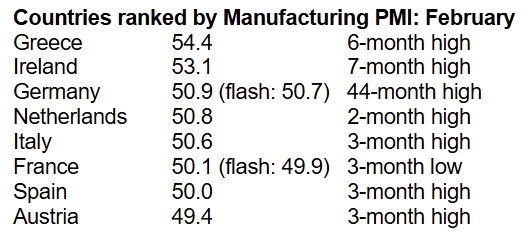
- Germany up 1.8 pts to 50.9, highest in 44 months.
- Eurozone up 1.3 pts to 50.8, highest in 44 months.
- Canada up 0.6 pts to 51.0, highest in 13 months.
- Romania down -2.8 pts to 45.3, lowest on record.
Japan
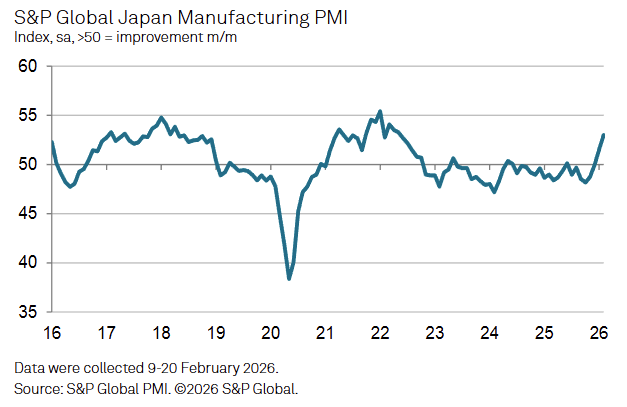
Japan’s Manufacturing PMI rose to 53.0 in February (Jan: 51.5), marking the strongest improvement in operating conditions since mid 2022.
-
Output expanded at the fastest rate in just over four years, with firms attributing the increase primarily to higher volumes of new business.
-
Total new orders grew at the quickest pace since January 2022, while export orders increased at the fastest rate since June 2021, reflecting stronger demand from Europe and other parts of Asia.
-
Employment increased for a 15th consecutive month and at the fastest pace in over four years as firms expanded headcounts to meet rising production needs.
-
Purchasing activity rose for a second straight month and at the quickest rate since May 2022, while inventories of inputs and finished goods declined slightly, indicating cautious stock management.
-
Backlogs of work continued to rise, though only marginally, signaling ongoing capacity pressure within the sector.
-
Input price inflation eased from January but remained historically elevated, and firms continued to raise selling prices despite a slower pace of charge inflation.
-
Business confidence improved to a 20 month high with expectations of stronger global demand and new product releases supporting output in the year ahead.
China
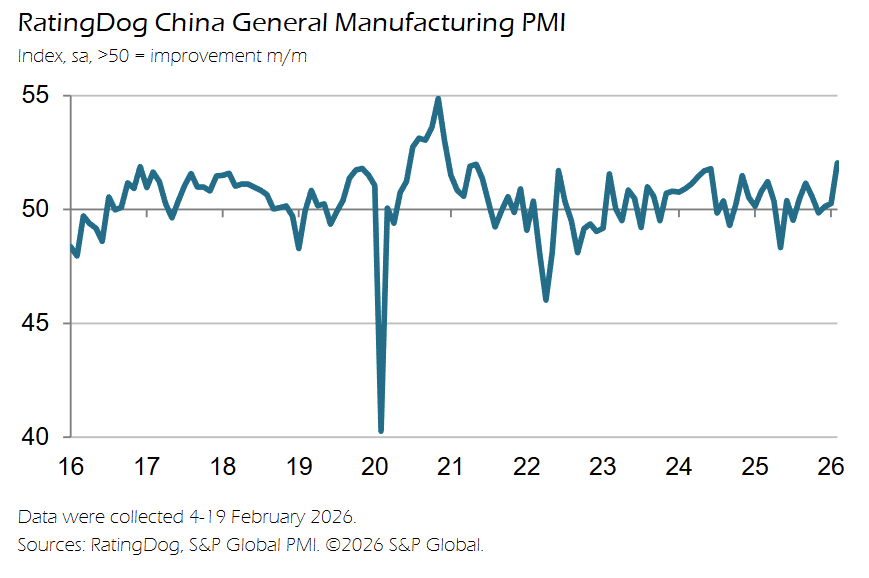
China’s S&P Global General Manufacturing PMI rose to 52.1 in February (Jan: 50.3), marking the strongest improvement in manufacturing operating conditions since December 2020 as demand, production, and purchasing activity accelerated.
-
Total new orders increased for the ninth consecutive month and expanded at the fastest pace since December 2020, with particularly strong growth in export demand as new export orders rose at the quickest rate since September 2020.
-
Manufacturing output growth accelerated alongside stronger demand, with production expanding at the fastest rate since June 2024, while firms stepped up purchasing activity to meet the higher inflow of new work.
-
The volume of inputs purchased increased for a second straight month and at the fastest rate since November 2024, with buying activity running comfortably above the survey’s long-run average and broad-based across sectors.
-
Despite faster production growth, backlogs of work rose in February after manufacturers had previously cleared outstanding business in January, indicating that demand growth outpaced current production capacity.
-
Employment rose only fractionally for the second consecutive month, marking the first back-to-back increases in staffing since mid 2021, but highlighting continued caution among firms when expanding headcounts.
-
Input cost inflation accelerated to the highest level since June 2022, driven in part by stronger demand for raw materials and rising metal prices, although the rate of inflation remained below the long-run survey trend.
-
Output prices increased for the second consecutive month and reached a 15-month high for charge inflation, suggesting that firms continued to pass some of the higher input costs through to customers.
-
Business confidence strengthened to an 11-month high, with firms citing stronger market demand, new production lines, and improvements in production capacity and efficiency as supporting expectations for higher future output.
Eurozone
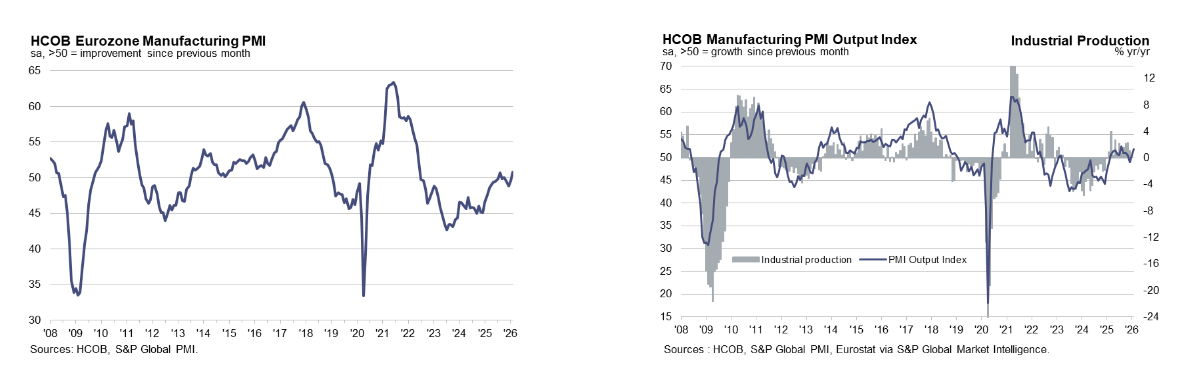
The HCOB Eurozone Manufacturing PMI rose to 50.8 in February (Jan: 49.5), moving back into expansion territory and reaching a 44-month high as improving demand supported broader operating conditions.
-
The Output Index increased to 51.9 (Jan: 50.5), a 6-month high, indicating production growth strengthened alongside improving order flows.
-
New orders expanded for only the second time in nearly four years and at the fastest pace since April 2022, showing a clear demand improvement after a prolonged weak period, while export declines moderated to the mildest contraction in three months.
-
Six of eight monitored countries recorded expansion, including Germany posting its strongest improvement in almost four years, whereas France stalled and Spain and Austria lagged, highlighting uneven regional performance.
-
Manufacturing employment continued to decline, consistent with the trend since June 2023, but backlog reductions slowed to the weakest pace in over three-and-a-half years as rising new work reduced the need to run down existing orders.
-
Purchasing activity nearly stabilised after a prolonged contraction and delivery times lengthened for a ninth straight month, while input inventories still fell but at the slowest rate since early-2023, suggesting supply and demand conditions were balancing.
-
Input cost inflation accelerated for a third consecutive month to a 38-month high, and output prices rose for a second straight month at the fastest rate since March 2023, indicating building inflation pressures within the sector.
-
Business confidence strengthened to a four-year high, the most optimistic outlook since early-2022, reflecting improved expectations for year-ahead production growth.
UK
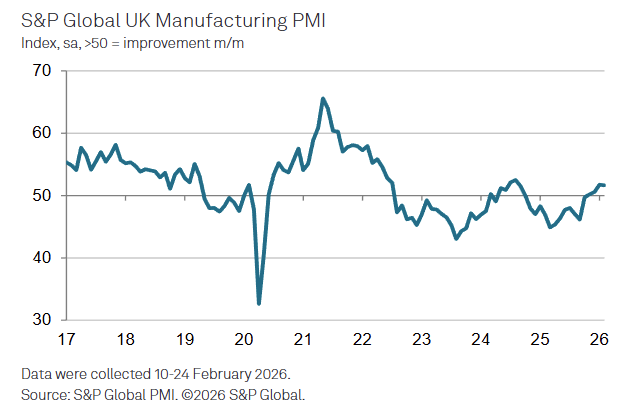
The S&P Global UK Manufacturing PMI registered 51.7 in February (Jan: 51.8), remaining in expansion for a fourth straight month as stronger domestic and overseas demand supported production momentum.
-
Manufacturing output rose for the fifth consecutive month and at a 17-month high, reflecting higher new business inflows and slightly improved client confidence.
-
New export orders increased at the fastest pace in four-and-a-half years, with demand strengthening across mainland China, the EU, the Middle East and North America, indicating broad-based external demand support.
-
Three of the five PMI components improved operating conditions, while employment and stocks of purchases declined, showing growth occurring alongside ongoing inventory and labour adjustments.
-
Business optimism stayed close to January’s recent high, with nearly three-fifths of firms expecting output growth over the next 12 months, supported by product launches, investment plans and improving client confidence.
-
Employment fell for a sixteenth consecutive month but only mildly, the slowest decline of the current downturn, suggesting labour market conditions were stabilising.
-
Input cost inflation accelerated for a third straight month to a six-month high, and selling prices rose for a third consecutive month, though at a slightly softer pace than January, indicating continued but moderated pass-through.
-
Supply chains remained stretched as vendor delivery times lengthened for a 26th consecutive month, while small firms saw contracting output and orders even as medium and large firms expanded.
US
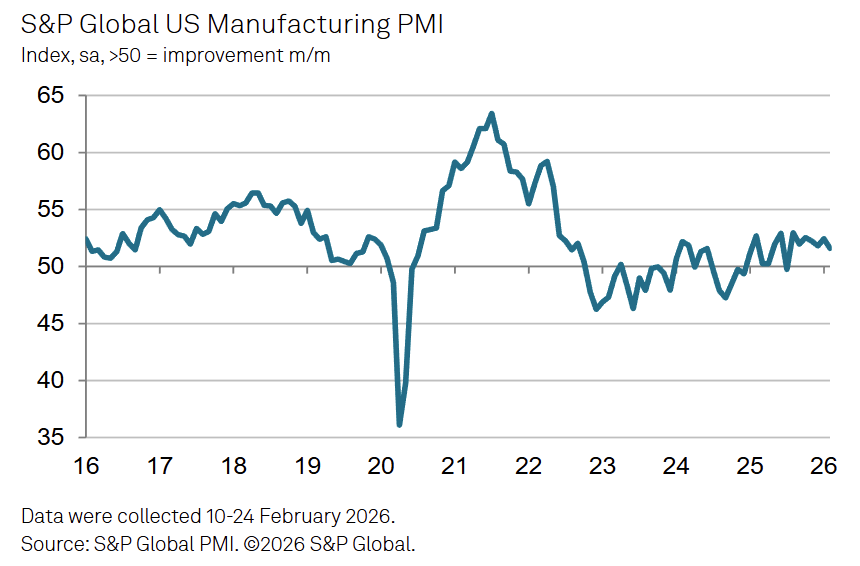
The S&P Global US Manufacturing PMI edged down to 51.6 in February (Jan: 52.4), marking the weakest expansion in seven months as slower orders and export declines moderated overall growth.
-
Output and new orders both increased but at softer rates, with production rising at the slowest pace since last September and new work only marginally higher as tariffs, high prices and extreme weather weighed on demand.
-
New export orders fell for an eighth consecutive month and at the sharpest rate since April 2025, particularly reflecting weaker sales to Canada, showing continued reliance on domestic demand.
-
Employment growth was minimal as firms showed restraint in hiring due to concerns about order book health and declining backlogs, indicating excess capacity limited workforce expansion.
-
Inventories of finished goods were unchanged, ending a six-month accumulation phase, while firms also reduced pre-production inventories for the first time in seven months as part of cost control efforts.
-
Supplier performance deteriorated with transportation delays and low stock availability, and purchasing activity rose more slowly than in January, indicating ongoing supply constraints.
-
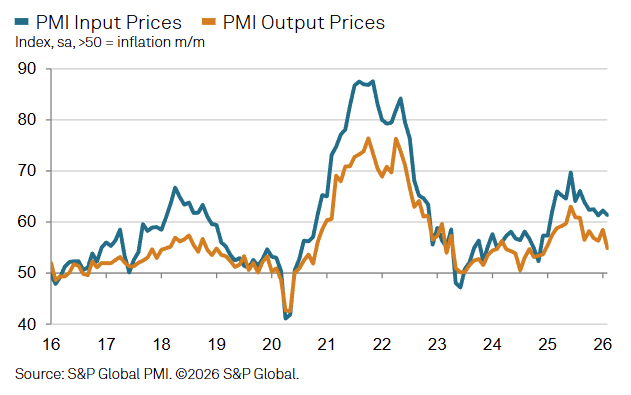
Input cost inflation remained elevated but below 2025 peaks due to tariffs and raw material prices, while selling price inflation slowed to a 14-month low as competitive pressures limited pass-through.
-
Business optimism strengthened to an eight-month high, supported by expectations for product launches and expansion plans despite uncertainty surrounding tariffs and the broader political environment.