


S&P Global Manufacturing PMIs: January 2026
Global - 2/2/2026
Asia Pacific
- Australia - 2/1/2026
- Malaysia - 2/2/2026
- ASEAN - 2/2/2026
- Myanmar - 2/2/2026
- Philippines - 2/2/2026
- Thailand - 2/2/2026
- Vietnam - 2/2/2026
- Indonesia - 2/2/2026
- Japan - 2/2/2026
- Taiwan - 2/2/2026
- China - 2/2/2025
- India - 2/2/2026
- Russia - 2/2/2025
- Kazakhstan - 2/2/2026
- South Korea - 2/2/2026
- Pakistan - 2/2/2026
Europe
- Austria - 1/28/2025
- Ireland - 2/2/2026
- Netherlands - 2/2/2026
- Romania - 2/2/2026
- Turkiye - 2/2/2026
- Poland - 2/2/2026
- Spain - 2/2/2026
- Czechia - 2/2/2026
- Italy - 2/2/2026
- France - 2/2/2026
- Germany - 2/2/2026
- Eurozone - 2/2/2026
- Greece - 2/2/2026
- UK - 2/2/2026
North & South America
Key Results
Japan
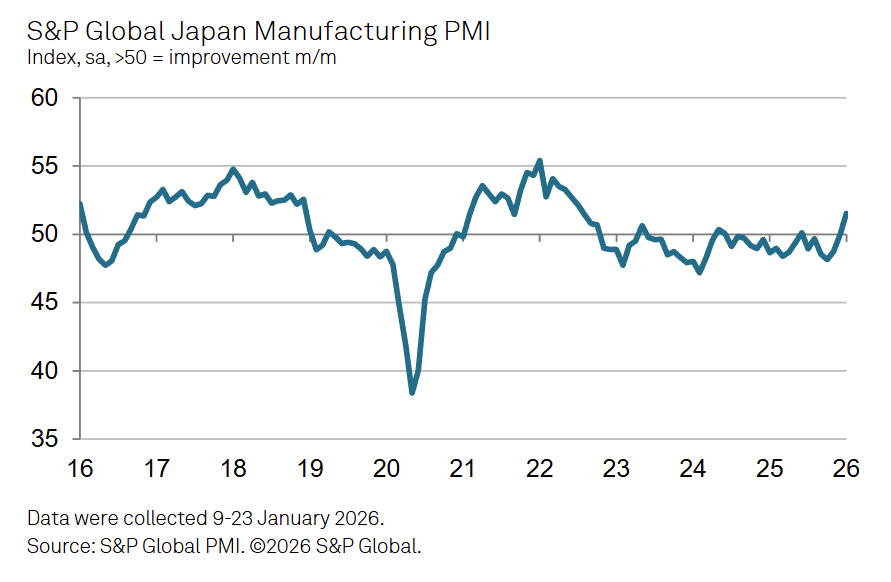
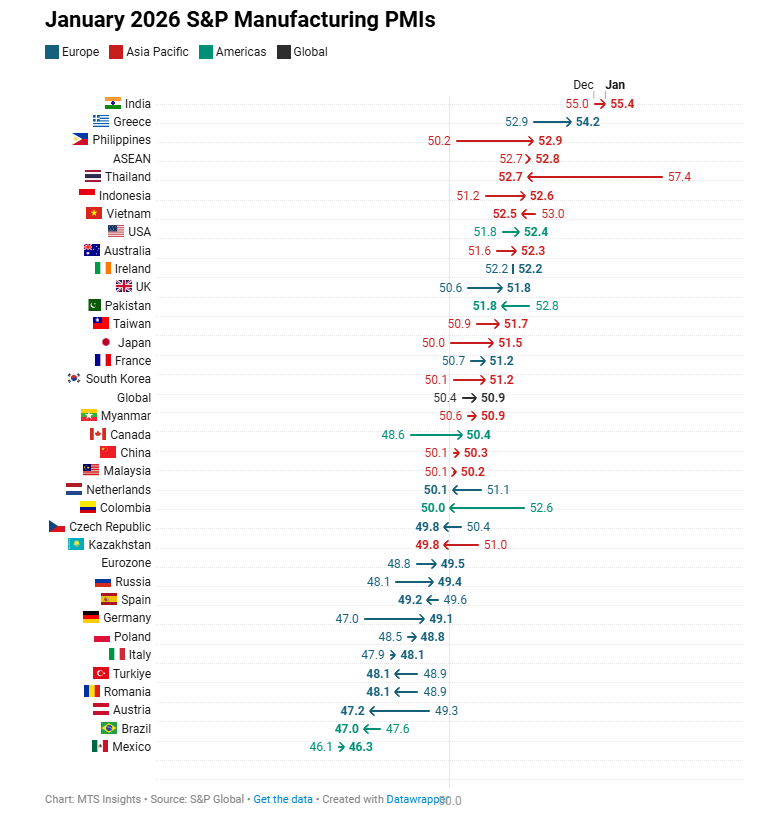
Japan’s Manufacturing PMI increased +1.5 pts MoM to 51.5 in January, returning manufacturing conditions to expansion for the first time since June and at the fastest pace since August 2022.
-
Total new orders rose for the first time since May 2023 and at the strongest rate in nearly four years, indicating a broad pickup in demand.
-
New export orders increased for the first time since February 2022, reflecting improved overseas demand, including from the U.S. and Taiwan.
-
Output expanded for the first time since June, with growth the fastest since April 2022 and above the long-run average.
-
Backlogs of work rose for the first time in three-and-a-half years, signaling increased pressure on manufacturing capacity.
-
Employment increased at the fastest pace in roughly 40 months, alongside the first rise in purchasing activity since September 2024.
-
Input costs accelerated at the sharpest rate in nearly a year, while selling price inflation reached a 19-month high as firms passed higher costs to customers.
China
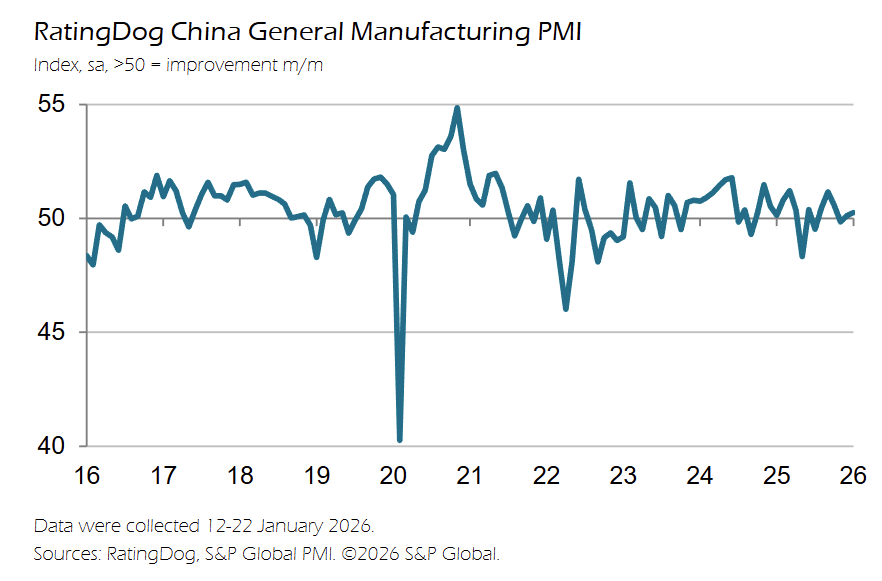
China’s Manufacturing PMI rose +0.2 pts MoM to 50.3 in January, marking a second consecutive month above 50 and the quickest growth rate in three months.
-
Manufacturing output expanded at a faster rate than in December, supported by higher inflows of new business.
-
Total new orders increased again, including a fresh rise in new export orders after December’s contraction, with demand notably strengthening from Southeast Asia.
-
Employment rose for the first time in three months as firms added staff to manage rising workloads and production needs.
-
Outstanding business declined for the first time in eight months, reflecting improved capacity alongside workforce expansion and efficiency gains.
-
Purchasing activity increased and stocks of purchases rose for a second straight month, while inventories of finished goods continued to fall as orders were fulfilled.
-
Input prices climbed for a seventh consecutive month and at the fastest pace since September 2025, contributing to the first rise in output charges since November 2024, with price increases among the strongest in roughly 18 months.
Eurozone
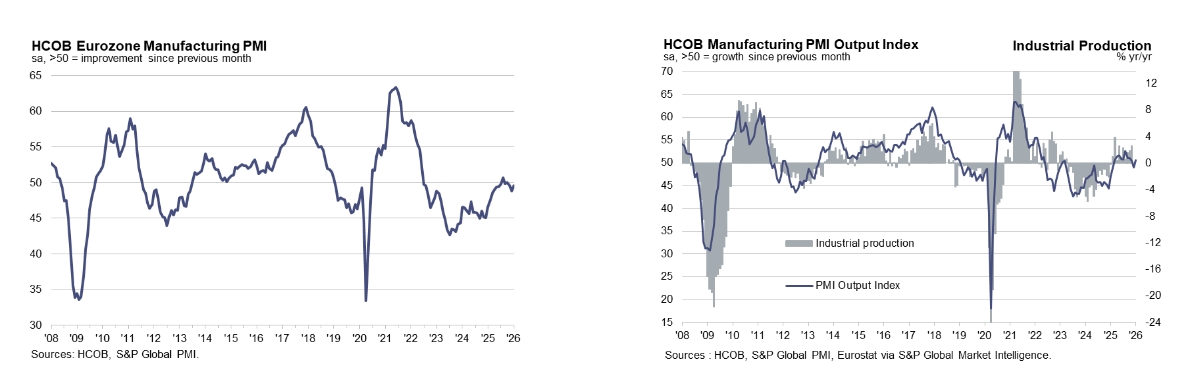
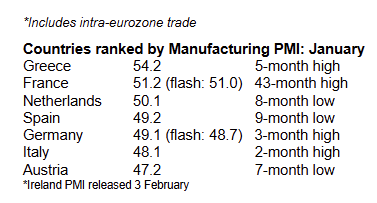
The Eurozone HCOB Manufacturing PMI increased +0.7 pts MoM to 49.5 in January, reaching a two-month high but remaining below the 50 expansion threshold for a third consecutive month.
-
The Output Index climbed to 50.5 (from 48.9), a three-month high, reinstating production growth after December’s first output decline in ten months.
-
New orders fell for a third straight month, though the contraction slowed and was described as marginal, while new export orders also continued to decline in line with the trend since last July.
-
Employment declined for a thirty-second consecutive month, but the pace of job losses eased to the softest since September 2025, indicating slower workforce reductions.
-
Purchasing activity and inventories both decreased again, with firms cutting buying volumes modestly and accelerating drawdowns in both pre- and post-production stocks.
-
Input price inflation accelerated to a three-year high, reflecting stronger cost pressures, while output charges were broadly unchanged MoM, signaling limited pricing power.
-
Business confidence improved to its highest level since February 2022, pointing to a more optimistic 12-month production outlook despite ongoing near-term weakness.
UK
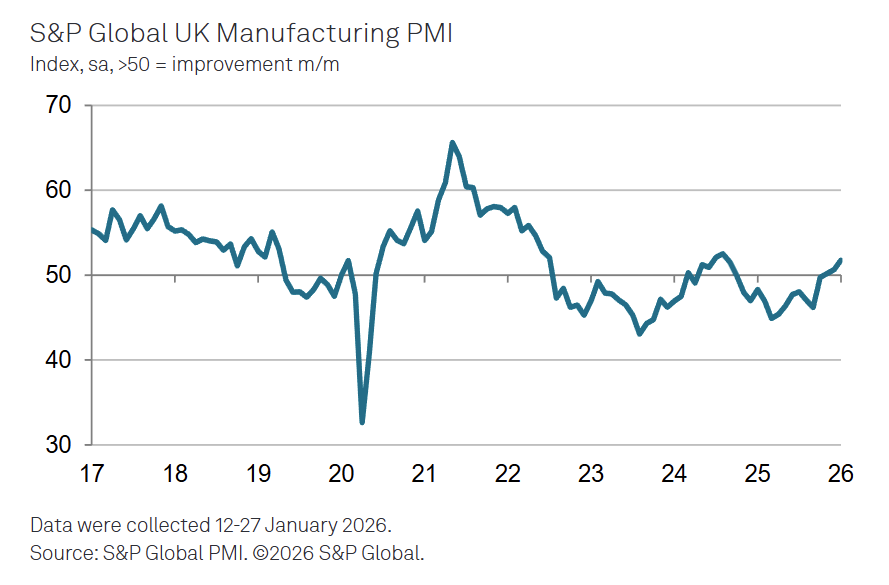
The UK S&P Global Manufacturing PMI rose +1.2 pts MoM to 51.8 in January, a 17-month high and the third consecutive month above the 50 expansion threshold.
-
Manufacturing production increased for a fourth straight month, reaching its joint-fastest pace since September 2024, supported by export demand, stable domestic conditions, and customer restocking.
-
New orders grew at the quickest pace in nearly four years, with gains across consumer, intermediate, and investment goods, signaling broad-based demand improvement.
-
New export orders rose for the first time in four years, with higher sales reported to Europe, the US, China, and several emerging markets.
-
Employment continued to decline for a fifteenth consecutive month, but the rate of job losses slowed to the weakest since cuts began, pointing to easing labor contraction.
-
Purchasing activity increased at the fastest pace in over three and a half years, while supplier delivery performance deteriorated further, indicating stretched supply chains.
-
Input costs and selling prices both accelerated mildly, with firms citing higher raw material and supplier-passed costs, alongside a second consecutive monthly rise in output charges.
US
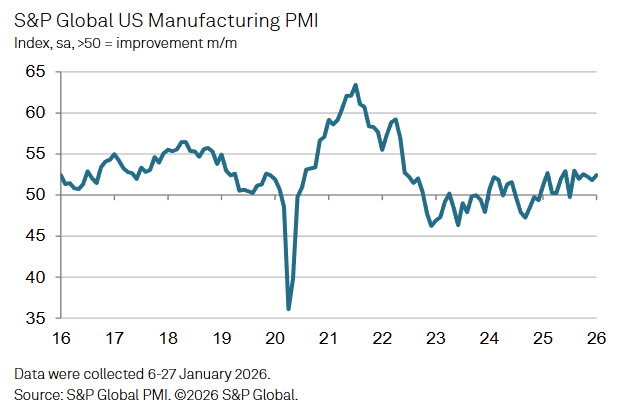
The US S&P Manufacturing PMI increased +0.6 pts MoM to 52.4 in January, marking a faster pace of manufacturing expansion broadly in line with the survey average.
-
Manufacturing output surged at the joint-sharpest rate since May 2022 and the strongest since August, pointing to a notable upturn in production momentum.
-
New orders returned to expansion but rose only modestly and remained below the survey average, indicating limited underlying demand growth.
-
New export orders fell for a seventh consecutive month, with tariffs and trade uncertainty cited as weighing on overseas demand, particularly from Europe and South America.
-
Finished goods inventories increased for a sixth straight month, though at the slowest pace of the sequence, reflecting production continuing to outpace sales.
-
Backlogs of work rose modestly after four months of decline, suggesting slightly higher workload pressures as order inflows improved.
-
Employment increased again, but only modestly and at the slowest pace in three months, showing cautious hiring despite stronger output.
-
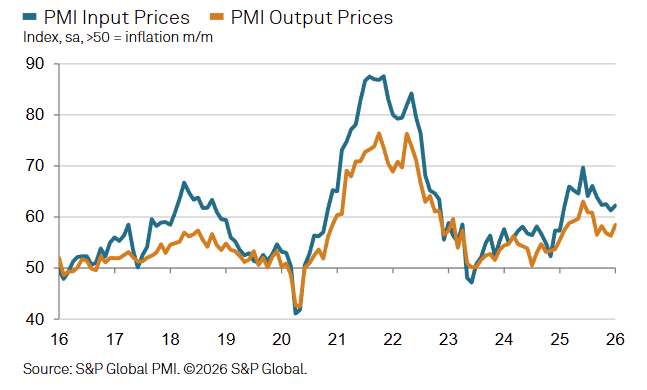
Input cost inflation accelerated due to tariff-related price increases from suppliers, while output charges rose at their fastest rate since August, signaling intensifying price pressures.