

AAR Rail Industry Overview: January 2026
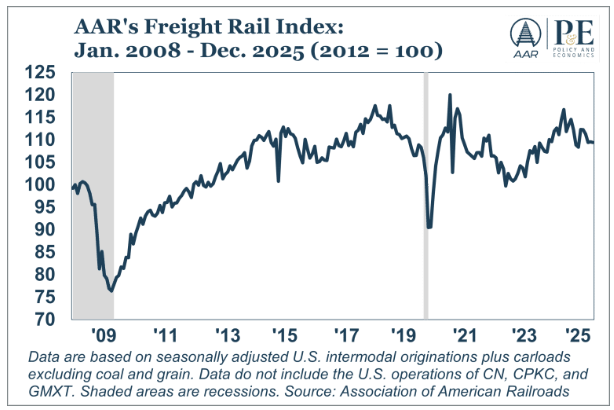
The AAR Freight Rail Index slipped in December and was down -6.3% YoY, marking its seventh decline in nine months and indicating weaker economy-sensitive rail volumes driven mainly by softer intermodal traffic.
-
The Freight Rail Index (FRI), which tracks seasonally adjusted intermodal shipments plus carloads excluding coal and grain, declined slightly in December, extending a downtrend that has produced 7 declines in the last 9 months.
-
U.S. carloads excluding coal fell -3.0% YoY in December, only the third YoY decline in 2025 and the fourth in the 24 months since January 2024, consistent with slow underlying industrial and manufacturing growth.
-
For full-year 2025, carloads excluding coal rose +1.0% YoY to 8.48M, the highest annual total since 2019, indicating modest growth in industrial-linked rail demand despite recent softness.
-
Grain carloads increased +2.9% YoY in December, representing the 10th YoY increase of 2025 and the 21st gain in the last 24 months; 2025 grain volumes rose +5.2% YoY to 1.12M, the most since 2021, reflecting stronger U.S. grain exports.
-
Coal volumes improved modestly in 2025, with rail coal carloads up +3.1% YoY (more than +92k carloads), alongside coal’s share of U.S. electricity generation rising to ~16.7% (from 15.2% in 2024) amid higher natural gas prices.
-
The EIA’s December 2025 outlook projected U.S. coal production down -2.2% in 2026 and coal consumption down -4.7%, with risks tied to fuel-price dynamics, regulatory interventions, and export-market conditions.
-
Chemical carloads fell -4.3% YoY in December and declined -1.3% in Q4 (their first quarterly drop since Q2 2023), though full-year chemical carloads still rose +0.8% YoY to 1.70M (a record), as earlier-year gains offset late-year weakness.
-
Steel-related volumes remained firm: primary metal products carloads rose +2.0% YoY in December (9th increase in the last 10 months) and were up +3.2% YoY in 2025, while iron and steel scrap carloads rose +9.2% YoY in December and +9.9% YoY in 2025 to 232,368 (the most since 2008).