


US Employment Situation: December 2025
Establishment Data
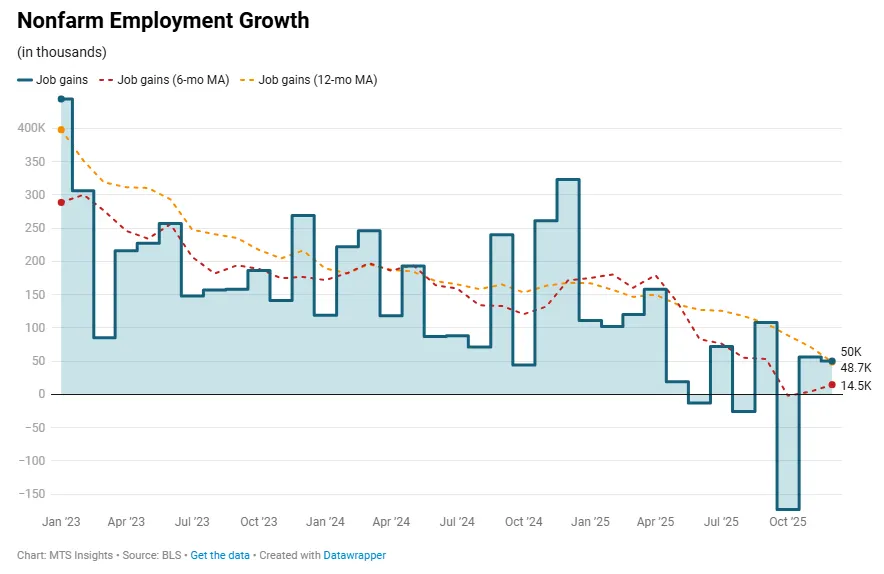
US nonfarm payroll employment increased by 50,000 in December, meaning that the year ended with low job growth. The gain was below the estimate of an increase of 60,000 and slightly below the 56,000 increase in November. Revisions of October and November data were less flattering. The October nonfarm employment decline was revised down to -173,000 (from -105,000 in the 1st estimate), and the November gain was revised down to +56,000 (from +64,000 in the 1st estimate). In total, there were -76,000 jobs lost to revisions. Indeed, the negative bias to revisions reversed the trend of a slight recovery in the 3-month average in November to job losses all throughout Q4 2025.
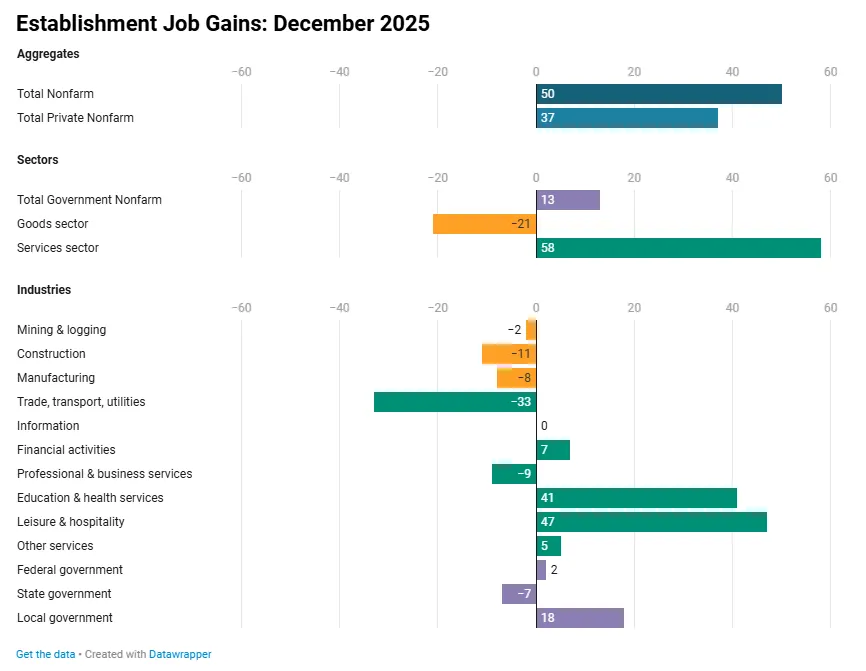
The pace of private sector hiring weakened in December, dropping to 37,000 in December after a 50,000 rise in November. This was below expectations of a 64,000 increase and slightly weaker than the ADP private employment gain of 41,000. Like the headline job growth number, private sector job gains were very affected by revisions. The October increase of 52,000 was revised down to 1,000, and the November increase of 69,000 was revised down to 50,000. This trend reduced the momentum in private hiring (measured by the 3-month average) to 29,000. well below the November print in last month’s report of 75,000. Here are some details in the industry breakdown:
- The goods sector lost -21,000 jobs in December, led by a decline of -11,000 in the construction industry. Every industry within the goods sector saw employment fall. Manufacturing employment dropped by -8,000, the eighth straight monthly decline.
- The service sector added 58,000 jobs in December, continuing to be the main source of job gains in the private sector. There was more variability in the industries, with about half losing jobs (retail trade down the most at -25,000) and about half adding jobs (leisure & hospitality added the most at +47,000). Education & health services maintained its streak of consistent solid gain, adding 41,000 in December.
- The diffusion index, measuring the balance between gaining and losing industries, was weak in December. The index for all private industries was down to 50.8, indicating that the gaining industries barely had an edge. The index for all manufacturing industries was an exceptionally weak 38.2, the lowest since May and the 3rd lowest in over five years.
Public sector employment was back to increasing in December, but not nearly enough to offset the massive October decline. The final month of the year saw government jobs up 13,000, leaving total public sector employment down -155,000 in Q4 2025 alone. This large drop can be attributed to several factors impacting federal government employment, including the government shutdown and the DOGE early retirement program. The October drop of -173,000 is only a one-time shift in government employment, and I expect it to return to increasing in 2026, albeit slowly increasing.
Overall, the Establishment data tells the story of a weak labor market in Q4 2025, but the large decline in government employment in October does obfuscate the trend a bit. Private sector employment reflects a more true picture of where the labor market is going into the new year, a slow deterioration in hiring, but no real capitulation to layoffs. This reflects the descriptions of a “no hire, no fire” employment situation in the US, described by Fed officials, including Chair Powell.
Household Data
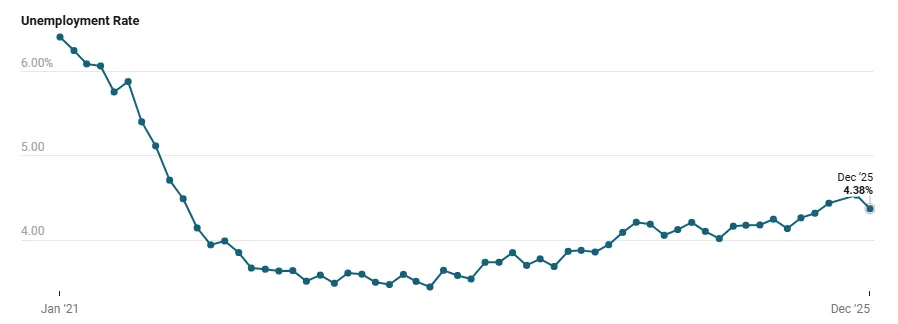
The Household data has been the more volatile, uncertain section of the jobs report due to the disruptions from the government shutdown, and now because of the seasonal adjustment refactoring in the December report. The latest data point for the unemployment rate is back below 4.40% with a December reading of 4.38%, the lowest since August 2025. This was down -16 bps from the 4.54% reading in November and below expectations of analysts’ forecast of 4.50%. It is really important to look at these numbers with 2 decimals of precision, because rounding makes the swings look more significant than they are. At that precision, the 1st estimate of the November unemployment rate of 4.6% was revised down to 4.5% due to new seasonal adjustment (when more precisely, the revision was -2 bps), and the December rate fell to 4.4% (when more precisely, the decline was -14 bps).
The takeaway from all this is that the labor market does not look as loose as it was after last month’s report. Indeed, the other segments oft he labor force flows in December all point to this. The total number of unemployed fell by -278,000, and the total number of employed increased by 232,000 (pushing the employment-population ratio up 0.1 ppts to 59.7%). The labor force shrank by -46,000, and the participation rate dropped -0.1 ppts to 62.5%. Additionally, the short-term unemployment population dropped significantly: less than 5 weeks down -251,000 and 5 to 14 weeks down -121,000. Most month-to-month statistics in this report run against the November narrative that labor market slack had increased significantly in November; however, they push back against the magnitude and not necessarily the direction.
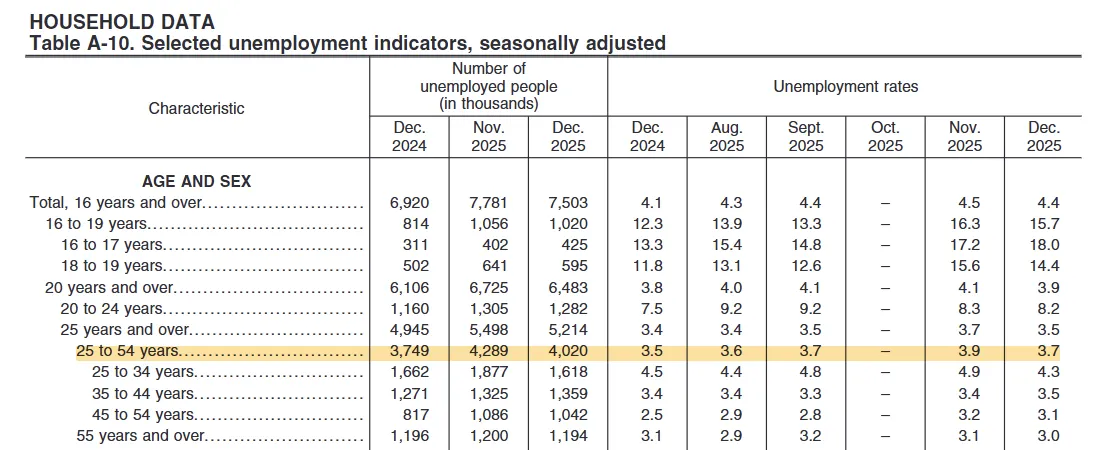
Another good example of the reversal in the narrative is the snap back in the prime age unemployment rate in December. After rising to 3.9% from September to November (the second highest in four years), the BLS reported a -0.2 ppts drop back to 3.7% in December. It’s unclear if this reflects some sort of reality in the US labor market or if the volatility is due to disruptions to data collection and statistical quirks. Regardless, it alters the narrative of accelerated labor market loosening that was developed from the November report.
Wage Growth
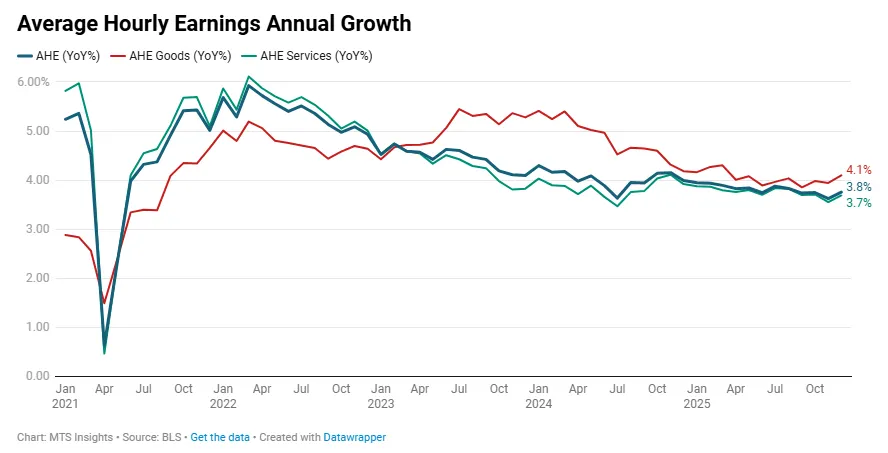
Despite signs of weakness in the hiring data from the Establishment survey, wage growth surprised to the upside. Average hourly earnings increased 0.3% MoM and 3.8% YoY in December, above the 3.6% YoY increase that was expected. This was partly due to revisions, however, as the November YoY wage growth was revised up from 3.5% YoY in the 1st estimate to 3.6% YoY in the 2nd estimate. Both the goods and services sectors saw wage growth accelerate in December, and YoY growth in average hourly earnings in the goods sector specifically accelerated to a nine-month high of 4.1%.