


US Employment Situation: November 2025 (DELAYED)
Establishment Data
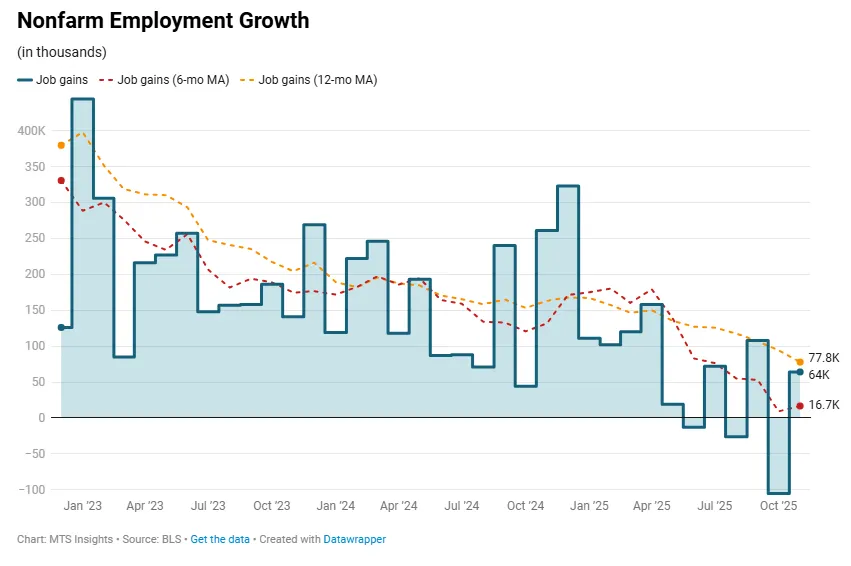
The report does provide an update on the Establishment dataset for both October and November, as the data was still able to be collected despite the government shutdown. Total nonfarm payroll employment was shown to have increased by 64,000 in November, after a -105,000 drop in October. On balance, this suggests that -41,000 jobs were lost in the two-month period since September. However, the government shutdown heavily affected government payrolls. While furloughed workers were not counted as unemployed, the BLS counted any contractors or government employees who did not work/receive pay in October as unemployed. This resulted in a -157,000 decline in government payrolls.
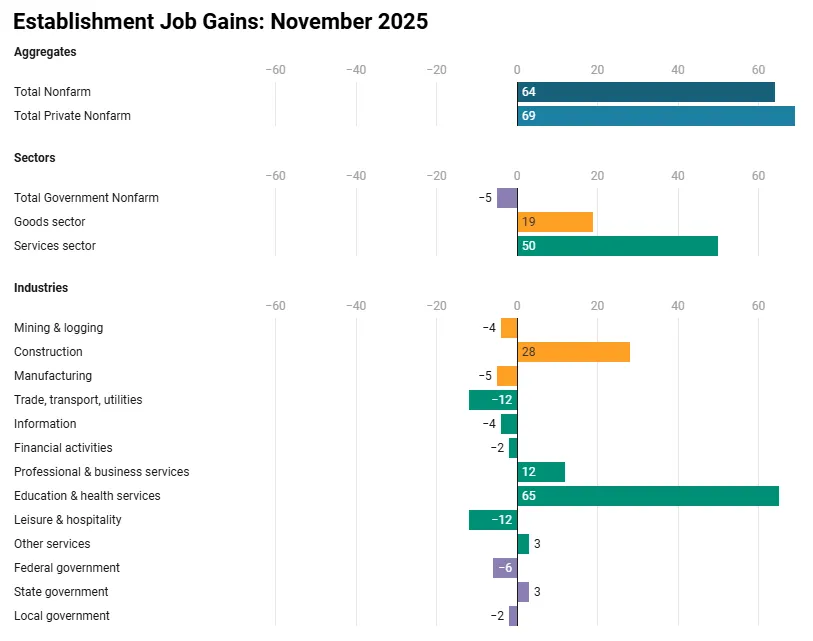
Private payroll growth tells a less volatile story. Private payrolls increased in both of the reported months, by 52,000 in October and by 69,000 in November. Notably, the November increase is above the 45,000 that was forecasted by analysts and completely different than the -32,000 reported in ADP’s National Employment Report. The stronger data point means that there was an increase in hiring momentum as the 3-month moving average of private payroll growth increased from 57,000 in September to 75,000 in November. Some notes on the industry breakdown:
- The goods sector added 19,000 jobs in November after losing -9,000 in October. Basically, all of the growth came from an increase of 28,000 in the construction industry in November. The manufacturing sector continues to see employment decline: down by -9,000 in October and by -5,000 in November.
- The services sector added 50,000 jobs in November and 61,000 jobs in October. Like in the goods sector, most of the growth across both months came from one segment, education and health services, which added 65,000 in November and 59,000 in October. That means that without this segment, service sector employment would’ve contracted in the last 2 months.
- Industries that might be positively impacted by the holiday period appeared to be in a slump. The wholesale and retail trade together only added 3,900 jobs in October and November, and the transportation & warehousing industry reported payrolls down by -18,200 in that period.
As mentioned before, government payrolls have become a bit of a confounding variable in this jobs report due to the volatility caused by the government shutdown. Government payrolls dropped -162,000 across both months, a very unusual result, but the BLS does explain some of it. Not only was the decline affected by the government shutdown, but there was also a decline in employment as a result of the DOGE deferred resignation offer for federal employees. In summary, the DOGE early retirements, disengagement of federal contractors, and temporary layoff of some government workers explain the large October drop. However, the BLS is not able to “precisely quantify” how these factors affected the data. Thus, the only real value in the Establishment data in the November report is in the private payrolls.
Household Data
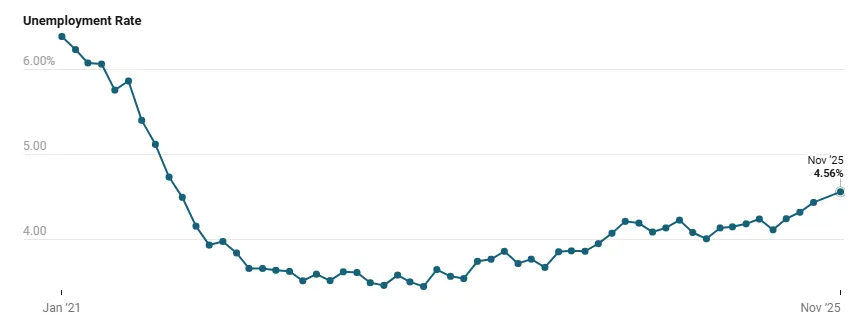
The November report does not include October data for the Household survey since it was not collected. Thus, we only have November data points to look at and 2-month deltas. The headline unemployment rate ticked up 12 bps to 4.56% from September to November, resulting in a rounded print of 4.6% (up from a rounded 4.4%). The rounded change of 0.2 ppts slightly overstates the increase in the unemployment rate, which is actually just over half that. Nevertheless, there was a material increase in joblessness after September, such that the unemployment rate is now at the highest point since September 2021.
The increase in the unemployment rate came from an increase in participation that led to a larger portion of that increase in the labor force becoming unemployed versus employed. Specifically, the labor force increased by 323,000 from September to November (participation rate up 0.1 ppts to 62.5%). The employed population increased by just 96,000 in that period (employment-population ratio down -0.1 ppt to 59.6%) while the unemployed population increased by 228,000 in the same period.
The BLS does note that the November Household survey should be interpreted with added caution, given several shutdown-related disruptions.
- October data were not collected and were not backfilled, meaning November estimates rely on a modified weighting process that shifts previously collected data forward and effectively forces analysis into two-month changes rather than standard month-to-month comparisons.
- Data collection for November began late and was extended around the Thanksgiving holiday, resulting in a lower-than-usual response rate of 64 percent and slightly higher standard errors across key series. While seasonal adjustment methods were unchanged and the reference week was otherwise typical, these factors increase statistical noise and reduce precision.
- Federal government workers were counted as employed because the government reopened before the end of the reference week, and the BLS noted that the overall impact of the shutdown on Household survey estimates cannot be precisely quantified.
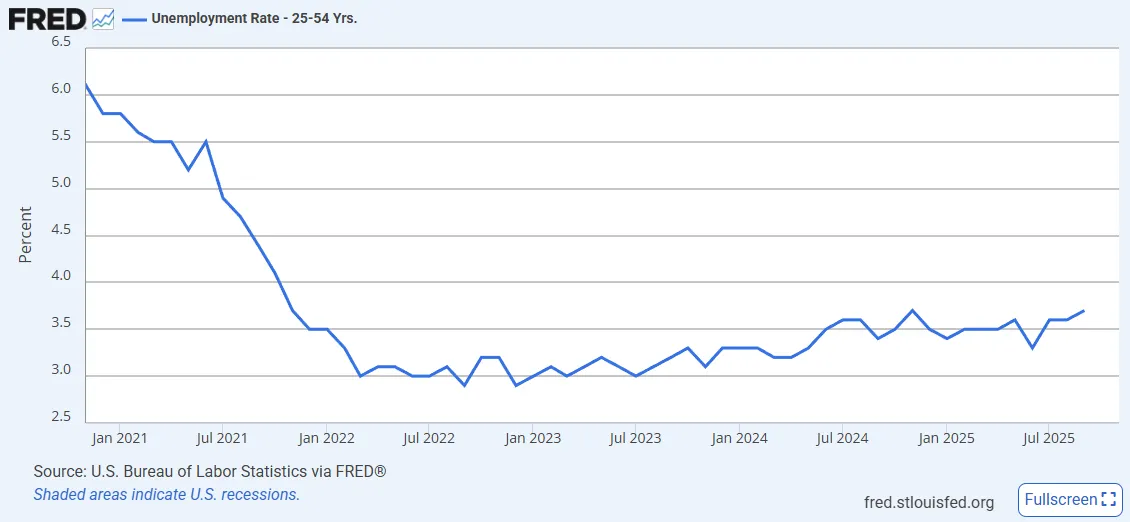
Despite these caveats, the Household data are a clear indicator of weakening in the labor market, and much more convincing than the Establishment data. The increase in joblessness was seen across several age groups, including the key prime working age cohort (25 to 54 years), where the unemployment rate increased 0.2 ppts to 3.9% over the two-month period, the highest it has been since November 2024 and, before that, since November 2021. Additionally, the part-time work for economic reasons due to slack work/business conditions jumped 321,000 in the two-month period, or an average of 160,500 in each month, which would be the highest monthly increases since February. It’s unlikely this part-time series was impacted by the government shutdown since the “only could find part-time work” indicator captured a roughly 600,000 increase that was likely caused by the federal work disruption.