

NY Fed Survey of Consumer Expectations: December 2025
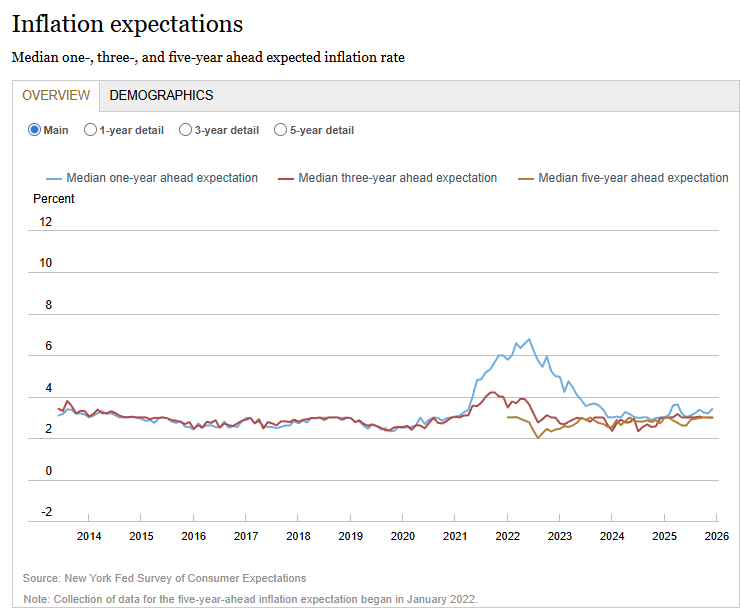
U.S. consumers’ one-year-ahead inflation expectations rose +0.2 ppt to 3.4% in December, while medium- and long-term expectations held at 3.0%, signaling firmer short-term inflation views amid weakening labor sentiment.
-
One-year-ahead inflation expectations increased to 3.4% (+0.2 ppt MoM), while three-year and five-year expectations were unchanged at 3.0%; disagreement across respondents widened at the one-year and three-year horizons.
-
Inflation uncertainty increased at all horizons, indicating greater dispersion around future price outcomes despite stable medium- and long-term medians.
-
Home price growth expectations held at 3.0% for a seventh consecutive month, remaining within a narrow 3.0%–3.3% range since August 2023.
-
Year-ahead commodity price expectations declined modestly: gas to 4.0% (-0.1 ppt), food to 5.7% (-0.2 ppt), medical care to 9.9% (-0.2 ppt), college costs to 8.3% (-0.1 ppt), and rent to 7.7% (-0.6 ppt).
-
Earnings growth expectations edged down to 2.5% (-0.1 ppt MoM), remaining below the 12-month average of 2.7%, while expected household income growth ticked up to 3.0% (+0.1 ppt).
-
Labor market expectations weakened: the mean probability of unemployment being higher in one year fell slightly to 41.8% (-0.3 ppt), but the perceived probability of job loss rose to 15.2% (+1.4 ppts), above its 12-month average.
-
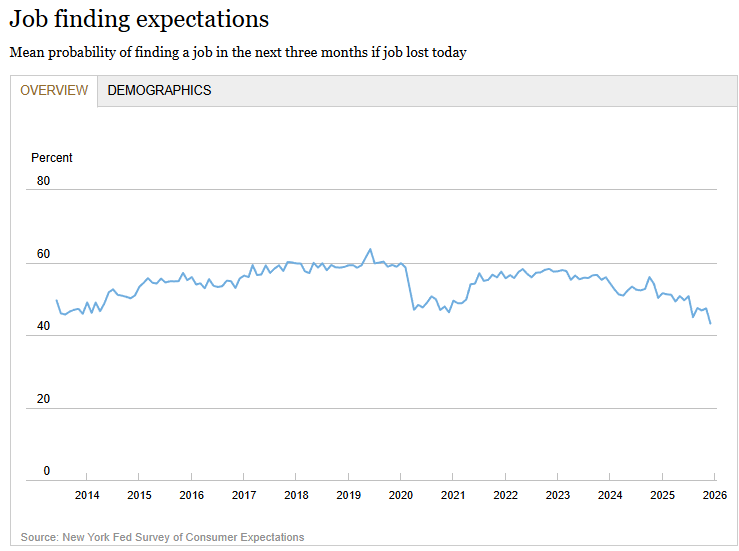
Job-finding expectations declined sharply to 43.1% (-4.2 ppts), reaching a new series low and driven primarily by lower-income respondents, older workers, and those with less education.
-
Household financial stress indicators worsened, with the probability of missing a minimum debt payment rising to 15.3% (+1.6 ppts), the highest since April 2020, even as perceptions of current and future household financial situations improved.