


NFIB Small Business Optimism: October 2025
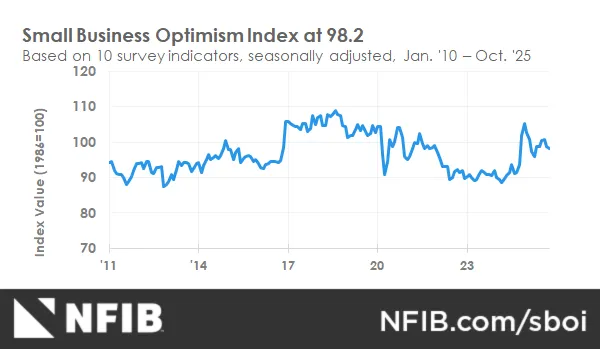
The NFIB Small Business Optimism Index dropped -0.6 pts to 98.2 in October, reaching its lowest level since April (when the “Liberation Day” tariffs were announced). Small business saw a bounce in the months that followed the introduction of broad tariffs, but since then, increases in optimism have been dampened. In the long-term, however, October 2025’s reading is the best for an October since October 2021 when the index was also at 98.2.
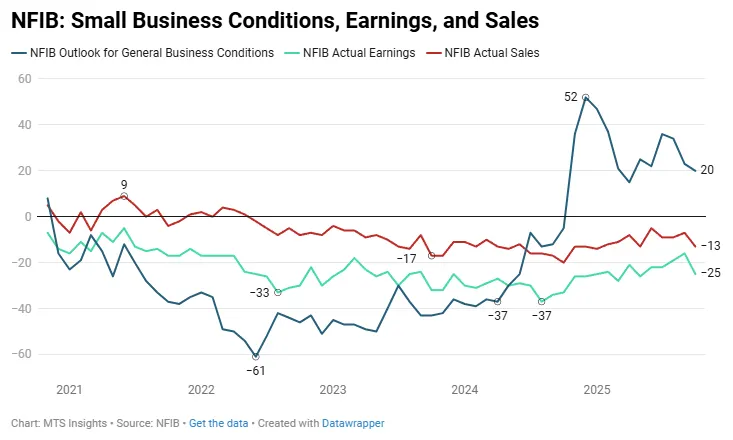
One component stuck out as the main reason for the weaker sentiment in October, the subindex tracking trends in earnings. NFIB noted that the Actual Earnings Changes index dropped -9 pts to -25, the lowest since May of this year, but still above the 2023-2024 averages. The decline in profitability also coincided with a drop in observed sales, down -6 pts to -13 (also the lowest since May), and an easing in the outlook for business conditions, down -3 pts to 20 (lowest since April). Overall, we are seeing a deterioration in both the soft. sentiment and hard, operating data points to a pretty significant degree. A plurality of the businesses that were more negative or uncertain pointed to “economic conditions” as the reason for the expansion outlook.
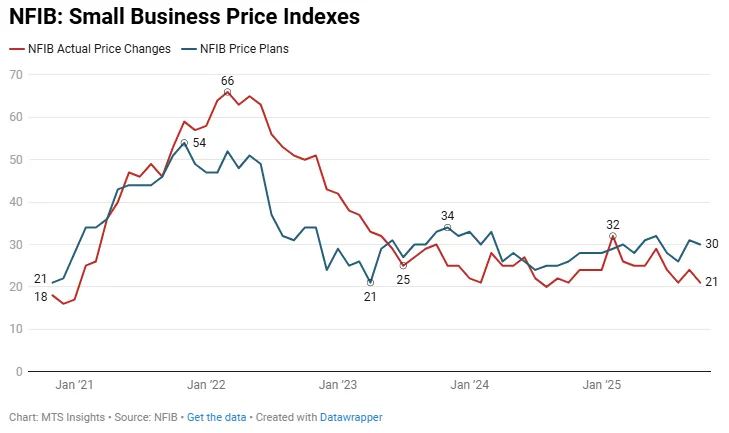
The price indexes moved a bit more favorably in October as both the current and future readings on price changes dropped. The Actual Price Changes index saw the larger decline, dropping -3 pts to 21 which is the joint lowest since August 2024 (tied with August 2025 and October 2024). The Price Plans index was a bit stickier, only dropping -1 pt to 30, as it stayed towards the higher end of the readings of the last three years (2023-2025 average is 28.6). These readings suggest there is still some moderate inflationary pressure on small businesses, but there was a slight decline in the share of respondents pointing to it as the “single most important problem,” from 14% in September to 12% in October.
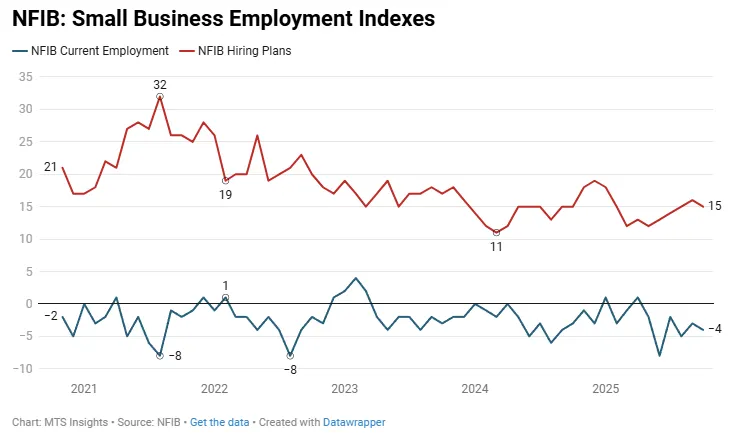
The NFIB’s employment indexes broadly point to a gradual slowdown in hiring by small businesses, but lower supply continues to keep the labor market tighter than it would be otherwise:
- On the demand side, we see that the Actual Employment and Hiring Plans both dropped -1 pt to 15 and -4, respectively. The trend in current employment has been mostly stable this year, while hiring plans have trended down when general optimism declined. The positive gap between actual and expected hiring is likely linked to the supply issue.
- On the supply side, the Job Openings index was unchanged at 32, and the Qualified Applicants index edged down to 49. In fact, 27% of small business owners cited labor quality as their single most important problem, up 9 ppts from September and the highest level since the record high of 29% in November 2021. Construction firms were especially concerned about the labor quality as 49% reported it as the “single most important problem,” 22 ppts higher than for all firms.
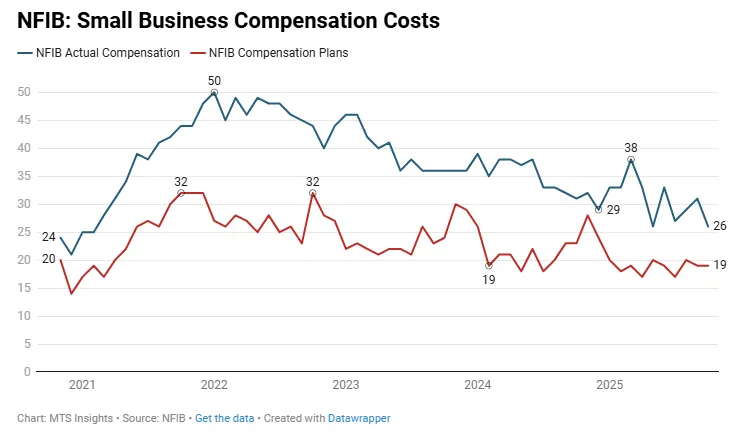
The interplay between weaker labor demand and continued supply constraints has kept compensation growth steady. While the overall trend has been one of moderation since the 2022 peak, the deceleration has occurred only gradually. In October 2025, the Actual Compensation index slipped -5 pts to 26, matching its lowest level since February 2021 but still hovering near its 2018–2019 average. Meanwhile, the Compensation Plans index has shown little change this year, remaining in a relatively narrow 17–20% range, suggesting that small businesses continue to face enough hiring challenges to maintain upward pressure on wages.
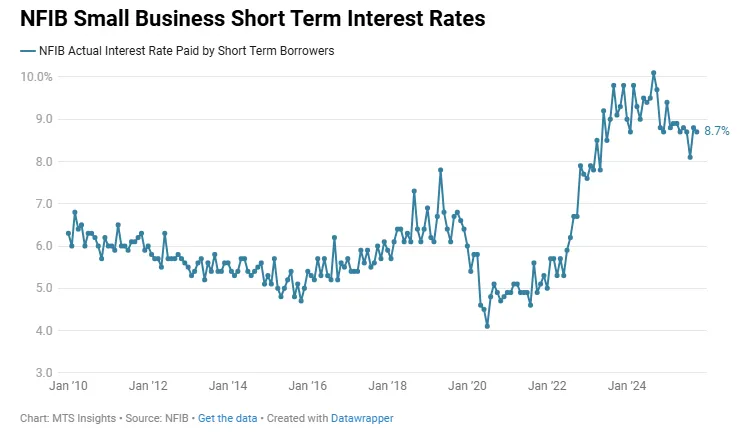
In terms of financial conditions, small businesses are not finding things too much easier after the September rate cut. The reported interest rate on short-term loans only fell slightly in October, down -0.1 ppts to 8.7%, but on a slightly more positive note, the index tracking rates paid by regular borrowers dropped to the lowest so far this year, indicating that only a net 1% of firms saw increases in rates vs 3 months ago. In general, small businesses haven’t seen a significant improvement due to the September rate cut, but we might see more of a response in the data to the second rate cut in late October.