


Texas Service Sector Outlook Survey: October 2025
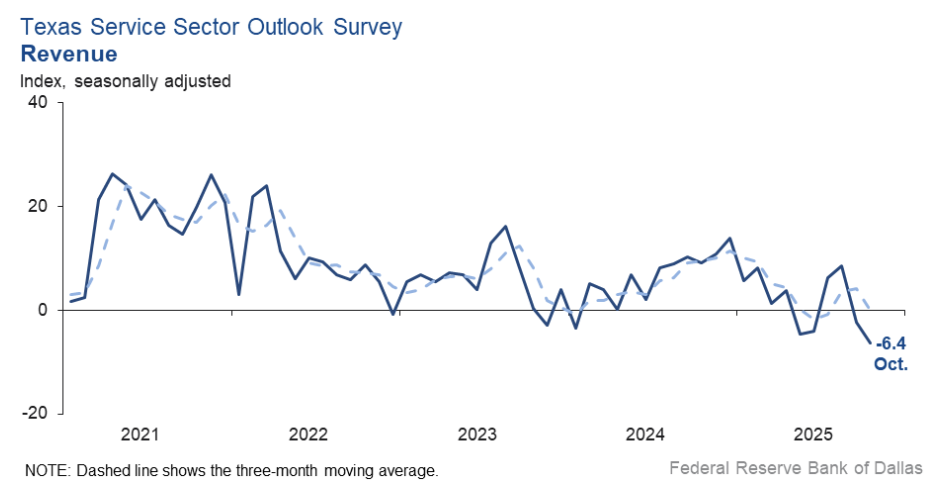
Texas service sector activity weakened further in October 2025, with the Revenue Index falling -4.0 pts to -6.4, marking the lowest reading since July 2020 and signaling continued contraction in business conditions.
-
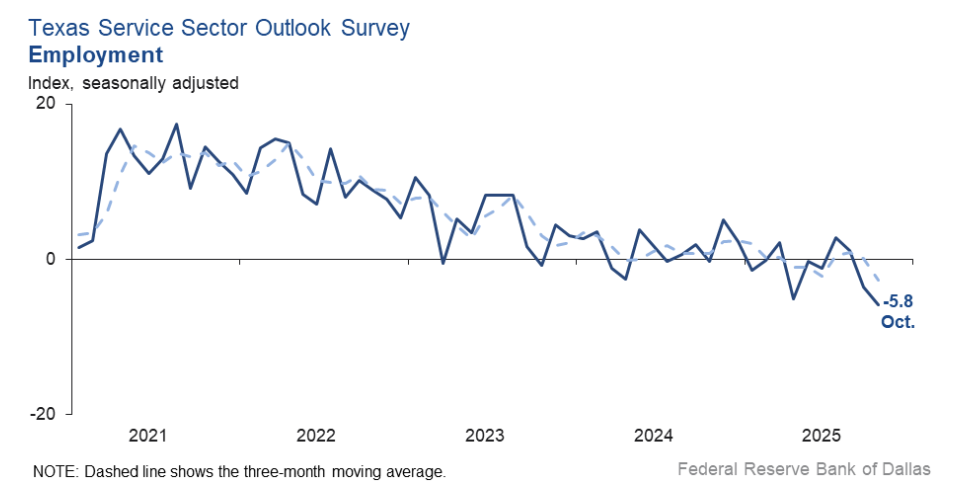
Employment declined to -5.8 (Sep: -3.6), reflecting further job losses, while part-time employment (-0.1) and hours worked (-1.4) showed little change.
-
Wages and benefits were steady at 10.7 (Sep: 11.9), indicating continued but moderate upward pressure on labor costs.
-
Input prices eased slightly to 23.0 (Sep: 24.4), while selling prices increased to 4.6 (Sep: 1.6), suggesting some improvement in firms’ pricing power.
-
Capital expenditures edged lower to 5.8 (Sep: 7.3), remaining positive but below average levels.
-
General business activity dropped to -9.4 (Sep: -5.6) and company outlook fell sharply to -10.0 (Sep: -2.6), highlighting worsening sentiment.
-
Outlook uncertainty held steady at 22.2, well above the long-term average of 13.8.
-
Despite current weakness, future expectations stayed positive, with the future revenue index at 33.7 and future general business activity at 5.7, though both were below their long-run averages.
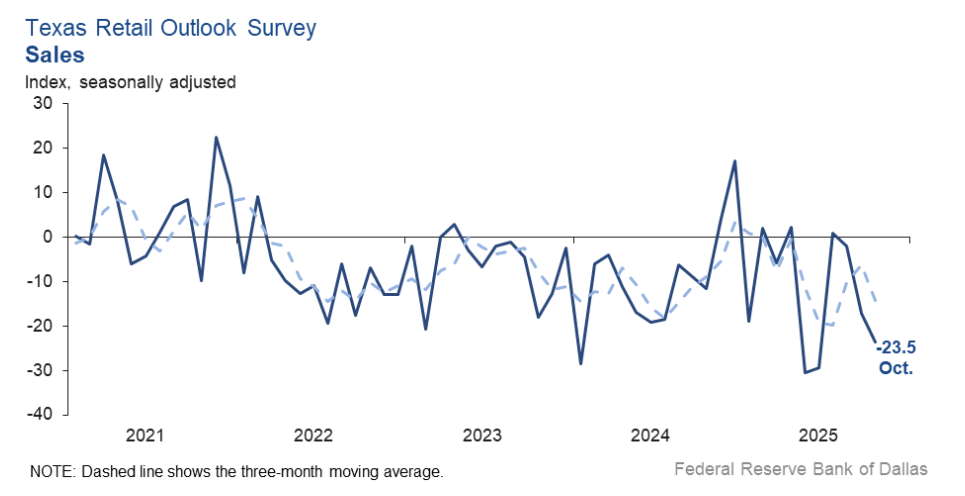
Texas retail activity contracted sharply in October 2025, with the Sales Index falling -6.3 pts to -23.5, marking the weakest reading since mid-2020 and indicating widespread declines in retail demand.
-
Employment fell steeply to -15.3 (from -3.0), while part-time employment was little changed at -3.2, reflecting further deterioration in retail labor conditions.
-
Hours worked remained subdued at -6.8 (from -8.2), indicating continued reductions in workweeks.
-
Wages and benefits edged up slightly to 13.3 (from 12.6), suggesting ongoing cost pressures despite weaker activity.
-
Input prices surged to 30.6 (from 22.0), and selling prices rose to 15.4 (from 9.2), signaling a pickup in inflationary pressures for retailers.
-
Capital expenditures increased to 15.7 (from 13.7), pointing to modest investment momentum despite weak sales.
-
General business activity deteriorated to -23.7 (from -14.7), and company outlook fell sharply to -22.3 (from -5.4), underscoring heightened pessimism across the sector.
-
Outlook uncertainty eased to 17.3 (from 26.3) but remained above the series average, indicating persistent caution among retailers.