


S&P Global Manufacturing PMIs: July 2025
Global - 8/1/2025
Asia Pacific
- Australia - 7/31/2025
- Malaysia - 8/1/2025
- ASEAN - 8/1/2025
- Myanmar - 8/1/2025
- Philippines - 8/1/2025
- Thailand - 8/1/2025
- Vietnam - 8/1/2025
- Indonesia - 8/1/2025
- Japan - 8/1/2025
- Taiwan - 8/1/2025
- China - 8/1/2025
- India - 8/1/2025
- Russia - 8/1/2025
- Kazakhstan - 8/1/2025
- South Korea - 8/1/2025
- Pakistan - 8/1/2025
Europe
- Austria - 7/29/2025
- Ireland - 8/1/2025
- Netherlands - 8/1/2025
- Romania - 8/1/2025
- Turkiye - 8/1/2025
- Poland - 8/1/2025
- Spain - 8/1/2025
- Czechia - 8/1/2025
- Italy - 8/1/2025
- France - 8/1/2025
- Germany - 8/1/2025
- Eurozone - 8/1/2025
- Greece - 8/1/2025
- UK - 8/1/2025
North & South America
Key Results
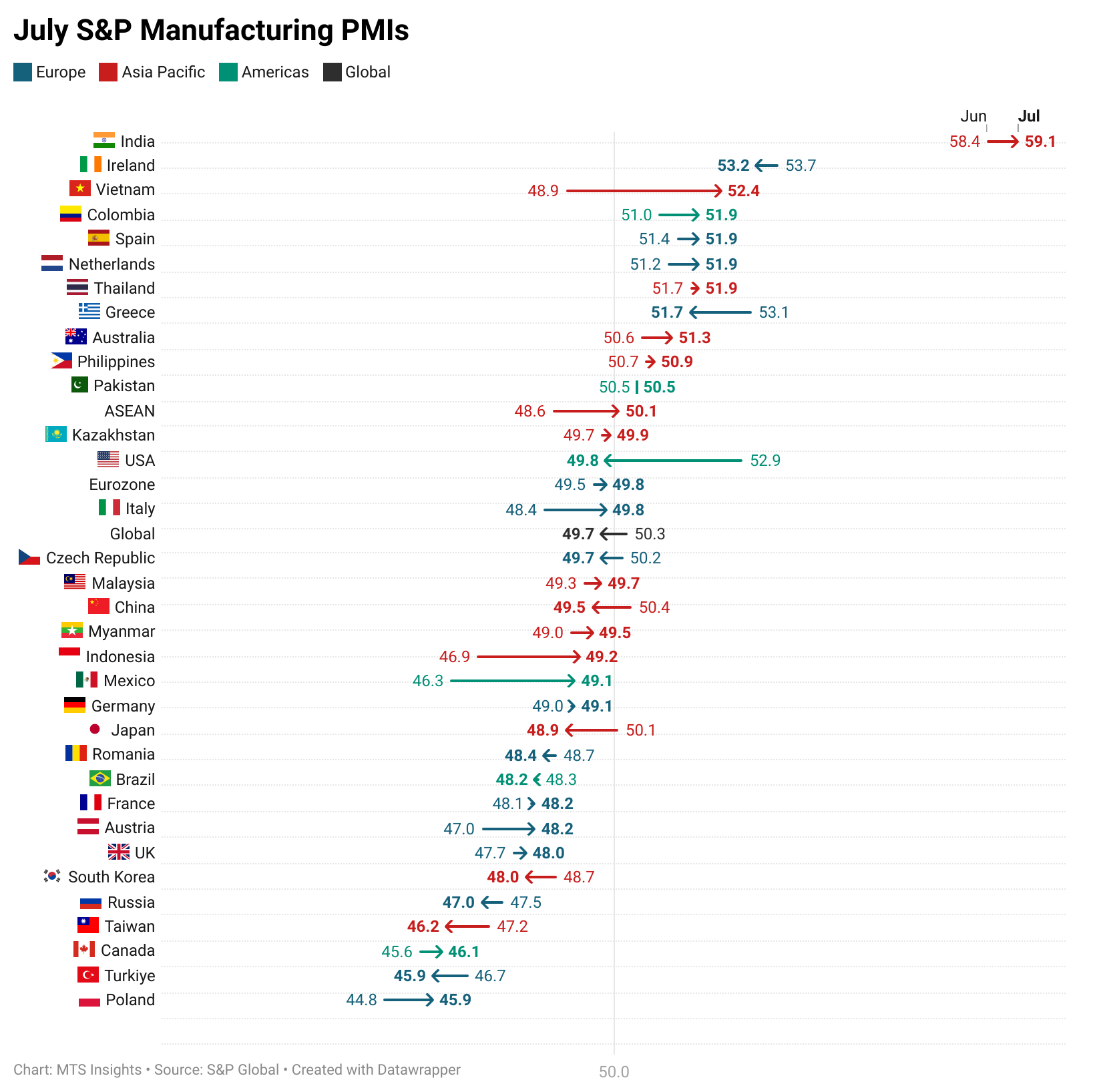
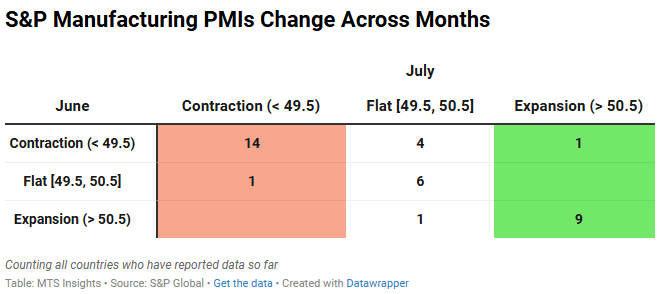
ASEAN
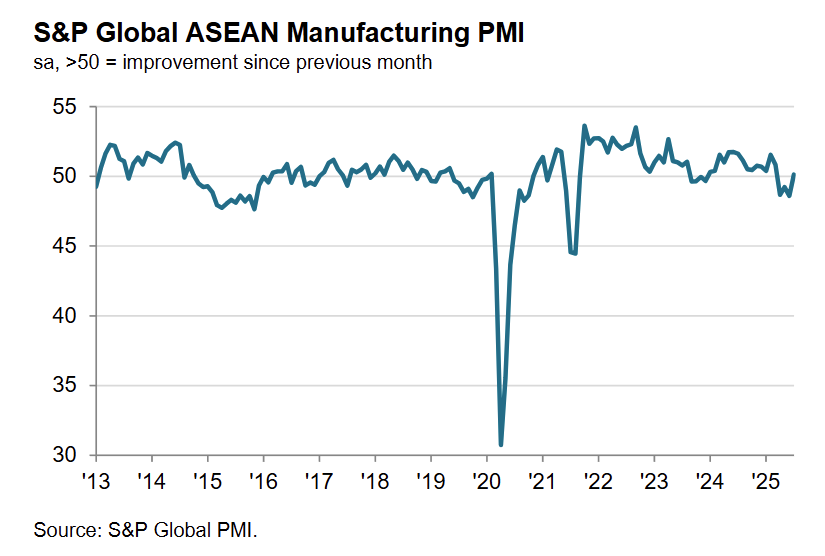
The S&P ASEAN Manufacturing PMI rose to 50.1 in July from 48.6 in June, indicating the first expansion in output since March and signaling a modest improvement in operating conditions.
- Output rose at a solid pace, marking the end of a three-month decline, while new orders fell only marginally—suggesting easing demand weakness.
- Employment continued to decline, but the pace of job losses slowed; purchasing activity stabilized after three months of cuts.
- Input costs and output prices rose at the fastest pace in four and five months, respectively, though still below long-run averages.
- Business confidence fell to a five-year low, with firms expecting only modest growth in output over the next year.
Taiwan
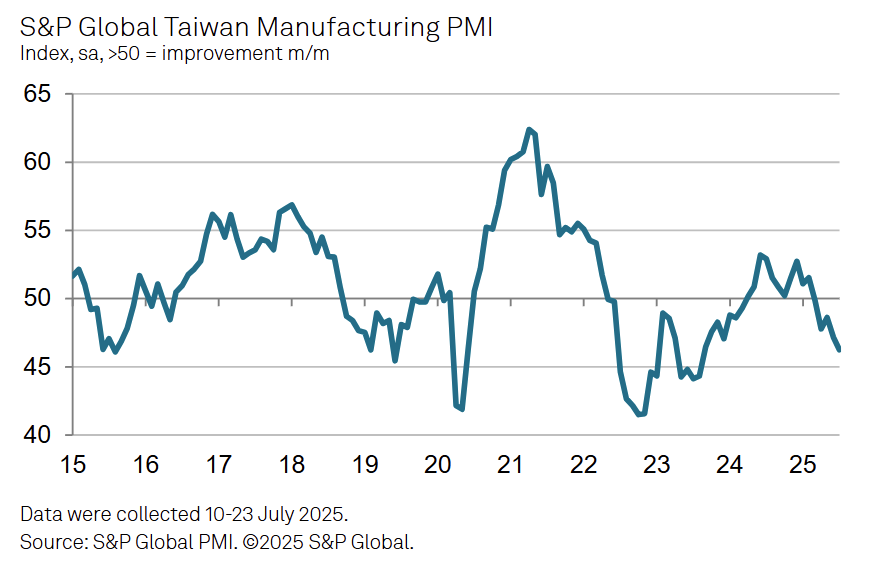
The S&P Taiwan Manufacturing PMI fell to 46.2 in July (from 47.2 in June), marking the steepest deterioration in operating conditions since August 2023 and the fifth consecutive month in contraction.
- Output, new orders, and export sales all declined at their fastest rates in nearly two years due to weak demand and uncertainty over US trade tariffs.
- Purchasing activity dropped at the sharpest pace since August 2023, while employment continued to fall amid hiring freezes and attrition.
- Input costs rose modestly on higher raw material prices (notably metals), but output prices declined slightly due to competitive pressure.
- Business sentiment slipped to its lowest level in two and a half years, reflecting subdued forecasts for year-ahead production.
India
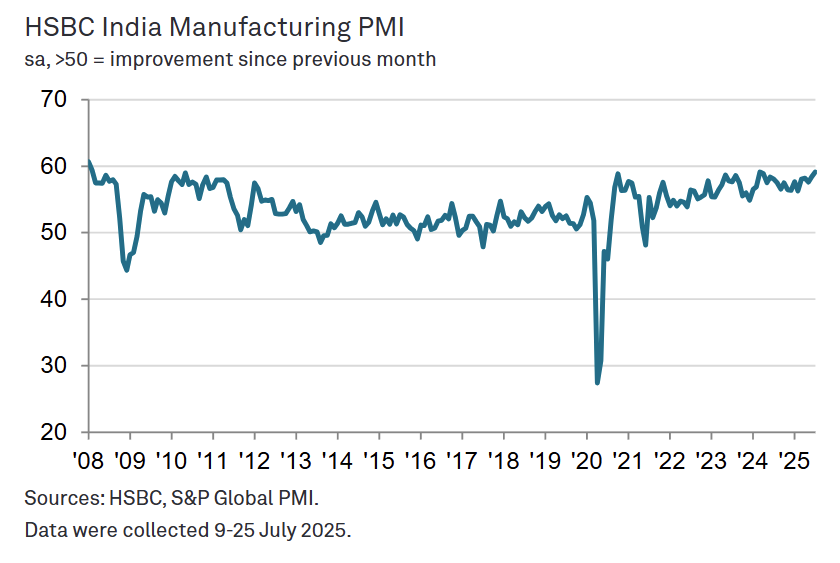
The HSBC India Manufacturing PMI rose to 59.1 in July (from 58.4 in June), marking a 16-month high and signaling the strongest improvement in sector conditions since March 2024.
- New orders expanded at the fastest pace in nearly five years, while output growth reached a 15-month high, driven by intermediate goods producers.
- Export growth remained strong, though slightly below June’s pace; inventories of inputs rose at the fastest rate in 15 months.
- Employment growth slowed to the weakest since November 2024 as most firms reported adequate staffing.
- Input costs rose at a faster rate due to higher raw material prices (aluminum, rubber, steel), and output prices rose above trend levels due to strong demand.
- Business confidence fell to a three-year low amid concerns over inflation and competitive pressures.
Eurozone
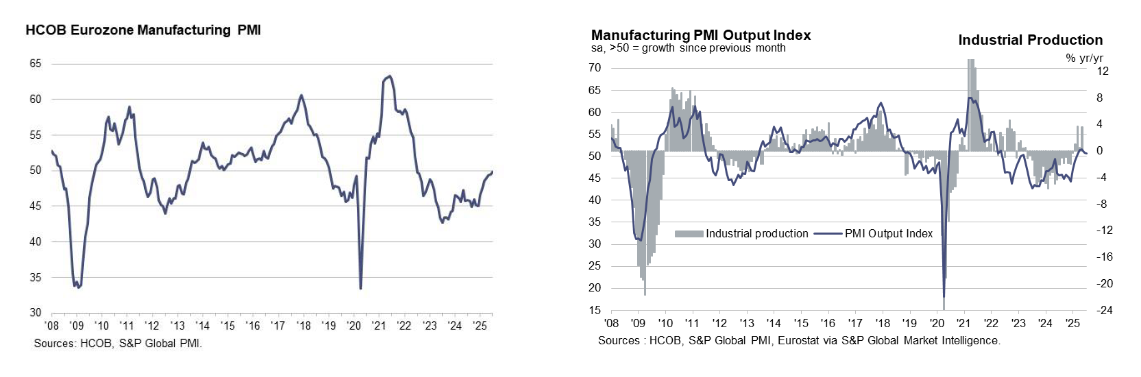
The HCOB Eurozone Manufacturing PMI rose to 49.8 in July (from 49.5 in June), a 36-month high that signals near-stabilization in factory conditions, though still just below the 50.0 expansion threshold.
- Output rose for a fifth consecutive month but slowed to a four-month low (50.6) as new orders fell again, particularly from foreign clients.
- Input costs and output prices were broadly unchanged after recent declines, indicating muted price pressures.
- Employment and purchasing activity declined at the slowest pace in nearly two years, showing signs of stabilizing.
- Supply chain pressures ticked up, with input lead times lengthening to the greatest extent since November 2022.
- Business confidence dipped slightly from June but remained above the long-run average, supported by smaller economies like Spain, the Netherlands, and Ireland.
US
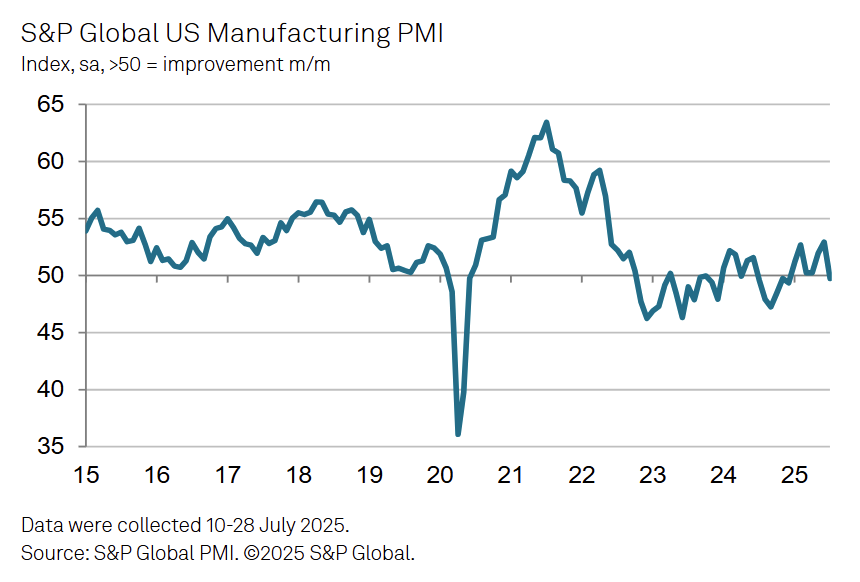
The S&P Global US Manufacturing PMI fell to 49.8 in July (from 52.9 in June), the first sub-50 reading of 2025 and a signal that operating conditions worsened slightly amid soft demand and tariff-related uncertainty.
- New orders were broadly flat, with export orders falling for the first time in three months amid weaker demand from China, the EU, and Japan.
- Employment declined modestly for the first time since April as firms cited cost concerns and excess capacity.
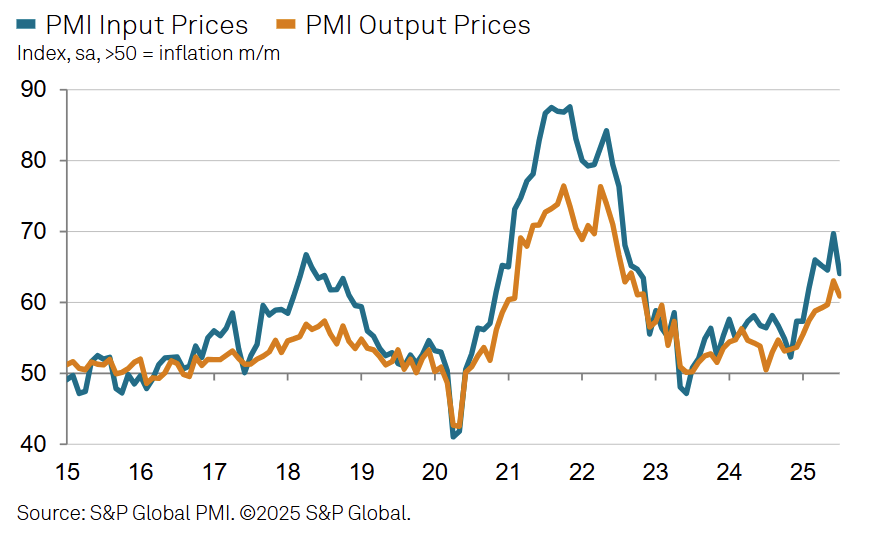
- Input costs remained elevated due to tariffs, but inflation eased from June’s near three-year high; selling prices still rose at the second-fastest pace since Nov 2022.
- Inventories were drawn down for the first time in three months as firms slowed purchasing and relied on existing stockpiles.
- Supplier delivery times improved significantly, marking the best performance in over a year as supply constraints eased.