


S&P Global Manufacturing PMIs: June 2025
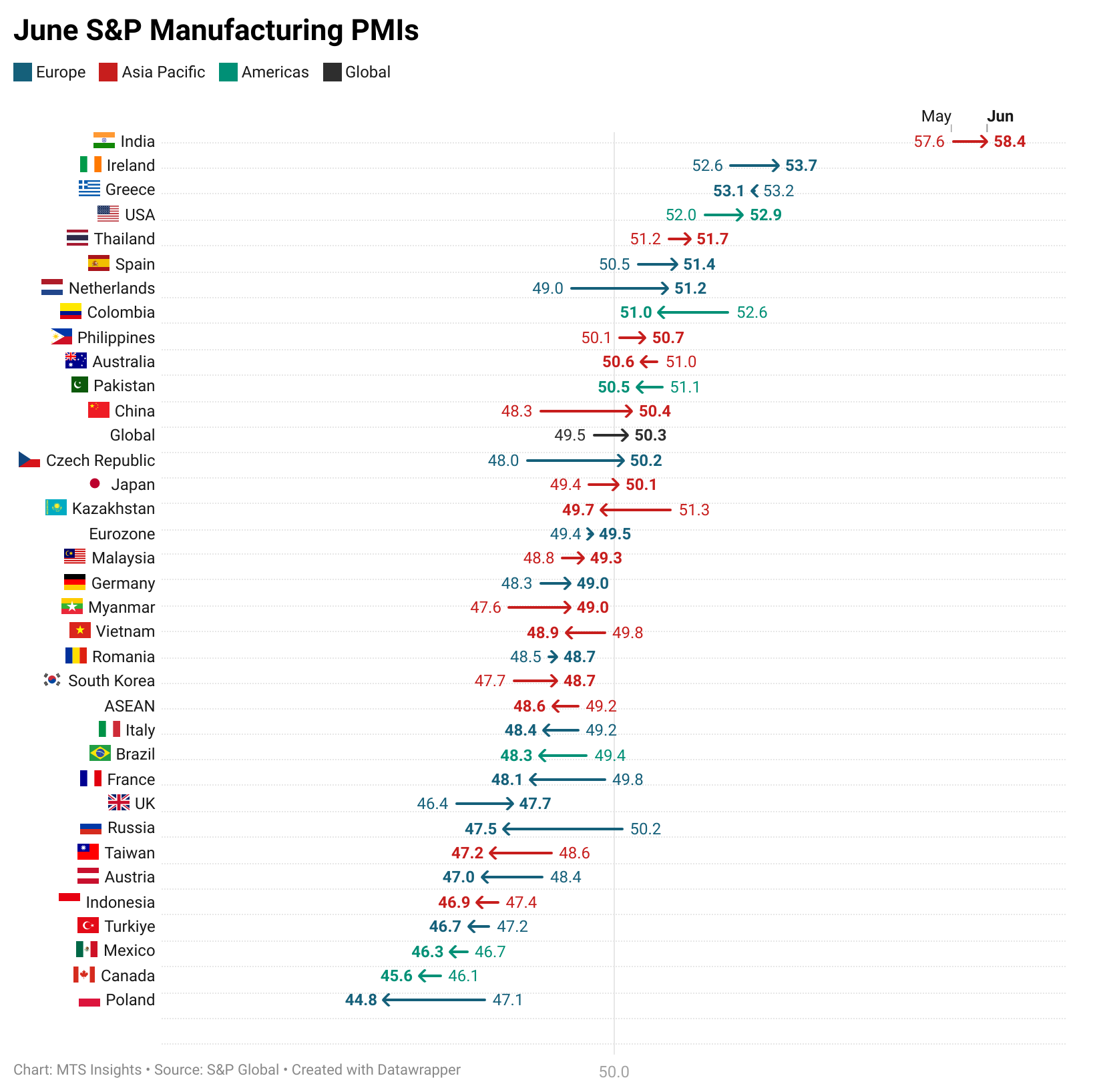
Global - 7/1/2025
Asia Pacific
- Australia - 6/30/2025
- Malaysia - 7/1/2025
- ASEAN - 7/1/2025
- Myanmar - 7/1/2025
- Philippines - 7/1/2025
- Thailand - 7/1/2025
- Vietnam - 7/1/2025
- Indonesia - 7/1/2025
- Japan - 7/1/2025
- Taiwan - 7/1/2025
- China - 7/1/2025
- India - 7/1/2025
- Russia - 7/1/2025
- Kazakhstan - 7/1/2025
- South Korea - 7/1/2025
- Pakistan - 7/1/2025
Europe
- Austria - 6/26/2025
- Ireland - 7/1/2025
- Netherlands - 7/1/2025
- Romania - 7/1/2025
- Turkiye - 7/1/2025
- Poland - 7/1/2025
- Spain - 7/1/2025
- Czechia - 7/1/2025
- Italy - 7/1/2025
- France - 7/1/2025
- Germany - 7/1/2025
- Eurozone - 7/1/2025
- Greece - 7/1/2025
- UK - 7/1/2025
North & South America
Key Results
ASEAN
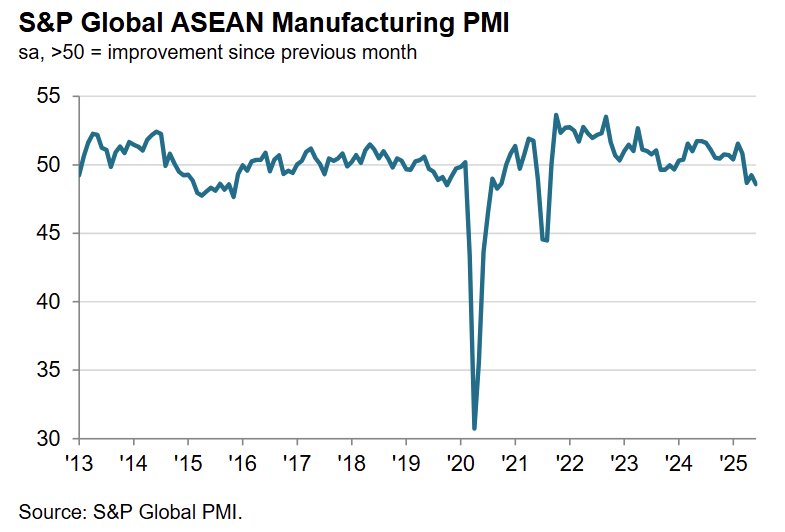
The S&P Global ASEAN Manufacturing PMI fell 0.6 pts to 48.6 in June, the lowest reading since August 2021, signaling the sharpest deterioration in operating conditions in nearly four years.
- New orders declined at the fastest pace since August 2021, with export demand weakening further for the eighth consecutive month.
- Employment dropped at the steepest rate in 44 months, while input purchasing also saw a deeper contraction.
- Output contracted for a third month, though the rate of decline remained marginal and consistent with May.
- Input price inflation eased to its lowest in over five years, while output prices rose only modestly.
- Business confidence softened to the second-lowest level since July 2020, pointing to a muted outlook for future output.
Taiwan
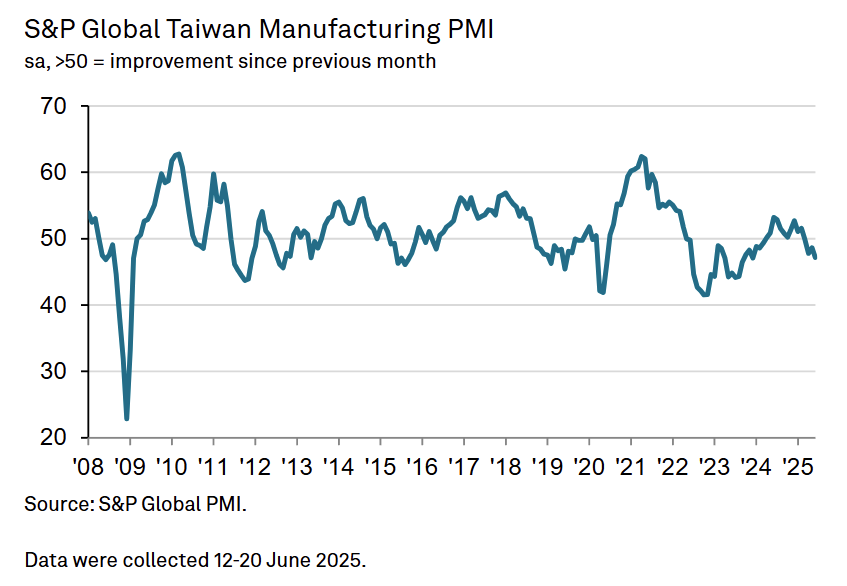
The S&P Taiwan Manufacturing PMI dropped 1.4 pts to 47.2 in June, marking the sharpest deterioration in factory activity in 18 months amid deepening declines in output and new orders.
- Output fell at the fastest pace since December 2023, while new orders and new export work posted their steepest drops since August 2023.
- Employment declined again as firms cut staff and purchasing in response to weaker demand and tariff-related uncertainty.
- Supplier delivery times lengthened at the fastest rate this year, while input costs rose modestly after falling in May.
- Factory gate prices were reduced for the fourth straight month despite rising input costs, reflecting efforts to support sales.
- Business confidence remained subdued for the third consecutive month, with many firms expecting output to decline over the coming year.
China
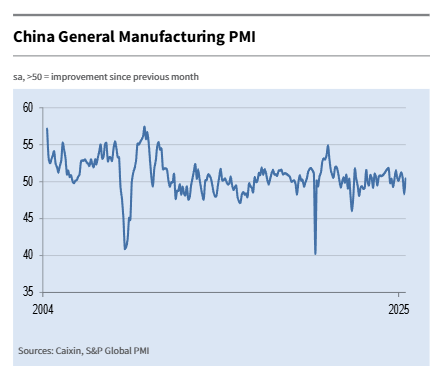
The Caixin China Manufacturing PMI rose 2.1 pts to 50.4 in June, returning to expansion territory and signaling the eighth improvement in nine months, as output and new orders rebounded modestly.
- Output expanded at the fastest rate since November 2024, supported by stronger domestic demand and promotional efforts.
- New orders rose slightly, but new export orders fell for a third consecutive month, weighed down by weak global demand and U.S. tariffs.
- Employment declined for the ninth time in ten months, with workforce reductions leading to a marginal increase in backlogs.
- Input costs fell for the fourth straight month, but output prices dropped at the fastest pace in five months amid fierce competition.
- Business confidence softened from May and remained below average, with firms cautious due to weak external demand and policy uncertainty.
Russia
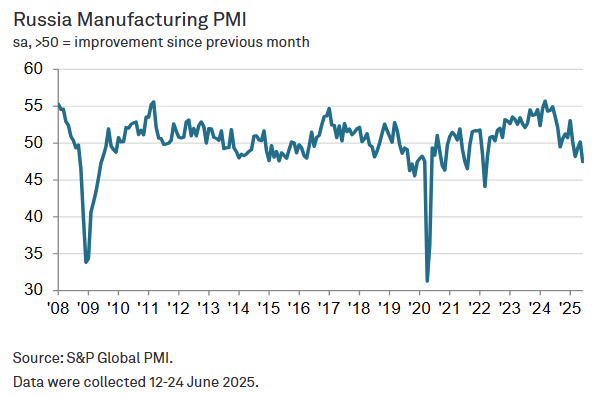
The S&P Russia Manufacturing PMI fell -2.7 pts to 47.5 in June, the third straight decline in the last four months and the steepest drop since March 2022.
- New export orders contracted by the sharpest rate since November 2022.
- The fall in staffing levels was the second in the last three months, with the pace of job shedding the sharpest since April 2022.
- The level of optimism was stronger than the series average, but ticked down to the lowest since October 2022 amid concerns regarding global economic uncertainty.
Poland
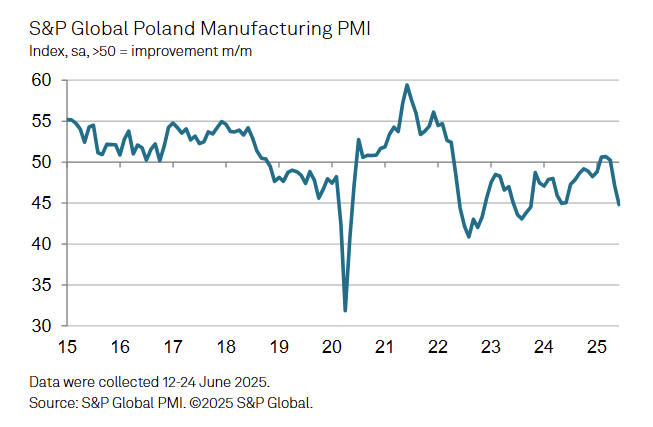
The S&P Poland Manufacturing PMI dropped -2.3 pts to 44.8 in June, the sharpest deterioration in the Polish manufacturing sector since October 2023.
- The headline figure has fallen by -5.4 pts since April, the steepest two-month drop since mid-2022.
- New orders contracted at the strongest rate since October 2023 with new export orders contracting at the strongest rate since November 2022.
Netherlands
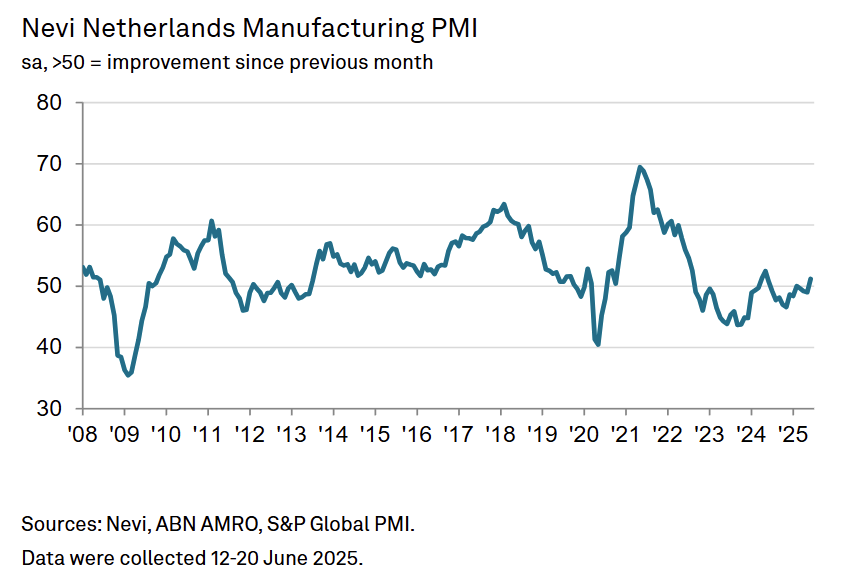
The S&P Netherlands Manufacturing PMI increased 2.2 pts to 51.2 in June, the first time conditions have improved in a year.
- New export orders expanded for the first time since May 2024.
- Employment across the manufacturing industry rose for the first time in nearly a year, albeit modestly.
- Average input cost inflation continued to soften in June, with the latest uptick in expenses the least pronounced in seven months.
Germany
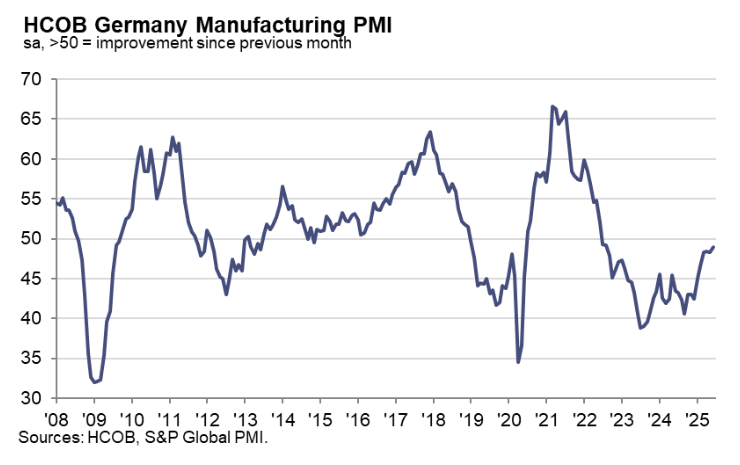
The S&P Germany Manufacturing PMI increased 0.7 pts to 49.0 in June, the highest in 34 months.
- The New Orders index was in expansionary territory for the third time in four months, and growth was the strongest since March 2022.
- Goods producers' purchases of raw materials and other inputs meanwhile rose for the first time in three years as expectations towards future output improved.
- June's survey indicated a slight improvement in manufacturers' growth expectations for the coming year. Confidence was the highest since February 2022, reflecting the plans for increased public sector spending and hopes of a wider economic upturn.
Eurozone
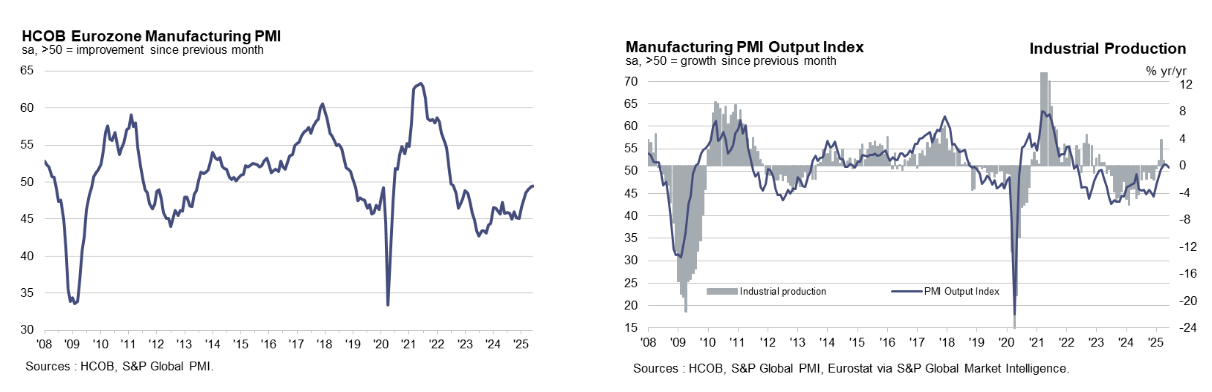
The S&P Eurozone Manufacturing PMI edged up 0.1 pts to 49.5 in June, the highest in 34 months, signaling a marginal downturn but hinting at growing stabilization across the sector.
- Output Index slowed -0.5 pts to 50.8, still in expansion but at a 3-month low, supported by stable order books and backlog clearing.
- New orders and export sales stabilized, ending a 37-month streak of declining demand.
- Confidence rose to its highest level since February 2022, though job shedding and reduced input buying continued.
- Delivery times lengthened for the first time since January, while purchasing costs and output prices declined for a third straight month.
- National divergence persists: Greece, Ireland, Spain, and the Netherlands saw improvement, while France, Italy, Austria, and Germany remained in contraction.
UK
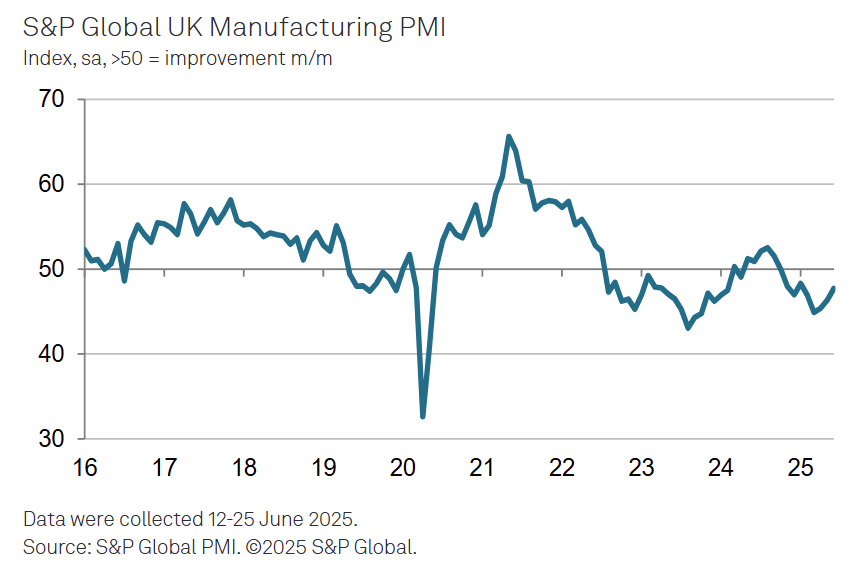
The S&P UK Manufacturing PMI increased 1.3 pts to 47.7 in June, unchanged from the flash estimate and up slightly from prior months, marking the highest reading in five months but still indicating contraction in the sector.
- Output, new orders, and employment all declined for another month but at slower rates, with optimism rising to a 4-month high.