


US Retail Sales: March 2025
US retail sales bounced back strongly to end the first quarter of 2025 after January spending was hampered by bad weather and February sales disappointed. The strong result is not a clear signal of economic strength, however, as it’s likely that the jump in sales was driven by consumers picking up spending ahead of tariffs, especially in the auto segment. Instead, quarterly growth rates point to a weaker result of a slow decline in consumption growth.
Headline Retail Sales
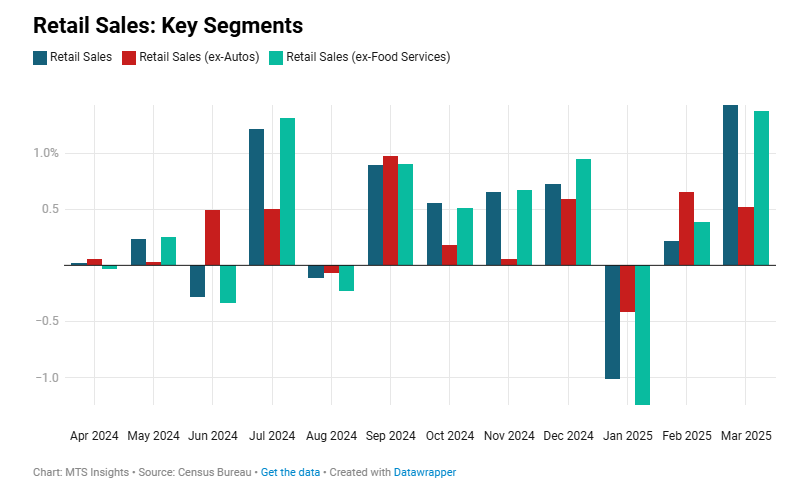
US retail & food services sales posted a strong result in March, surging 1.4% MoM and beating expectations of a 1.3% MoM gain. The monthly increase is the strongest since January 2023 and is considered a rebound from the weak results in the first two months of the year. When looking at the first quarter as a whole, retail sales were only up 0.3% QoQ.
The jump in sales in March was driven by a strong increase in auto sales. Retail spending on autos and auto parts surged 5.3% MoM and was up 8.8% YoY. The move was a result of two major factors. First, January and February auto sales were notably weak, so a rebound to close Q1 was largely expected. Second, consumers looked to front-run the 25% tariff on auto imports that Trump announced would be put in place in April. So what we’re seeing here is a largely secular move higher that is likely to be reversed in April. Auto sales in Q1 as a whole were still weak despite the March surge, falling -0.9% QoQ.
Offsetting the large increase in auto sales was a large decline in gas station sales. The -2.5% MoM drop was caused by oil prices falling in March and causing a similar decline in gas prices (-6.3% MoM according to March CPI). The annual change in gas station sales flipped to a decline of -4.3% YoY in March, and for the quarter as a whole, was -0.7% YoY.
Core Retail Sales
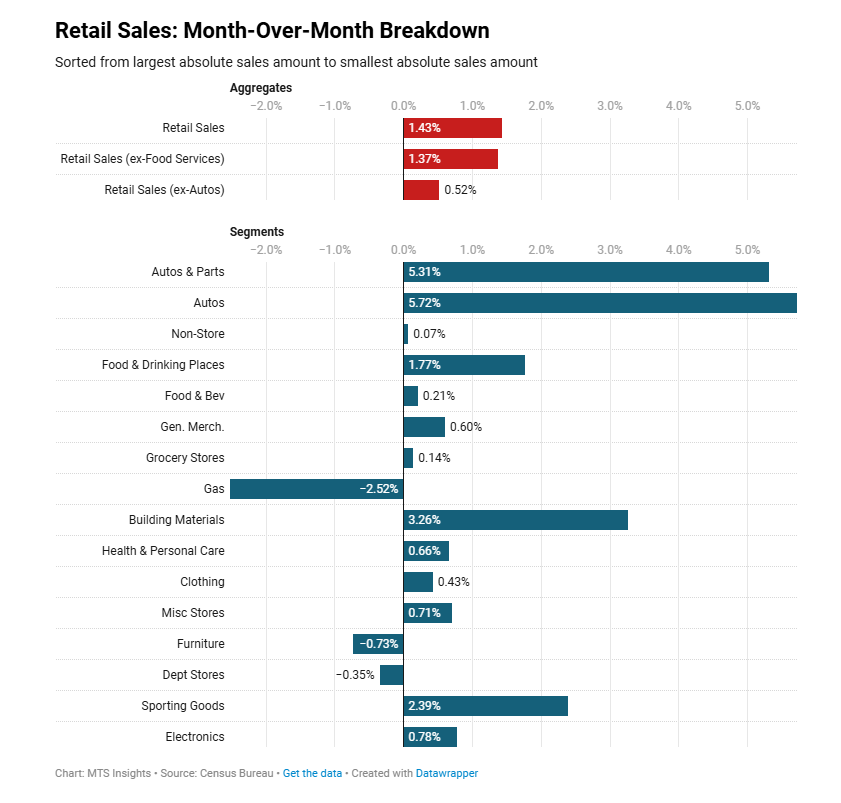
When excluding both gas sales and auto sales, retail sales still posted a strong increase, up 0.8% MoM, which actually matched the core sales increase in February. Notably, only one of the core retail sales subsegments saw a decline in March, and the rest saw some kind of increase. The core segment results inspire a little bit more confidence in the consumption picture. When excluding the weak auto segment, core retail sales were up 0.6% QoQ in the first quarter.
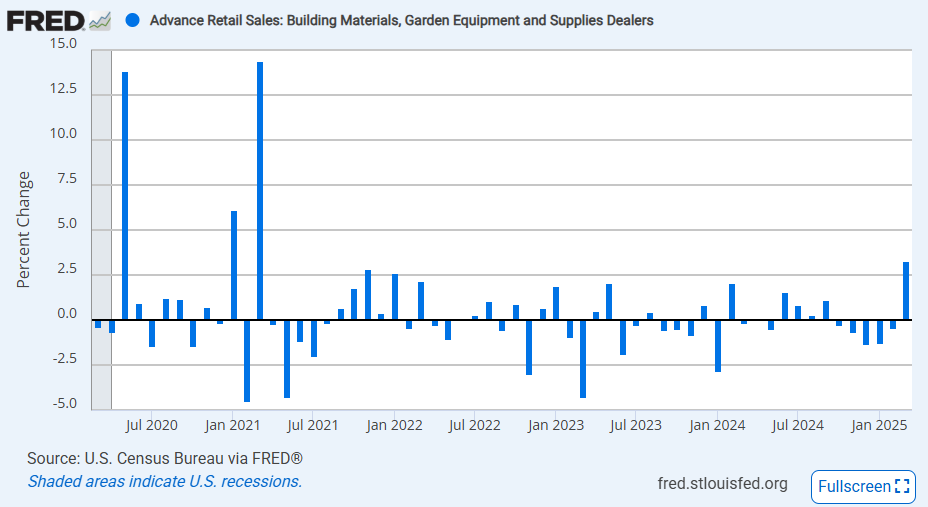
- The building materials & garden equipment segment was the core segment with the largest increase in March, up 3.3% MoM. This was the largest MoM gain in four years and a reversal from five straight monthly declines. I suspect there was some tariff impact here combined with a positive change in the weather in March vs January and February. Weakness in the first two months meant that building materials sales were still down -1.6% QoQ, the largest quarterly drop since Q2 2023.
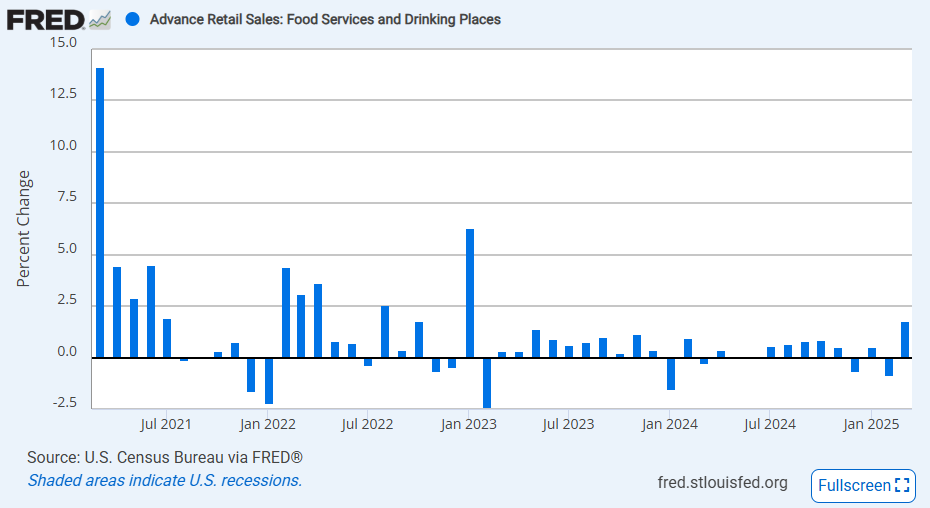
- Food services & drinking places was another segment with a strong bounce, up 1.8% MoM, posting its largest monthly increase since January 2023. This segment was notably weak in February when it dropped -0.8% MoM, and the strong end to Q1 brings the quarterly increase to 0.2% QoQ. Like the building materials segment, I think the bounce here was partly driven by weather, but there are also more signs of consumer strength here because tariffs likely didn’t impact this segment much.
- Core segments that may have been impacted by tariffs include electronics (+0.8% MoM), sporting & hobby goods (+2.4% MoM), health & personal care (+0.7% MoM), and general merchandise (+0.6% MoM). It’s likely that without the tariffs, these segments would have been closer to flat.
- Nonstore retail sales were one of the weakest categories in March, up just 0.1% MoM, but that followed a surge of 3.2% MoM in February. Interestingly, there wasn’t much of a response in this category to tariffs.
- The sole segment posting a decline was furniture sales, down -0.7% MoM. Despite the drop, sales in this segment were still up 7.7% YoY, and they increased 0.9% QoQ.
NRF Retail Monitor
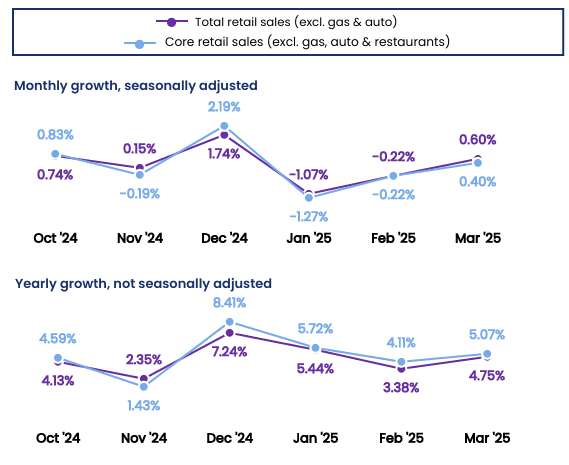
The NRF Retail Monitor, released a few days before the Census report, saw retail sales (ex autos and gas) growth a bit weaker in March at 0.6% MoM. The main deviation was in the building & garden supplies segment, which, according to the NRF, saw sales down -0.81% MoM, not a jump of 3.3% MoM. It was also more pessimistic on electronics sales (-0.29% MoM) and health & personal care (-0.44% MoM). One thing that was consistent across both reports was the strong performance in food services & drinking places, which the NRF reported up 1.48% MoM. In general, the NRF report presents a smoother view of sales than the Census report, where the February drop was smaller and the March gain was weaker.
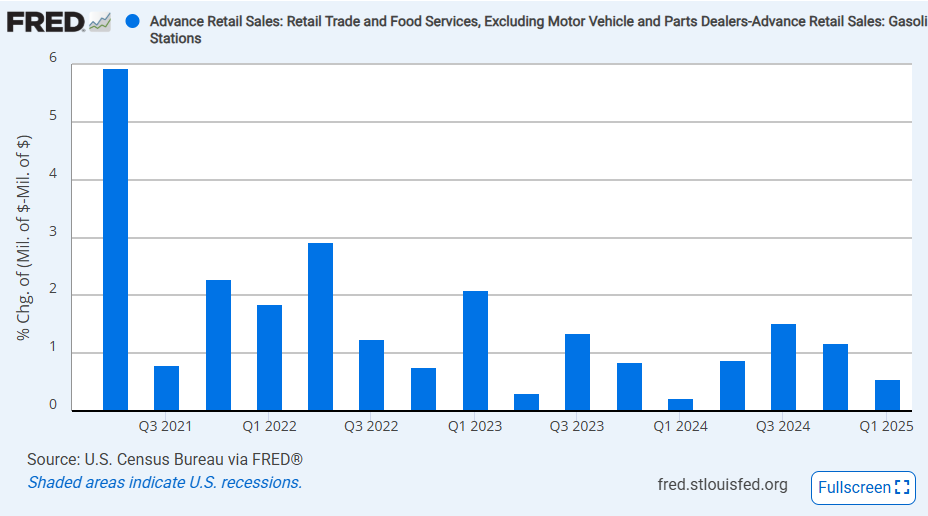
Overall, it’s hard to take much away from the March retail report because of the volatility in Q1 due to weather and the impact of tariff front-running on the March numbers. A trend is more visible when looking at quarterly trends. The increase of retail sales excluding autos and gas slowed to about 0.56% QoQ in Q1 2025, the lowest since Q1 2024 and a clearer signal that consumption growth is gradually slowing. If tariffs are in place throughout Q2, I expect that to have a dampening effect on goods sales growth through higher prices and weaker personal income (through lower wage growth and/or higher unemployment).