


US Retail Sales: April 2025
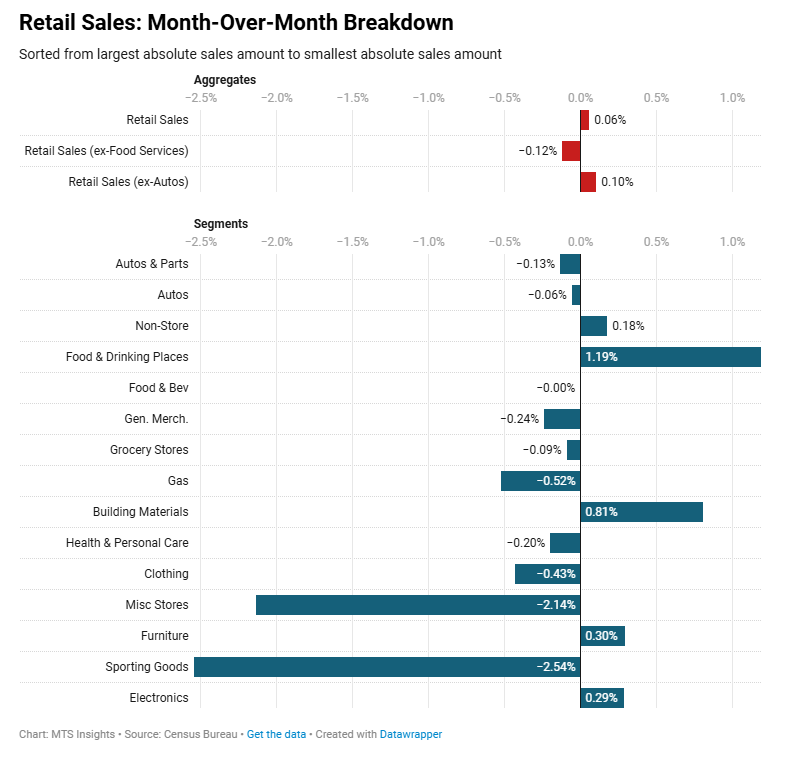
US retail sales in April increased just 0.1% MoM, a sharp slowdown in consumer spending following the 1.7% MoM increase in March (which was actually revised up from 1.5% MoM). Despite the slowdown, the small increase was a slight beat over expectations that there would be no growth in sales. Both auto and gas sales weighed down the headline number:
- Motor vehicle and auto part retail sales fell -0.1% MoM in April, keeping the overall sales subdued due to its heavy weight. However, the small decline in auto & parts sales is actually a bit of a surprise as sales surged in March, up 5.5% MoM. That means that consumer spending on autos was remained strong in April with an annual increase of 9.4% YoY.
- Gas sales fell -0.5% MoM in April as weak oil prices continue to keep spending on gasoline low. In the three months to April, gas sales are down -1.1% compared to the previous three months and down -3.9% YoY. Energy commodity prices will have to bounce before this segment of sales can recover.
The core segment of sales that excludes autos and gas saw a slightly stronger increase of 0.2% MoM. The performance across segments was generally mixed with the strongest gains in food services & drinking places (+1.2% MoM) and building materials & supplies (+0.8% MoM) offset by declines elsewhere. The large non-store segment only increased 0.2% MoM but was still at a healthy 7.5% YoY gain. The sharpest declines were seen in sporting goods & hobbies (-2.5% MoM) and miscellaneous stores (-2.1% MoM) which look to be reversals of strong March gains.
Overall, the April retail sales report is not much of a surprise given the strong gain in March. Consumers were always going to slow from the pacey spending growth fueled by tariff front-running, so we shouldn’t look too much into the monthly numbers as a sign of consumer weakness. In fact, many segments reported strong annual rates because there wasn’t much of a reversal of the March spending growth, so the report actually looks a bit stronger in that light.