


US Retail Sales: February 2025
February retail sales hits with another soft reading of consumption after the significant decline in January. This time, there was a slight increase in retail sales of 0.2% MoM, but it was below expectations of a stronger bounce of 0.6% MoM. The weakness was a result of another month of sluggishness in auto sales as other segments looked better. Regardless, the market is forced to contend with the possibility that the consumer really is fading away and what that means for growth.
Headline Retail Sales Totals
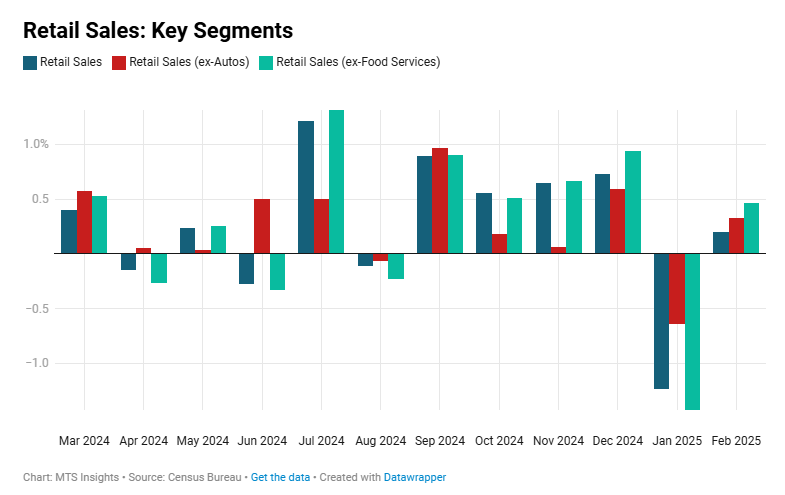
The headline reading of retail & food services sales increased 0.2% MoM in February, failing to post a significant recovery from a weak January and a sizeable miss from an expected increase of 0.6% MoM. The figure is even more disappointing when considering the fact that the January decline was revised down from -0.9% MoM to an even worse -1.2% MoM. This means that the seasonally adjusted total for February of $722.7 billion was actually a decline on the initial January estimate made last month of $723.9 billion. When looking at the details, the sales figures look slightly better.
The weak February print can be attributed to a -0.4% MoM decline in auto sales in February which failed to bounce from the -3.7% MoM decline in January. When excluding this segment, retail sales were up 0.3% MoM, a slightly smaller miss from the expected 0.4% MoM increase. This aggregate includes a -1.0% MoM decline in gas sales which was caused by a decline in gas prices in March. When excluding gas sales and autos, retail sales growth was up a rosier 0.5% MoM which actually beat expectations for that segment and was a better bounce from that segment’s decline of -0.8% MoM in January.
Segment Details
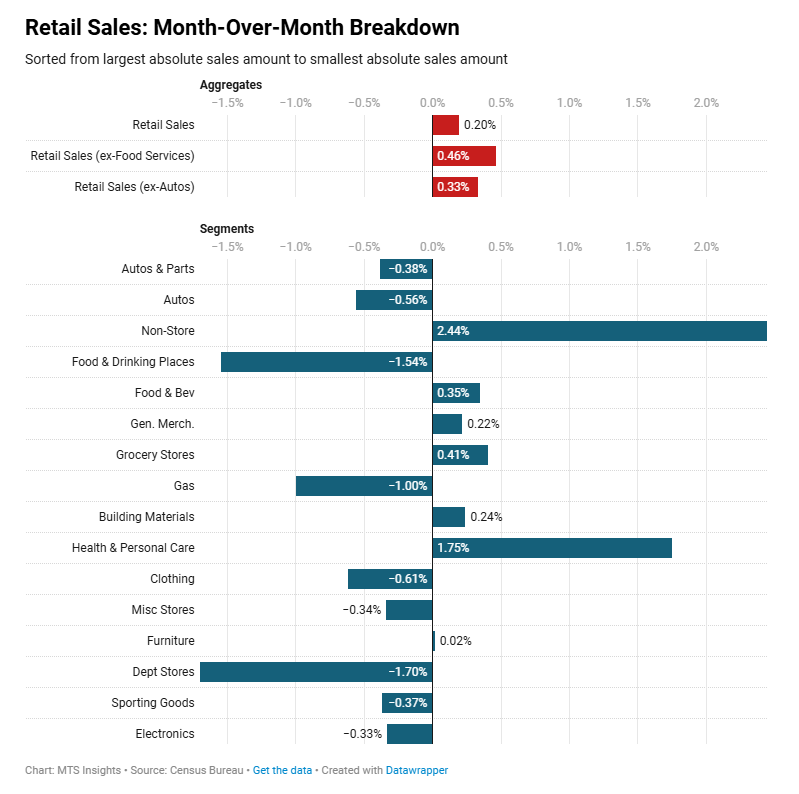
The details of the retail sales were indeed quite mixed with some segments bouncing from January weakness and others maintaining it:
- The nonstore retail sales segment was one of those segments on a bounce, up 2.4% MoM in February after a -2.4% MoM decline in January. With this segment being the second largest, it played a major part in offsetting the weak auto results and pushing the headline indexes into positive territory.
- The third largest segment, food services & drinking places, maintained its January weakness, down -1.5% MoM in February after no growth in January. This challenges the validity of the conjecture that January retail sales data was caused by exceptionally cold weather as there would probably be a recovery in this segment if that were the case. The annual increase of food services sales is now just 1.5% YoY, the weakest since the US completely opened up after the pandemic in February 2021.
- Food & beverage sales (+0.4% MoM) and general merchandise sales (+0.2% MoM) maintained low stable rates with the latter trending a bit weaker than the former. Grocery store sales were up 0.4% MoM which was likely helped by rising food prices.
- Health & personal care sales was another segment that saw a strong rebound. The segment was up 1.7% MoM in February, reversing the -1.1% MoM decline in January. In the last three months, sales increased 5.3% compared to the Sep-Nov period where sales were only up 0.2%.
- Some weak segments that maintained weakness from January: sporting goods & hobbies down -0.4% MoM in February and -3.1% MoM in January, electronics down -0.3% MoM in February and -1.1% MoM in January, and furniture 0.0% MoM in February and down -1.2% MoM in January. Notably, there are all discretionary segments that would be sensitive to cyclical changes in the economy.
Early Retail Sales Readings
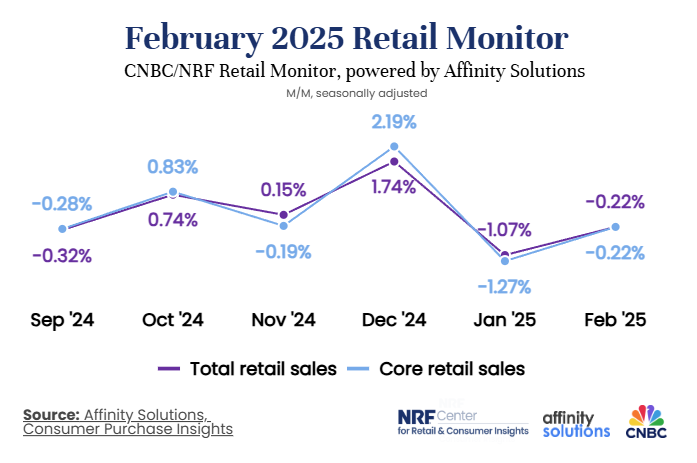
Early readings of retail sales had confirmed that February would be a weak report for retail sales. The NRF’s Retail Monitor reported retail sales (ex gas and autos) down -0.2% MoM February with significant declines in building & garden supplies (-1.0% MoM), furniture (-1.0% MoM), and clothing (-0.8% MoM). Additionally, the Chicago Fed CARTS nowcast pointed to an even sharper decline in the retail & food services sales (ex-auto) segment of -0.8% MoM. Both appeared to be too pessimistic because they missed the surge in nonstore sales, but the general soft sentiment was there early.