


NFIB Small Business Optimism: February 2025
The NFIB Small Business Optimism Index fell -2.1 pts to 100.7 in February, below expectations of a smaller but similar decline to 101.0. The index is now down -4.4 pts from its post-election peak of 105.1. The decline in optimism has been paired with a rise in uncertainty that small business owners thought would ease following the election of Trump. The Uncertainty Index is up to 104 in February from the December low of 86 and similar to the uncertainty seen just before the election in October at 110. This uncertainty can be traced to the recent volatility in trade policy that has become a nightmare for small businesses in more ways than one.
NFIB Survey Data
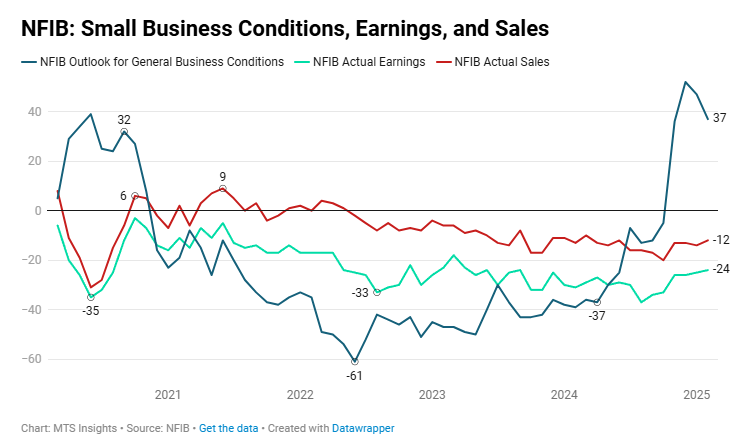
The rise in the NFIB index after the election was a result of soft data, like indexes tracking outlooks, improving as Trump was expected to be a pro-small business leader. Notably, the General Business Conditions Outlook index surged 41 pts from October into November and reached an all-time high of 52 in December. Trump actually refers to this figure frequently in his press conferences. This index can be treated like the UMich Consumer Sentiment subindex that tracks Republican sentiment. The chart above shows how there were clear swings in 2021 and 2025 aligning with shifting leadership just like in the UMich sentiment data.
Hard data in the NFIB survey, tracking actual changes in business fundamentals, remain largely negative for small businesses unlike the soft data. The Actual Earnings and Actual Sales indexes did both see minor improvements in February, up 1 pt and 2 pts respectively, but were both still just as negative as they were in the previous administration, at -12 and -24. There hasn’t been an immediate relief for small businesses that some outlook measures may have hoped for, and it may not be coming.
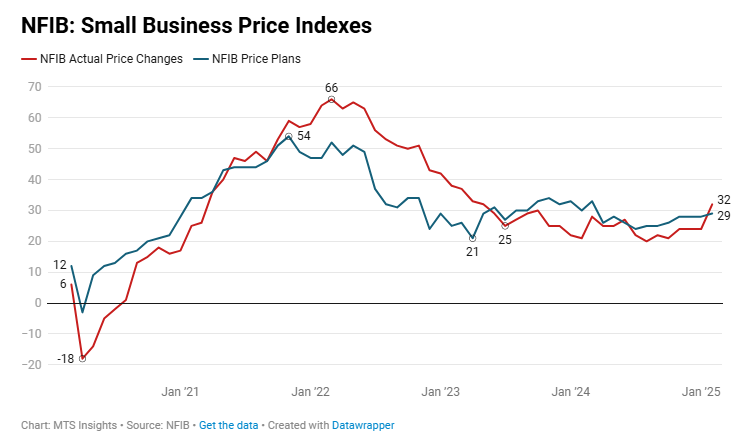
Changes in trade policy have become the new focus for small businesses, increasing uncertainty and damaging the hopeful outlook. Rising costs are likely to become a new problem for small businesses as supply chains are gummed up by tariffs and general uncertainty in trade policy. As a result, inflation is reemerging as a concern. The Actual Price Changes index jumped 10 pts in February to 32, the highest since May 2023 and the largest one month jump since April 2021. As current prices change, small businesses will be increasingly forced to increase prices in the future especially if tariffs are likely to stay in the place. As a result, we see the Price Plans index tick up 3 pts to the highest since March 2023.
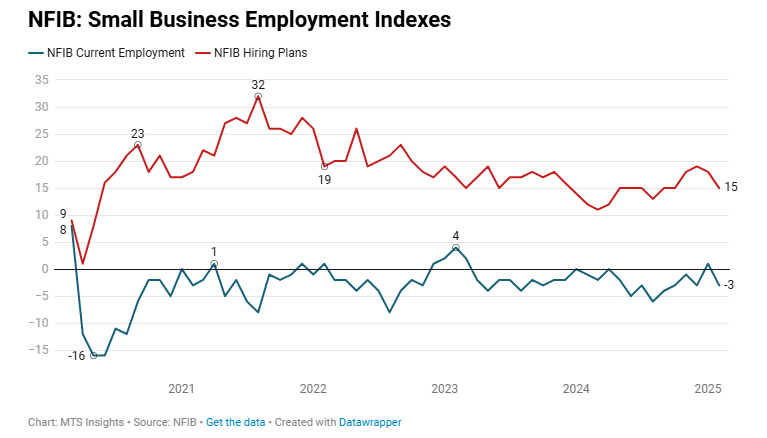
Trade uncertainty is also impacting small businesses’ demand for labor. Both the Actual Employment Changes index and the Hiring Plans index fell in February, down -4 pts to -1 and -3 pts to 15 respectively. The employment subindexes both improved in the post-election period alongside soft data which suggested that small businesses were looking to move forward with filling new positions with the expectation that Trump would bring on an improved business environment.
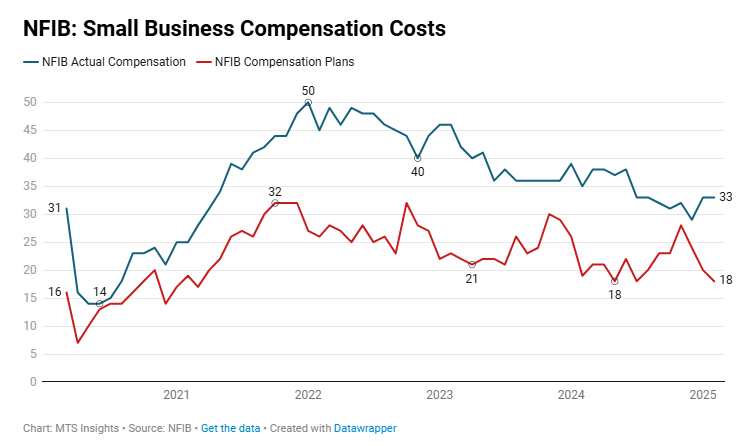
Instead, they are now looking at an increase in nonlabor costs that could crowd out potential investment in staff. As a result, plans to increase pay have soured with the Compensation Plans index down -2 pts to 18 in February and down -10 pts from the post-election peak in November. This highlights the effect of an artificial increase in supply chain costs. It causes small firms, which are typically running on thin margins and barely making a profit, to sacrifice investment elsewhere.
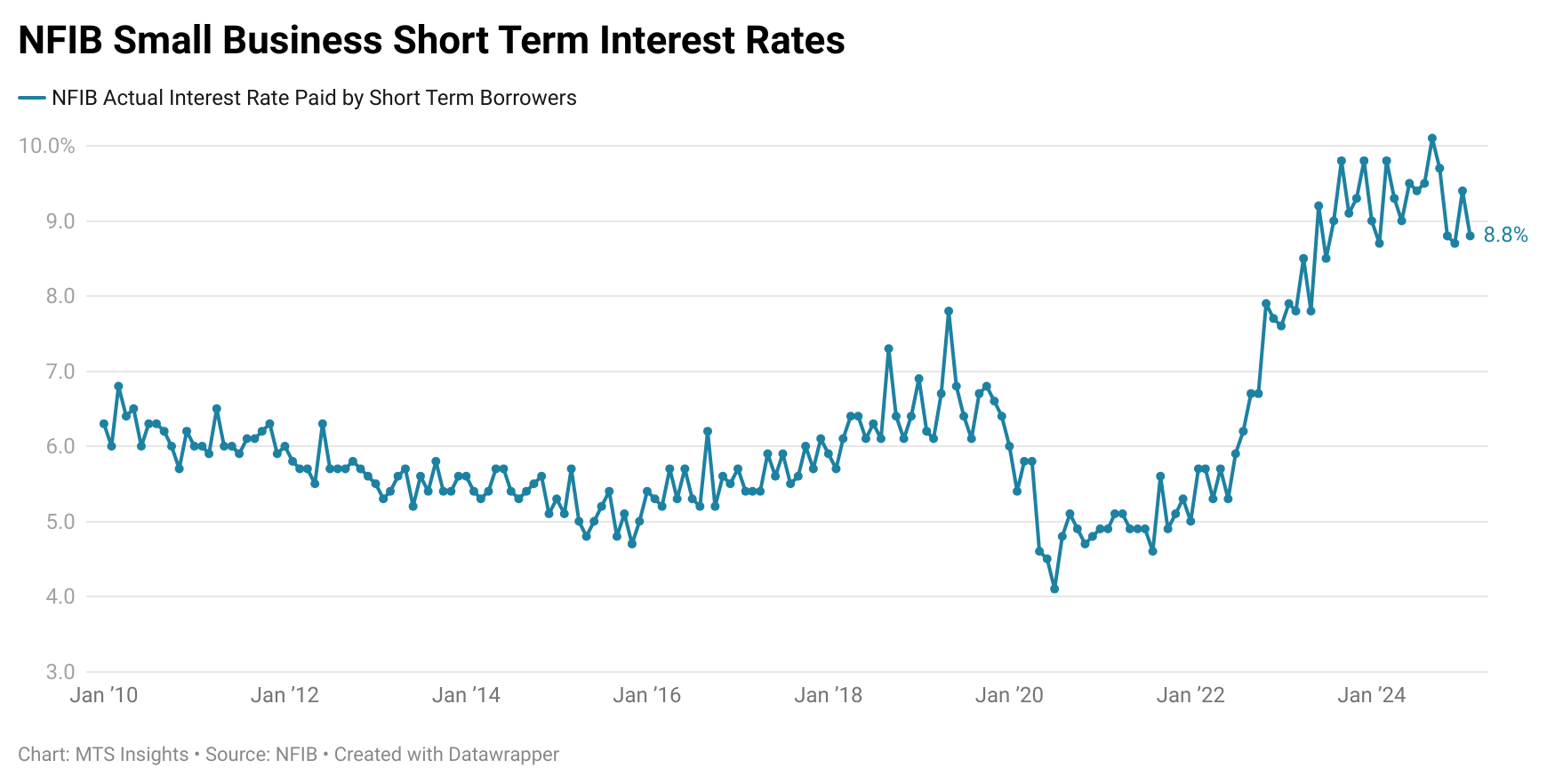
One thing that has improved for smaller firms is credit conditions through a mix of banks expecting deregulation and a decline in interest rates that has come from the rising expectations of slower growth. The rally in rates at the beginning of the year has subsided, and small business short-term interest rates fell back to 8.8% in February from a spike to 9.4% in January. Also, the Availability of Loans index improved another point to -2, the highest since February 2022. In general, however, borrowing costs are still high and loan availability low in a long-term context.