
 USA
/
EIA
EIA Short-Term Energy Outlook
About
-
December 8th, 2026 · 12:00 PM
Latest Releases
12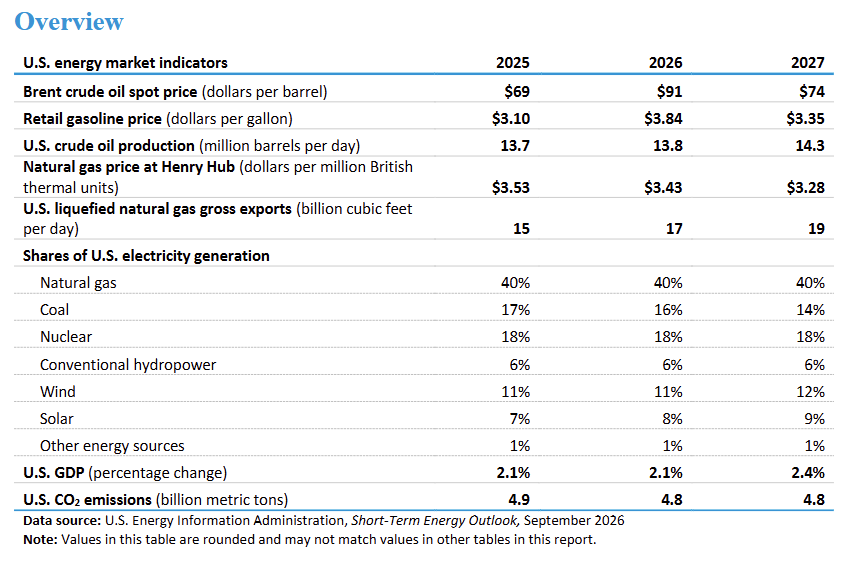
Forecast overview:
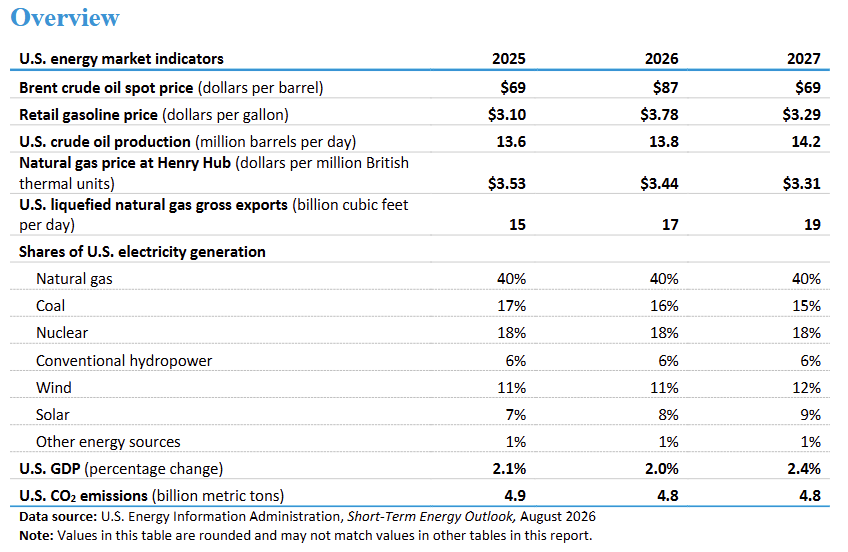
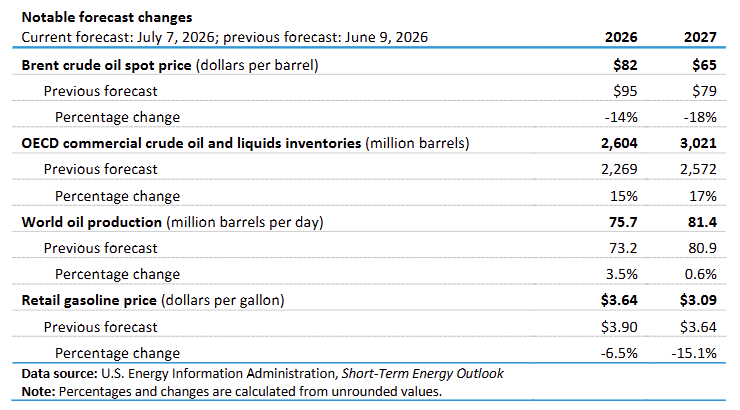
- Crude oil price movements. The Brent crude oil spot price has risen sharply following the onset of military action in the Middle East. Brent settled at $94 per barrel (b) on March 9, up about 50% from the beginning of the year and the highest since September 2023. Crude oil prices have risen as petroleum shipments through the Strait of Hormuz have fallen, and some Middle East oil production has been shut in.
- Middle East oil production. We make the assumption in our modeling that the effective closure of the Strait of Hormuz will cause oil production in the Middle East to fall further in the coming weeks. We assume this shut-in production will gradually ease as transit through the Strait resumes.
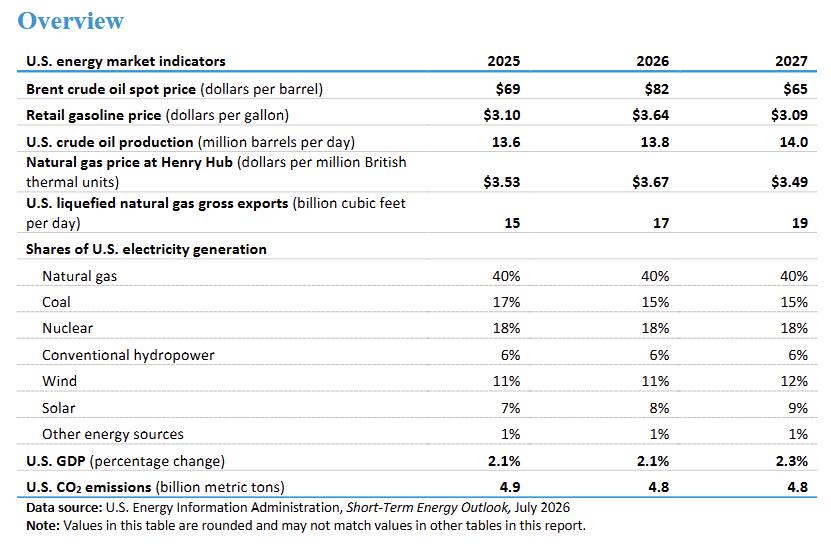
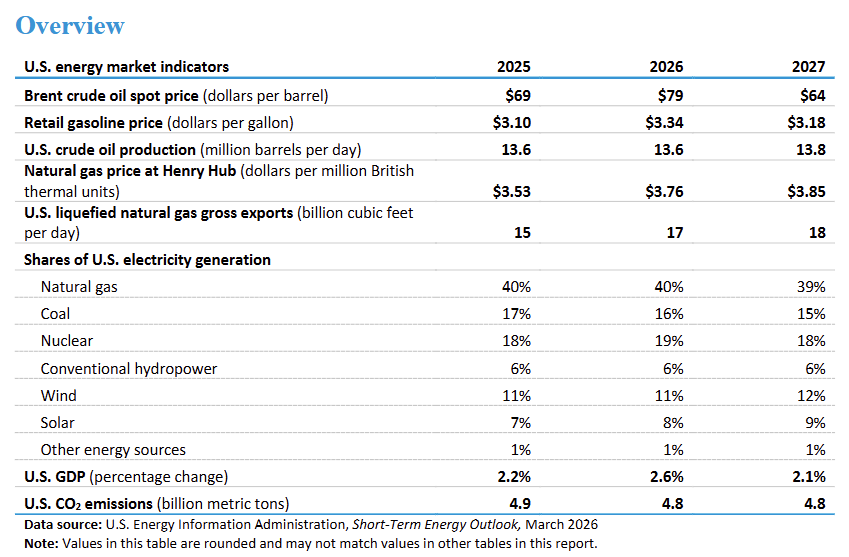
- Crude oil price forecast. We forecast the Brent crude oil price will remain above $95/b over the next two months, before falling below $80/b in the third quarter of 2026 and around $70/b by the end of the year. We expect prices to average $64/b in 2027. This price forecast is highly dependent on our modeled assumptions of both the duration of conflict in the Middle East and resulting outages in oil production.
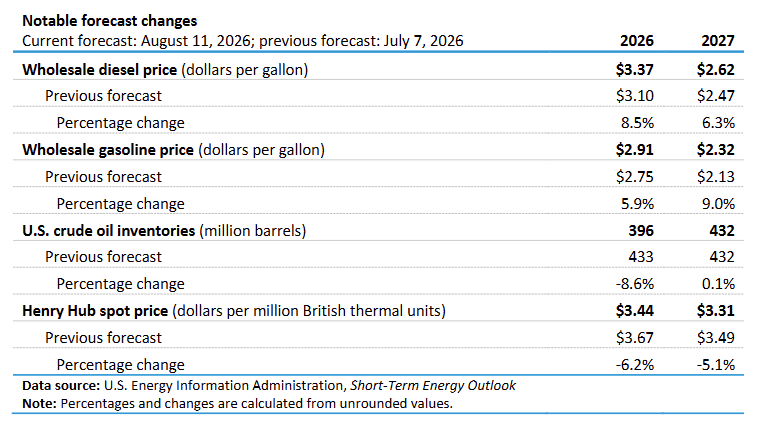
- U.S. crude oil production. Higher oil prices lead to more U.S. crude oil production in our forecast. We expect U.S. crude oil production will average 13.6 million barrels per day (b/d) in 2026 and rise to 13.8 million b/d in 2027. Our 2027 forecast is 0.5 million b/d higher than last month’s forecast.
- Natural gas prices. Although reduced liquefied natural gas (LNG) flows through the Strait of Hormuz have caused the price of natural gas in Europe and Asia to increase, we expect U.S. natural gas prices to be relatively unaffected by this development. In our forecast, the Henry Hub spot price averages about $3.80 per million British thermal units (MMBtu) in 2026, or 13% less than our forecast last month. Prices in the early part of our forecast are lower because of milder-than-forecast temperatures in February that left more natural gas in storage than we expected. The Henry Hub spot price averages nearly $3.90/MMBtu in 2027, 12% lower than our forecast last month. Lower prices in 2027 mostly reflect more associated natural gas production as a result of the recent increase in oil prices and the related increase in production later in the forecast.
- Natural gas production. Higher crude oil production results in more associated natural gas production. We expect marketed natural gas production to average 121 billion cubic feet per day (Bcf/d) this year, an increase of 2% from 2025. Production rises by an additional 3% in 2027 to reach 124 Bcf/d. The 2027 forecast is almost 2 Bcf/d higher than last month’s outlook.
- Natural gas inventories. We expect U.S. natural gas inventories to end the withdrawal season in March around 1,840 billion cubic feet (Bcf), which is near the five-year average (2021–2025). Storage withdrawals slowed in February, as milder weather moved across much of the country, following historic withdrawals in January related to Winter Storm Fern and subsequent cold weather.
- Electricity. U.S. electricity generation has been increasing by an average of 2% per year since 2021 to meet growing electricity demand following a period of flat demand growth between 2010 and 2019. We expect U.S. electricity generation will grow by 1.2% in 2026 and by 3.1% in 2027 led by demand growth in the Electric Reliability Council of Texas (ERCOT) region. In 2026, U.S. coal generation declines by 7% in our forecast as generation from renewable sources increases and the electric power sector retires about 4% of its coal-fired generating capacity.
- Coal exports. Coal exports fell in 2025 due to a combination of low prices, weak global demand, and increased domestic consumption. Our forecast assumes coal exports will rise slightly in 2026, supported by an increase in metallurgical coal exports, as additional production capacity comes online. Disruptions to the flow of global LNG exports through the Strait of Hormuz led to an increase in thermal coal spot prices, which may support higher U.S. coal exports should LNG trade disruptions persist.
Forecast overview:
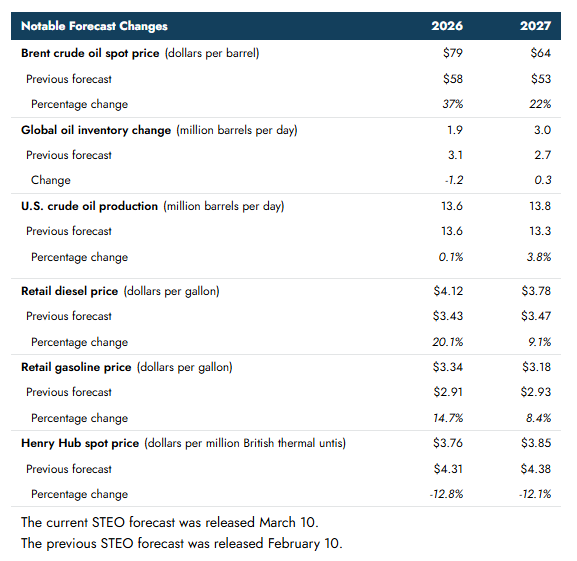
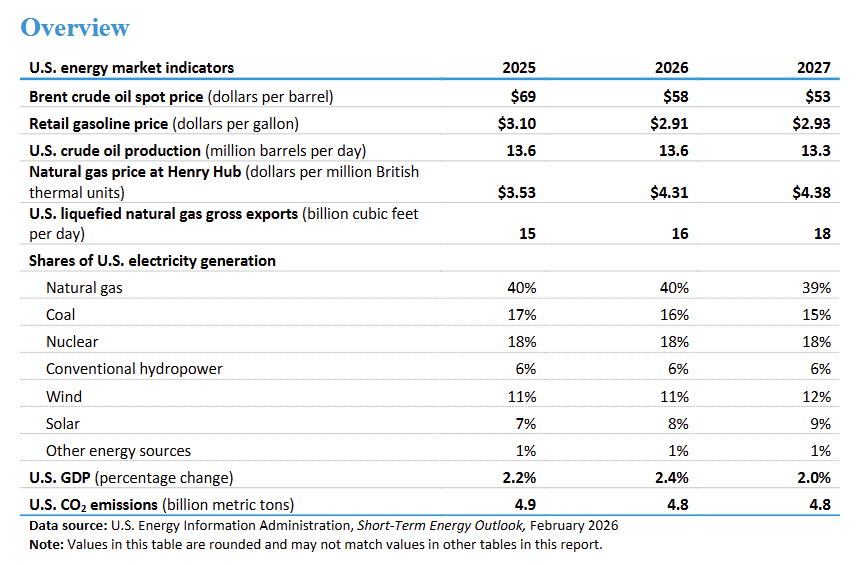
- Global oil prices. The Brent crude oil price averaged $67 per barrel (b) in January, the highest since September 2025, as weather-related events disrupted the global crude oil supply and escalating tensions with Iran put upward pressure on prices. Despite these short-term events, we expect oil prices will decline in 2026, as global oil production exceeds global oil demand, causing oil inventories to rise. Global inventories continue increasing into 2027. We forecast the Brent crude oil price will average $58 per barrel (b) in 2026 and $53/b in 2027.
- Natural gas prices. Natural gas prices rose sharply in January. The Henry Hub spot price averaged $7.72 per million British thermal units (MMBtu), up 81% from December, in response to increased heating demand, reduced production, and large inventory withdrawals as Winter Storm Fern blanketed a large portion of the United States. We now expect that the United States will finish the withdrawal season at the end of March with less than 1.9 trillion cubic feet of natural gas in storage, 8% less than previously forecast. As a result, we raised our Henry Hub spot price forecast in February and March by an average of almost 40% from the January STEO. We expect the price increases will moderate as drilling activity drives increases in natural gas production later in the forecast period. Our forecast now assumes the Henry Hub spot price will average about $4.30/MMBtu this year and almost $4.40/MMBtu in 2027.
- Natural gas production. Frigid weather conditions across the United States led to a 3% drop in U.S. natural gas production from December to January. We expect the production drop was temporary, with almost all of the production back online in February. By the second half of 2026 (2H26), we expect production to ramp up as new pipeline capacity comes online in the Permian and producers increase drilling activity in response to higher prices in 1H26. Overall, U.S. dry natural gas production in our forecast grows by 2% in 2026 and by 1% in 2027.
- Coal consumption. We raised our forecast of total U.S. coal consumption as the U.S. coal fleet increased generation to meet peak demand during recent cold weather. In January, power plants in the United States used 43 million short tons of coal, 10% more than estimated in our January STEO. We expect higher coal use to persist through 1H26 as result of higher natural gas prices over that period in this month’s forecast. Although we raised our forecast for coal consumption, we still expect the U.S. electric power sector will use about 7% less coal this year than it did in 2025.
- Electricity. Higher electricity demand in our forecast is driven by both increasing economic activity and data center growth concentrated in Texas and the mid-Atlantic regions. However, increases in electricity use in our forecast are becoming more geographically broad. This month we increased our outlook for electricity consumption in both the Central and Midwest regions because of raised expectations for data center expansion in those areas. We expect that the growing electricity demand will be met mainly through increased solar electricity generation. We expect a 17% increase in solar generation in 2026 and an additional 23% increase in 2027, and wind generation increases by 6% and 7%, respectively, over those years.
- We lowered our forecast for the Mont Belvieu propane spot price, which we now expect will average 58 cents per gallon (gal) this year and 64 cents/gal in 2027. Those forecast prices are down by 10 cents/gal and 13 cents/gal, respectively from last month’s outlook. The lower price forecast reflects our higher natural gas production forecast, which results in more propane production as well. With higher propane production we expect that propane stocks will be higher throughout the forecast period.
- We completed STEO modeling and analysis for this report on February 5, 2026, and therefore this month’s STEO report does not include the most recent updates to Petroleum Supply Monthly and Natural Gas Monthly that were published on February 6, 2026.
Forecast overview:
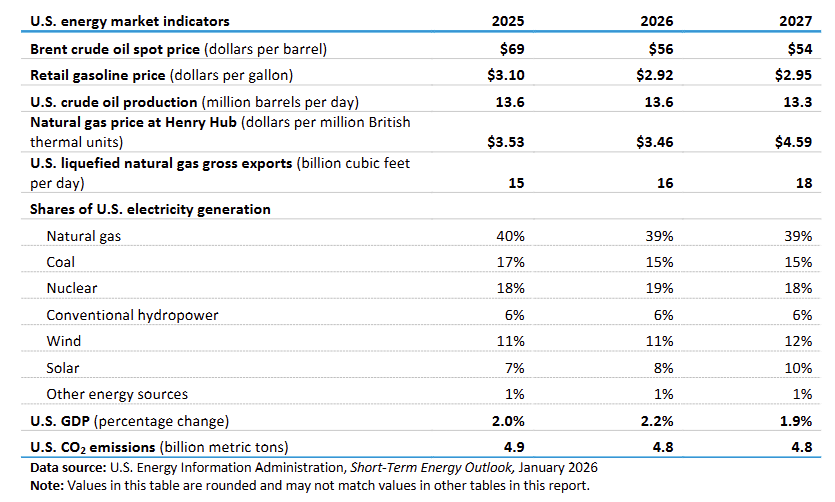
- Global oil prices. We expect oil prices will decline in 2026, as global oil production exceeds global oil demand, causing oil inventories to rise. Global inventories continue increasing into 2027, albeit at a slower pace. We forecast the Brent crude oil price will average $56 per barrel (b) in 2026, 19% less than in 2025, then average $54/b in 2027.
- Global oil production. We expect global production of liquid fuels will increase by 1.4 million barrels per day (b/d) in 2026 and 0.5 million b/d in 2027. Global liquid fuels production growth in 2026 is driven by crude oil production growth in OPEC+, while production growth in 2027 is driven by countries outside of OPEC+, primarily in South America. Our forecast assumes existing sanctions on Venezuela remain in place through 2027.
- U.S. crude oil production. After reaching an annual record of 13.6 million b/d in 2025, we forecast U.S. crude oil production will decrease in the forecast, declining by less than 1% in 2026 and by 2% in 2027. With sustained lower crude oil prices, we expect crude oil production will decrease as the slowdown in drilling activity will outpace increases in drilling productivity. The West Texas Intermediate price averages $52/b in 2026 and $50/b in 2027 in our forecast, down from $65/b in 2025.
- U.S. gasoline prices. Retail gasoline prices in our forecast for 2026 and 2027 are lower compared with 2025, which largely reflects our forecast of lower crude oil prices. We forecast U.S. gasoline prices in 2026 will average just over $2.90 per gallon (gal), a decrease of nearly 20 cents/gal from 2025. In 2027, we forecast prices to remain mostly flat at an annual average of just over $2.90/gal.
- Natural gas prices. We expect the spot price of natural gas at Henry Hub to average just under $3.50 per million British thermal units (MMBtu) in 2026, down 2% from 2025, and average $4.60/MMBtu in 2027. Natural gas prices increase in our forecast because growth in demand—led by expanding liquefied natural gas exports and more natural gas consumption in the electric power sector—will outpace production growth.
- Electricity consumption. We forecast electricity consumption will grow by 1% in 2026 and 3% in 2027, marking the first four years of consecutive growth since 2005–07, and the strongest four-year period of growth since the turn of the century. Rising electricity consumption in our forecast is mostly the result of growing power demand in the commercial and industrial sectors.
- Electricity generation. Solar power supplies the largest increase in power generation in the forecast. We expect 69 gigawatts of solar capacity additions during the forecast period, leading to a 21% increase in solar generation during both 2026 and 2027. We expect natural gas generation will remain flat in 2026 and rise by 1% in 2027. Generation from coal-fired power plants falls by 9% in 2026, followed by a less than 1% decrease in 2027.
The EIA’s December STEO projects Brent crude to average $55/b in early 2026 (little changed) and Henry Hub natural gas to average almost $4.30/MMBtu this winter (+$0.40 vs the November forecast), reflecting colder weather and rising inventories as key drivers of the near term outlook.
-
Global oil inventories are expected to continue rising through 2026, keeping downward pressure on crude prices, though OPEC+ production restraint and China’s ongoing inventory builds are expected to limit the scale of price declines.
-
Henry Hub natural gas prices were revised up for winter 2025–26, with the spot price now forecast near $4.30/MMBtu due to colder than expected December weather; prices are projected to ease to about $4.00/MMBtu in 2026 as milder early year temperatures and rising output temper demand.
-
U.S. electricity generation is forecast to grow +2.4% in 2025 and +1.7% in 2026, driven largely by surging data center demand in ERCOT and PJM regions; the 2026 forecast is lower than last month’s due to a slower observed pace of large load additions.
-
Coal consumption is expected to increase +9% in 2025, led by an +11% rise in electric power sector usage amid higher natural gas costs and stronger electricity demand; consumption is projected to decline in 2026 as renewable generation expands.
-
Coal production is expected to fall by less than consumption in 2026, supporting modest growth in exports and contributing to rising secondary coal inventories.
-
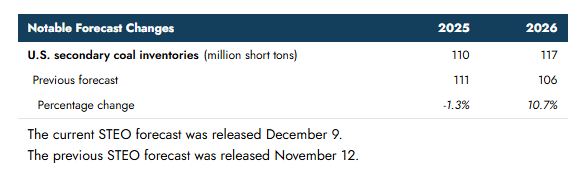
The STEO raises 2026 U.S. secondary coal inventories to 117 million short tons (+10.7% vs prior forecast), while the 2025 inventory projection was trimmed to 110 million short tons (-1.3%), reflecting updated expectations for supply balances heading into the mid 2020s.
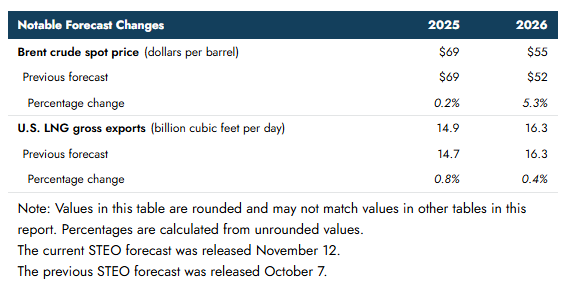
The EIA’s November STEO slightly raised 2026 energy price and export projections while maintaining expectations for broadly softer oil markets and steady LNG growth.
-
Brent crude is forecast to average $69/b in 2025 (unchanged) and $55/b in 2026 (+5.3% vs prior forecast), as updated assumptions on Chinese inventories and Russian sanctions temper expected price declines.
-
U.S. LNG exports are projected at 14.9 Bcf/d in 2025 (+0.8% vs prior) and 16.3 Bcf/d in 2026 (+0.4%), reflecting faster-than-expected ramp-up at Plaquemines LNG and continued export capacity expansion.
-
The EIA expects global oil inventories to rise through 2026, keeping prices under pressure despite the modest upward revision to Brent.
-
U.S. gasoline and diesel prices are forecast to decline through 2026, with gasoline averaging below $3.00/gal (-10% vs 2024) and diesel $3.50/gal (-7%), tracking lower crude benchmarks.
-
Henry Hub natural gas is projected to average $3.90/MMBtu in winter 2025–26 and $4.00 in 2026 (+16% YoY), driven by higher LNG exports amid flat production growth.
-
Electricity demand is expected to rise +2.4% in 2025 and +2.6% in 2026, led by strong load growth in Texas and the West South Central region from data centers and crypto mining.
-
Coal production is forecast to remain above 500 MMst in 2026, about 15 MMst higher than previously projected, supported by mine reopenings in Appalachia and slower inventory drawdowns.
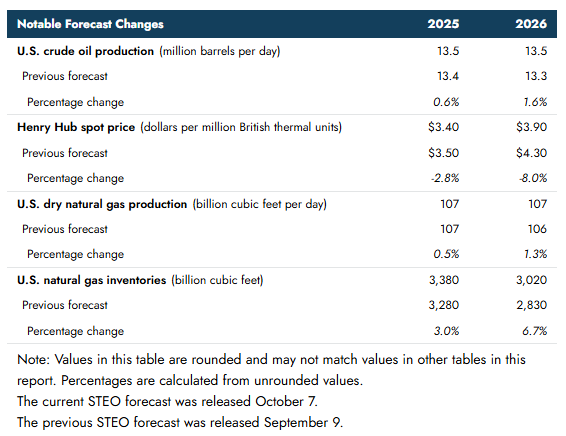
U.S. crude oil and natural gas forecasts were revised modestly in the latest STEO, reflecting higher starting production levels and rising inventories alongside lower price expectations for 2026.
-
U.S. crude oil production is forecast at 13.5 mb/d in both 2025 and 2026, up 0.6% and 1.5% respectively from prior forecasts. July output reached a record high above 13.6 mb/d, prompting upward revisions, especially in the Gulf of Mexico.
-
Henry Hub spot price is now projected at $3.40/MMBtu in 2025 (-2.8% vs prior) and $3.90 in 2026 (-8.0%), reflecting expectations of higher domestic supply and storage.
-
U.S. dry natural gas production remains steady at 107 Bcf/d for both 2025 and 2026, with small upward revisions (+0.5% and +1.3%) tied to expanding LNG capacity and continued drilling efficiency.
-
U.S. natural gas inventories are forecast at 3,380 Bcf in 2025 (+3.0%) and 3,020 Bcf in 2026 (+6.7%), signaling higher storage levels from robust output.
-
Global oil prices are expected to decline, with Brent crude averaging $62/b in Q4 2025 and $52/b in 2026, as global supply growth—particularly from non-OPEC+ producers—drives inventory accumulation.
-
LNG export capacity is set to rise by 5 Bcf/d through 2026, lifting total exports to 16.3 Bcf/d, led by new projects at Plaquemines and Corpus Christi.
-
Coal consumption in the power sector rose 15% YoY in 1H25 but is expected to slow to +4% in 2H25 before falling -3% in 2026, as solar generation expands despite firmer gas prices.