

NOAA Global Climate Report: June 2026
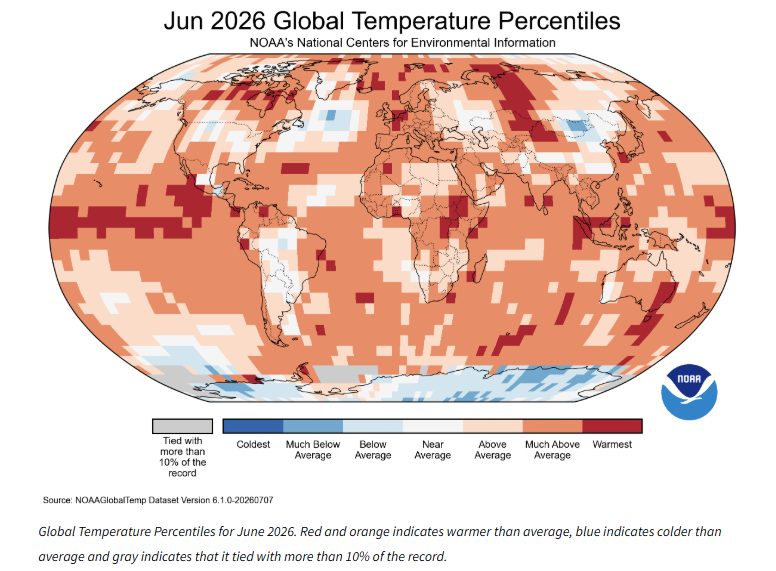
June 2026 was the second-warmest June on record globally, extending the long-running trend of elevated global temperatures. Record ocean warmth and historically low sea ice continued to characterize the global climate, while tropical cyclone activity ran above average.
- Global surface temperatures were +1.09°C (+1.96°F) above the 20th-century average, making June 2026 the second-warmest June in records dating back to 1850, behind only 2024. The month also marked the 50th consecutive June with above-average global temperatures, with the last cooler-than-average June occurring in 1976.
- Global ocean surface temperatures reached a record high for June, while land temperatures ranked as the 4th warmest on record. The Arctic experienced its warmest June on record, while North America, Europe and Africa each recorded their 2nd-warmest June.
- The first half of 2026 also remained exceptionally warm. January-June ranked as the 3rd-warmest start to a year on record, with NOAA indicating it is very likely that 2026 will finish among the five warmest years ever recorded.
- Sea ice remained well below normal. Global sea ice extent ranked as the 4th smallest June in the satellite record, with the Arctic recording its 3rd-lowest June extent and the Antarctic its 6th lowest.
- Global tropical cyclone activity was above average during June, with 7 named storms worldwide. Activity included Super Typhoon Mekkhala, which reached Category 4-equivalent intensity, while Tropical Storm Arthur brought heavy rain to portions of the U.S. Gulf Coast and Southeast.
- Assessing the Global Temperature and Precipitation Analysis in June 2026