

NOAA Global Climate Report: July 2026
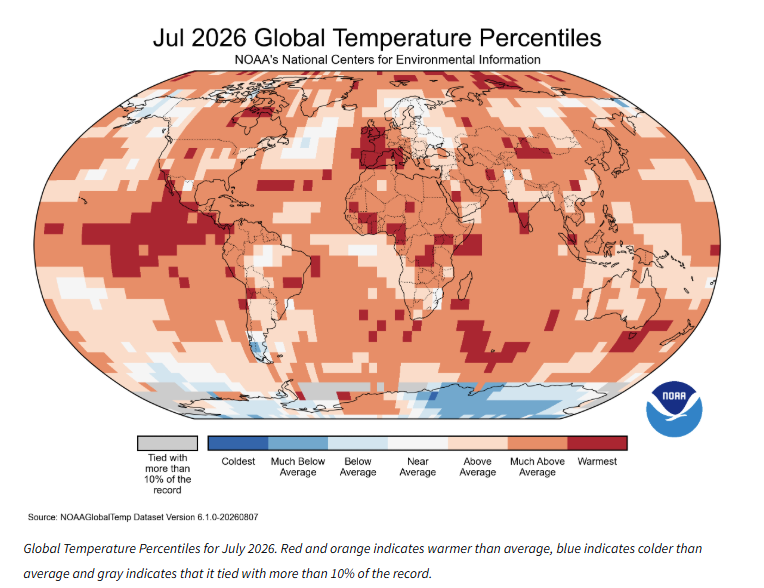
July 2026 tied 2024 as the warmest July on record globally, with surface temperatures +1.18°C (+2.12°F) above the 20th-century average and global ocean temperatures reaching a record high for the month, extending the run of exceptionally elevated global temperatures.
-
Global surface temperatures were +1.18°C (+2.12°F) above the 20th-century average, tying July 2024 for the warmest July on record. The past four Julys (2023–2026) were the four warmest on record, and July 2026 marked the 55th consecutive July above the 20th-century average.
-
Global ocean temperatures reached a record high for July at +1.02°C (+1.84°F) above average, making 2026 the first July with an ocean temperature departure above +1.0°C and tying August and September 2023 for the third-highest monthly ocean departure on record.
-
Global land temperatures ranked as the third warmest July on record, while Northern Hemisphere land temperatures set a new July record. Record-high temperatures were widespread across parts of Europe, the Americas, Africa, Asia, the Arctic and every major ocean basin.
-
North America, Africa and Asia each recorded their warmest July on record, while the Arctic had its third warmest, South America its sixth warmest, Europe tied for seventh warmest and Oceania ranked eighth warmest. Antarctica was the only major region with below-average temperatures.
-
January–July global surface temperatures ranked as the third warmest on record. NOAA said it is very likely that 2026 will finish among the five warmest years on record, with the highest probabilities centered on third or fourth warmest, while a strengthening El Niño could add further upward pressure later in the year.
-
Global sea ice extent averaged 8.77 million square miles, 810,000 square miles below the 1991–2020 average and the fourth-lowest July extent in the 48-year satellite record. Arctic sea ice ranked sixth lowest and Antarctic sea ice fifth lowest for July.
-
Tropical cyclone activity was near normal, with nine named storms globally, including five that reached cyclone strength and three that became major cyclones. All three Category 5 storms occurred in the Pacific.
-
Notable storms included Tropical Storm Bertha in the Atlantic, Category 5 Hurricane Genevieve in the East Pacific and Category 5-equivalent Super Typhoon Bavi in the West Pacific, highlighting active but broadly near-average global tropical cyclone activity.
-
Assessing the Global Temperature and Precipitation Analysis in July 2026