

Conference Board Employment Trends Index: March 2026
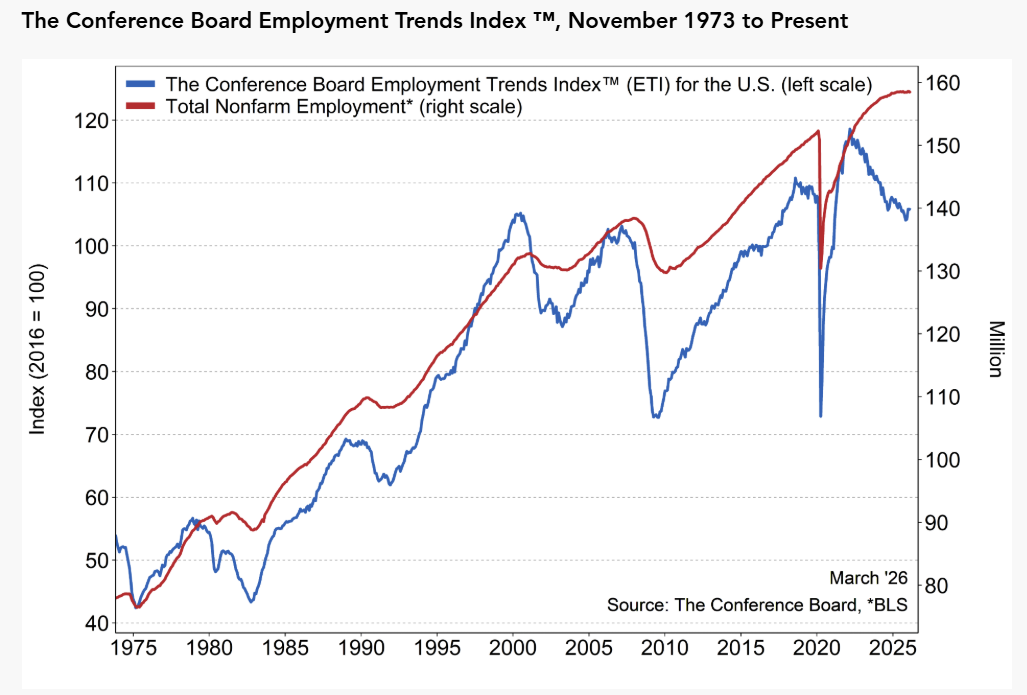
The Conference Board Employment Trends Index declined -0.12 pts MoM to 105.72 in March (from 105.84 in February), signaling a slight softening in a leading indicator of payroll employment amid a still resilient labor market.
-
The ETI fell to 105.72 in March from an upwardly revised 105.84 in February (-0.12 pts MoM), indicating a modest pullback in the composite measure that signals future employment trends.
-
Five of eight components contributed negatively, including the share of involuntary part-time workers, firms unable to fill positions, perceptions that jobs are hard to get, industrial production, and real manufacturing and trade sales, pointing to broad-based softening across labor and activity indicators.
-
The share of consumers reporting jobs are “hard to get” rose to 21.5% in March (+5 ppts YoY vs March 2025), highlighting a deterioration in job availability perceptions.
-
The share of small firms reporting positions they cannot fill declined -1 ppt to 32%, suggesting some easing in hiring constraints relative to prior months.
-
The share of involuntary part-time workers increased to 16.5% in March, though it remains below 19.4% in December, indicating a recent uptick but improvement over recent peaks.
-
Initial jobless claims declined to 207,800, continuing a steady improvement from the 2025 average of 226,450, providing a positive contribution to the index and signaling fewer layoffs.
-
Employment in temporary help services increased marginally in March and in three of the past five months, contributing positively and suggesting some stabilization in short-term hiring demand.
-
Industrial production and real manufacturing and trade sales were described as steady but still contributed negatively to the index, reflecting limited momentum in broader economic activity.