


China NBS PMIs: April 2025
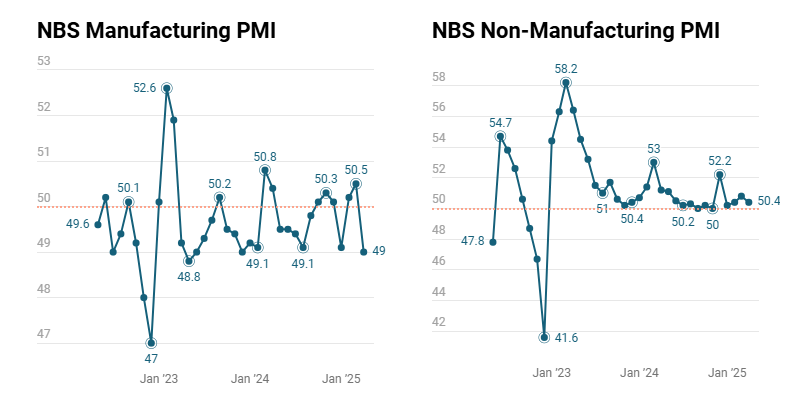
China’s NBS Manufacturing PMI fell -1.5 pts to 49.0 (vs 49.8 expected) in April, signaling a contraction in factory activity that was the worst since December 2023.
- The Production Index dropped -2.8 pts to 49.8, and New Orders fell -2.6 pts to 49.2, both slipping back into contraction.
- Notably, the Export Orders Index dropped -4.3 pts to 44.7, the weakest since December 2022, as a result of US tariffs slowing US-China trade.
- The Imports Index also fell, down -4.1 pts to 43.4, also the weakest since December 2022.
- Employment weakened, with the Employment Index down -0.3 pts to 47.9, while Inventories of Raw Materials remained weak at 47.0.
- The Supplier Delivery Time Index held just above the 50 mark at 50.2, indicating slightly faster deliveries.
- All enterprise sizes (large, medium, small) reported PMIs below 50, with large firms at 49.2 and small firms at 48.7.
China’s Non-Manufacturing PMI declined -0.4 pts to 50.4 (vs 50.7 expected) in April, still above the expansion threshold, but momentum weakened across sectors.
- Construction Business Activity fell -1.5 pts to 51.9; Services edged down -0.2 pts to 50.1.
- New Orders Index fell sharply to 44.9 (-1.7 pts), with construction orders plunging to 39.6.
- The New Export Orders Index crashed -7.6 pts to 42.2, signaling a sharp contraction and the lowest reading since April 2020.
- Input Prices (47.8) and Sales Prices (46.6) declined, reflecting softening pricing power.
- Employment Index dropped to 45.5, as construction hiring fell sharply (-3.6 pts to 37.8).
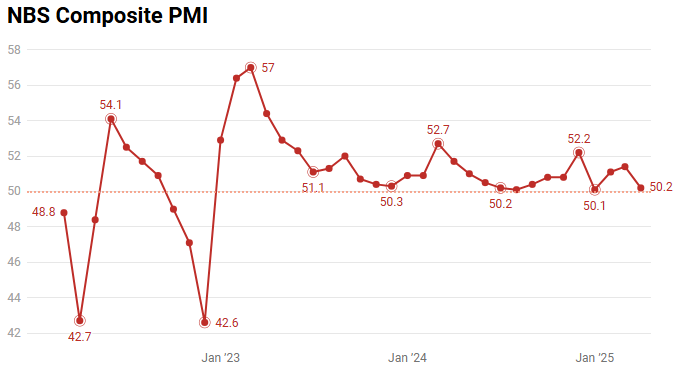
The Composite PMI Output Index fell -1.2 pts to 50.2 in April, suggesting continued but marginal growth in business activity across sectors.