

NY Fed Survey of Consumer Expectations: February 2026
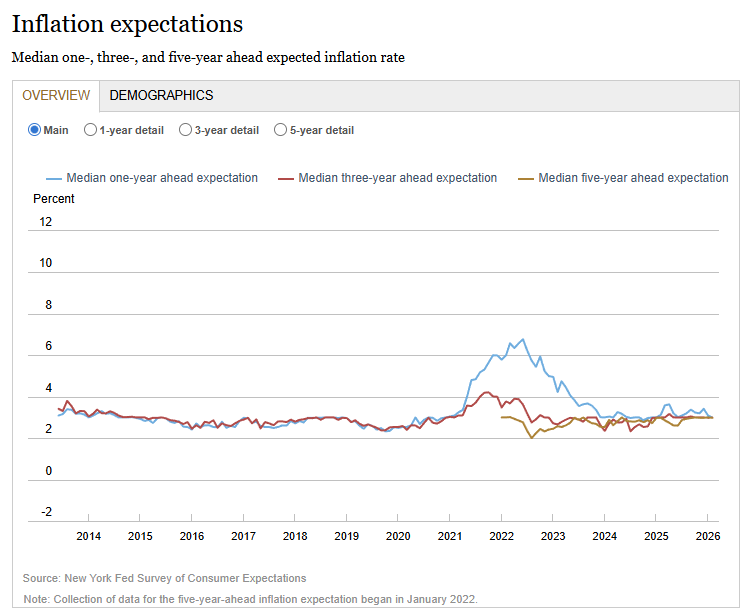
U.S. households’ one-year-ahead inflation expectations eased to 3.0% (-0.1 ppt MoM) in February 2026, while medium- and longer-term expectations held steady at 3.0%, indicating stable inflation outlooks with slightly softer short-term views.
-
Median one-year-ahead inflation expectations declined to 3.0% (-0.1 ppt MoM), while three-year and five-year expectations remained unchanged at 3.0%, suggesting that short-term inflation expectations softened slightly while longer-term expectations remained stable.
-
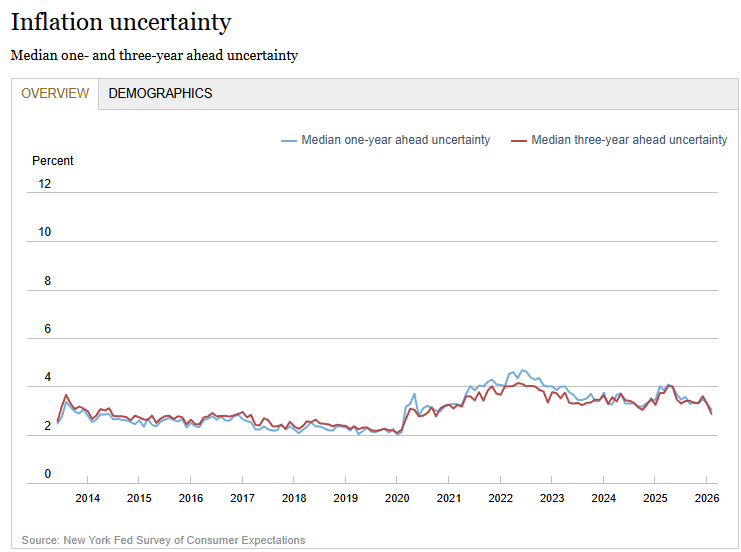
Measures of disagreement and uncertainty around inflation expectations both declined across all horizons, indicating that households’ views about future inflation became more aligned and less uncertain during the month.
-
Median home price growth expectations edged up to 3.0% (+0.1 ppt MoM), bringing the measure in line with its trailing 12-month average and suggesting stable expectations for housing price growth.
-
Year-ahead commodity price expectations declined for several categories, including food to 5.3% (-0.4 ppt), medical care to 9.7% (-0.1 ppt), and rent to 5.9% (-0.9 ppt), with the rent expectation reaching its lowest level since December 2024.
-
In contrast, expectations for gasoline prices increased to 4.1% (+1.3 ppts), while expected college cost inflation edged up to 9.1% (+0.1 ppt), indicating divergence across major household spending categories.
-
Labor market expectations softened modestly as median one-year-ahead earnings growth expectations fell to 2.5% (-0.2 ppt MoM), slightly below the trailing 12-month average of 2.6%.
-
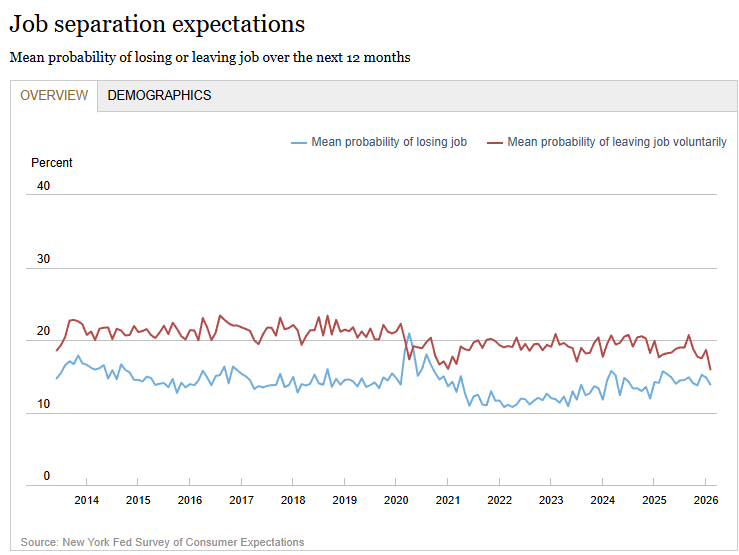
The mean perceived probability of job loss declined to 13.8% (-1.0 ppt MoM), while the probability that the unemployment rate will be higher one year ahead fell to 39.9% (-2.0 ppts), indicating some improvement in perceived labor market stability.
-
The probability of voluntarily leaving a job fell sharply to 15.9% (-2.8 ppts), a series low, while the probability of finding a job within three months if displaced declined to 44.0% (-1.6 ppts), highlighting weaker confidence in re-employment prospects.
-
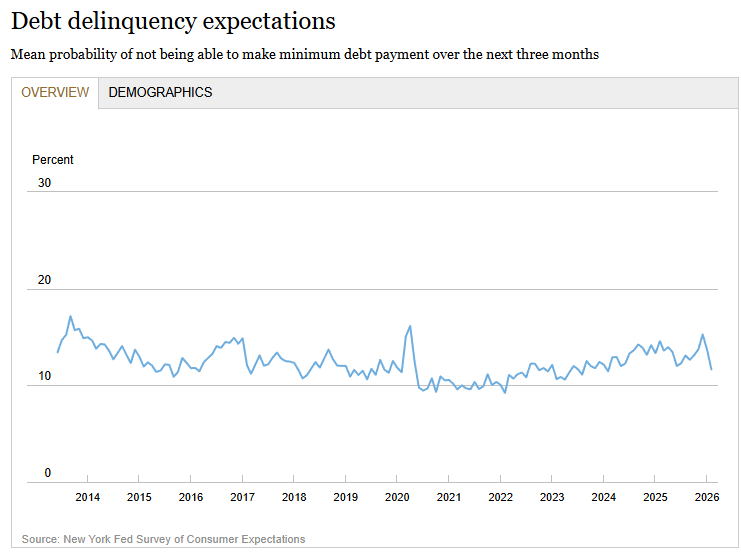
Household financial expectations were mixed: expected income growth remained unchanged at 2.9%, spending growth expectations held at 4.9%, and the perceived probability of missing a minimum debt payment fell to 11.6% (-2.1 ppts), the lowest since February 2024.