


US Employment Situation: February 2026
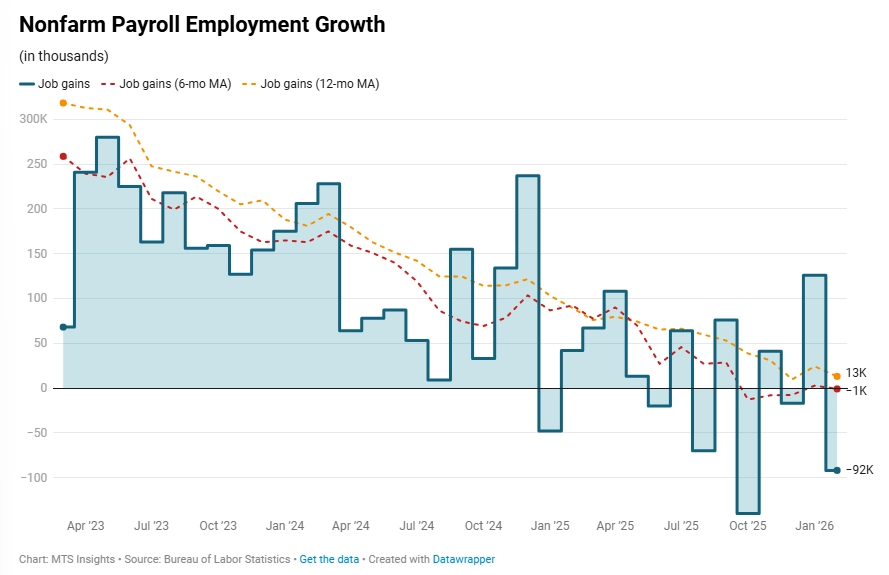
U.S. nonfarm payroll employment fell -92,000 in February while the unemployment rate rose +0.1 ppt to 4.4%, signaling a clear slowdown in labor market momentum after stronger hiring earlier in the year.
-
Nonfarm payrolls declined -92,000 in February versus expectations for +59,000, marking the worst monthly job loss since October 2025 (-140,000) and the second weakest reading since December 2020.
-
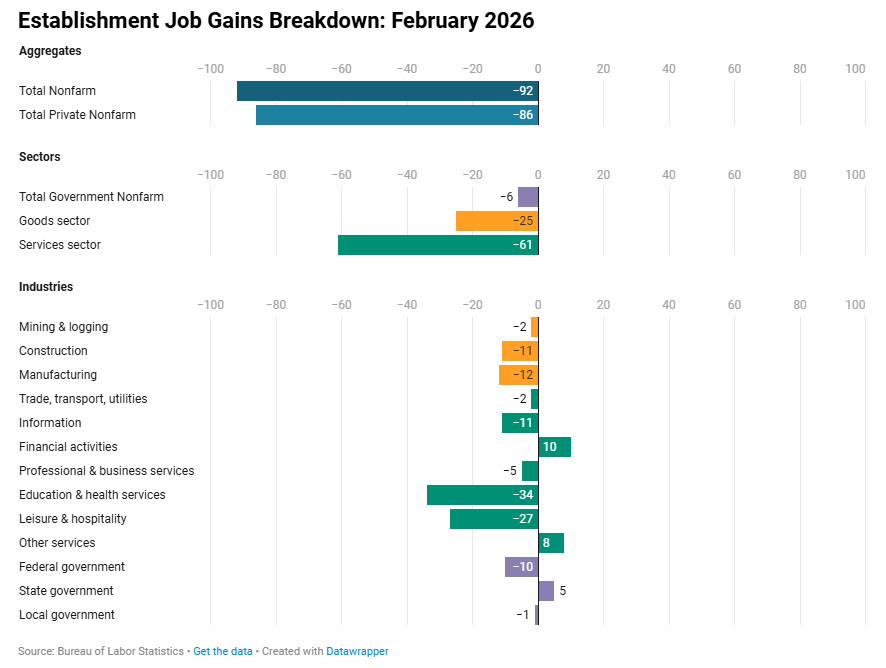
Private sector employment fell -86,000, the largest decline since December 2020, with job losses occurring across most industries.
-
Goods-producing employment declined -25,000 in February, including construction (-11,000) and manufacturing (-12,000), bringing total goods sector job growth over the past three months to -5,000.
-
Services employment dropped -61,000 after rising +95,000 in January, with major declines in education & health services (-34,000), leisure & hospitality (-27,000), information (-11,000), and transportation & warehousing (-11,300).
-
A strike in physician offices reduced health care employment by -37,000; excluding this effect would raise the education & health services change to +3,000 and adjust total payroll losses to roughly -55,000.
-
Government employment declined -6,000 in February, including a -10,000 drop in federal jobs; federal employment is now down -330,000 from its October 2024 peak, a decline of more than -10%.
-
Revisions lowered prior payroll estimates by a combined -69,000, with December revised from +48,000 to -17,000 and January reduced -4,000 to +126,000.
-
The three-month average payroll gain slowed to +6,000 while the six-month average turned negative at -1,000, indicating a notable loss of hiring momentum.
-
The unemployment rate increased to 4.4% (+0.1 ppt MoM), with employment falling -185,000 and unemployment rising +203,000 while the labor force increased only +18,000.
-
The labor force participation rate declined -0.1 ppt to 62.0% and the employment-population ratio fell -0.1 ppt to 59.3%, reflecting fewer individuals employed relative to the population.
-
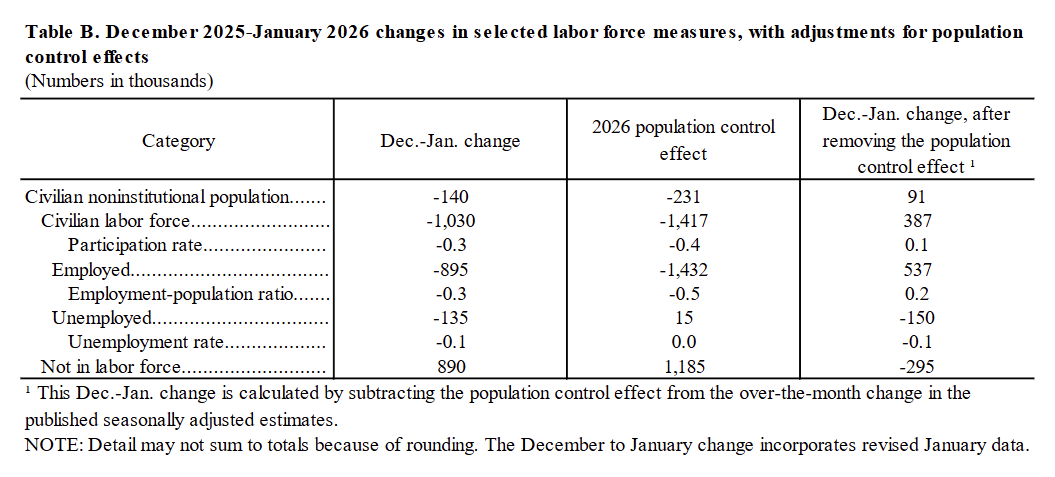
Annual population revisions lowered both the labor force and employment levels by about -1.4 million, while leaving the unemployment rate trend largely unchanged.
-
Participation among workers aged 55+ declined to 37.3%, the lowest since 2005, while prime-age participation (25–54) remained relatively stable despite the broader demographic adjustments.
-
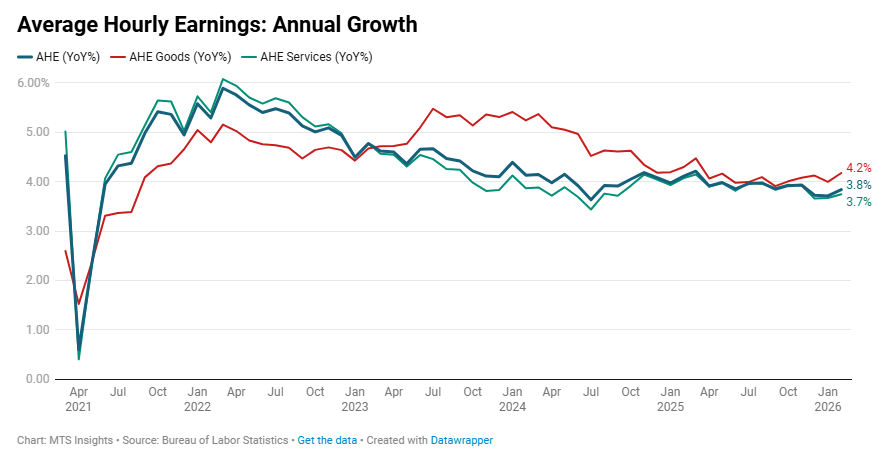
The annual growth in average hourly earnings accelerated slightly from 3.7% YoY in January to 3.8% YoY in February, with goods wage growth up to 4.2% YoY, the highest since March 2025.