

Logistics Managers’ Index: January 2026
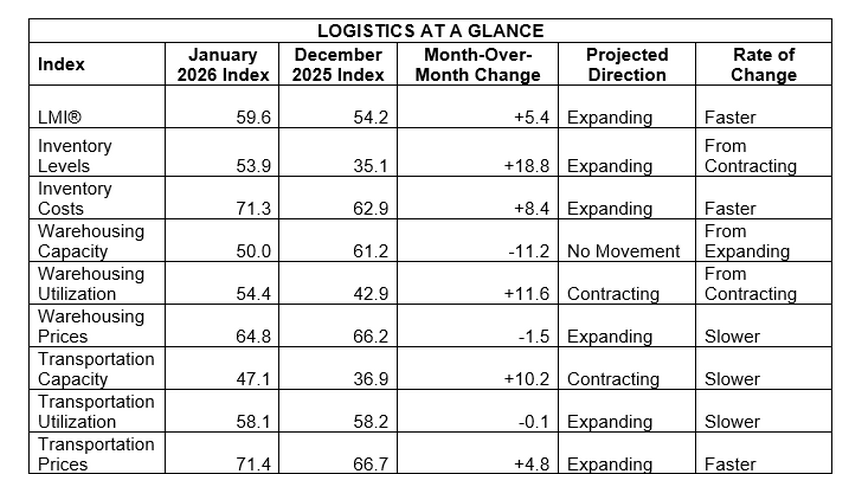
The Logistics Manager’s Index rose to 59.6 in January 2026 (+5.2 pts MoM) but was -2.4 pts lower YoY, reflecting a rebound from December’s low as firms began mild restocking.
-
The headline LMI increased to 59.6 (Dec: 54.2, +5.2 pts MoM), the fastest expansion since May but the 11th straight reading below the all time average (61.3), pointing to steady but slightly below trend logistics growth.
-
Inventory Levels swung to 53.9 (Dec: 35.1, +18.8 pts), rebounding from the lowest ever December reading and signaling restocking that the report characterizes as unusually mild for January.
-
Inventory Costs jumped to 71.3 (Dec: 62.9, +8.4 pts) and moved back above the 70 threshold for the 12th time in 13 months, indicating costs rose much faster than physical inventory volumes.
-
Warehousing Capacity dropped to 50.0 (Dec: 61.2, -11.2 pts) and was described as no movement, while Warehousing Utilization rose to 54.4 (Dec: 42.9, +11.6 pts), consistent with warehousing tightening as inventory flows resumed.
-
Transportation Capacity remained in contraction at 47.1 (Dec: 36.9, +10.2 pts), showing constraints eased versus December but did not fully return to neutral, with larger firms reporting tighter capacity than smaller firms.
-
Transportation Prices increased to 71.4 (Dec: 66.6, +4.8 pts), the strongest expansion since April 2022, aligning with continued capacity tightness and higher freight demand.
-
Forward expectations held elevated, with the 12 month outlook for the overall index at 65.8 (Dec: 65.3, +0.5 pts) and respondents projecting significant cost growth across Inventory Costs (74.2), Warehousing Prices (74.5), and Transportation Prices (79.5), suggesting continued logistics inflation pressure in the year ahead.