

Logistics Managers’ Index: December 2025
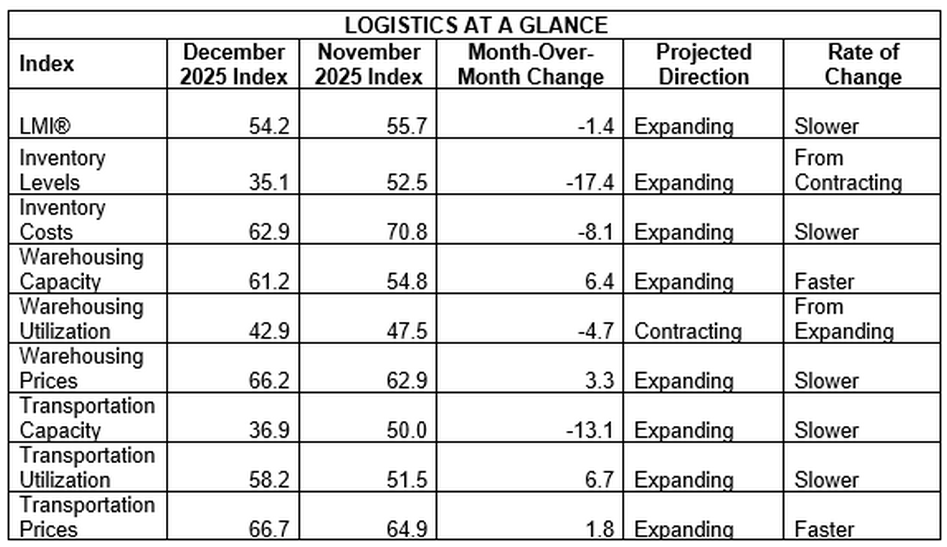
The December Logistics Manager’s Index eased to 54.2 (from 55.7 in November), marking the slowest expansion since April 2024 amid an extreme inventory drawdown and softer warehousing conditions.
-
The headline LMI fell -1.5 pts MoM to 54.2, remaining in expansion but logging its tenth consecutive reading below the long-run average of 61.4, with most of the drag coming from inventory and warehousing components.
-
Inventory Levels collapsed to 35.1 (from 52.5, -17.4 pts), the largest MoM decline in the history of the index, indicating an unprecedented drawdown as firms pushed goods downstream to meet strong holiday demand.
-
Inventory Costs slowed but stayed firmly expansionary at 62.9 (from 71.0, -8.1 pts), showing that carrying and handling costs continued to rise even as physical inventory volumes fell sharply.
-
Warehousing Utilization dropped to a second consecutive all-time low at 42.9 (from 47.6, -4.7 pts), while Warehousing Capacity rose to 61.2 (from 54.8, +6.4 pts), pointing to looser space conditions amid destocking.
-
Warehousing Prices continued to increase at a strong pace, rising to 66.2 (+3.3 pts), remaining the only LMI component that has never contracted since the index’s inception.
-
Transportation Capacity moved back into contraction at 36.9 (from 50.0, -13.1 pts), its lowest level since October 2021, signaling a sharp tightening in available freight capacity during peak holiday activity.
-
Transportation Utilization expanded to 58.2 (+6.7 pts) and Transportation Prices climbed to 66.7 (+1.8 pts), the fastest price expansion since January, reflecting strong seasonal freight demand despite lower diesel prices.
-
Forward-looking expectations rose, with respondents projecting the overall LMI at 65.3 in 12 months, alongside moderate inventory rebuilding but persistently high inventory, warehousing, and transportation costs in 2026.