


US GDP: Q3 2025 (Initial Estimate) (DELAYED)
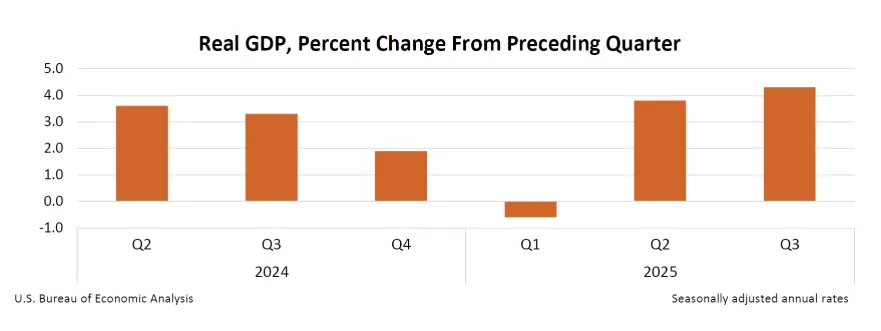
Third-quarter economic growth smashed expectations and blew by the Atlanta Fed’s forecast this morning. Real GDP expanded at a seasonally adjusted annual rate (SAAR) of 4.3% in Q3 2025, the strongest growth since Q3 2023 and above expectations of a print around 3.3% (analysts’ consensus) to 3.5% (Atlanta Fed nowcast). Growth was led by consumer spending, while investment was a very minor drag, and the contribution from trade was positive. Let’s dive into the details.
GDP Segments
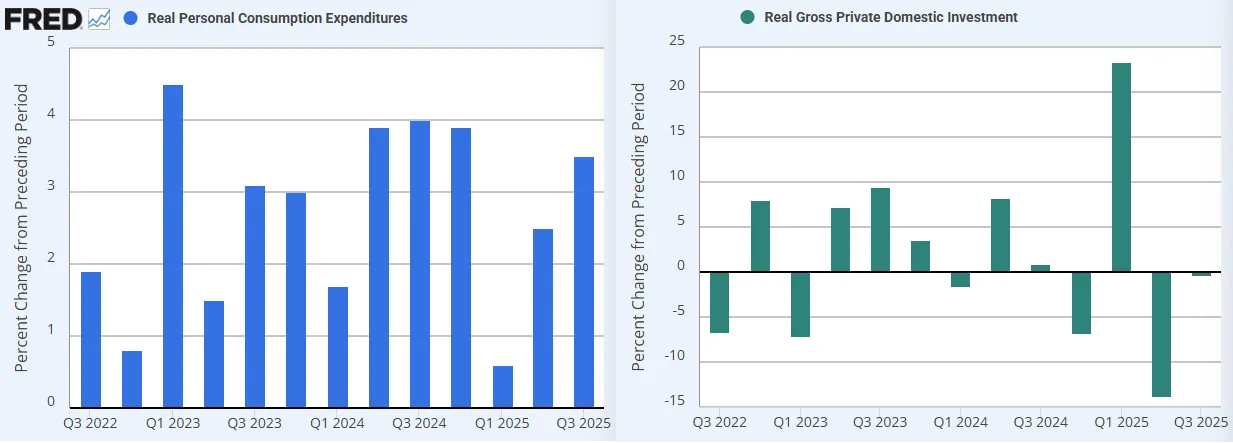
The consumer was the star in Q3 2025 as personal consumption expenditures increased at a SAAR of 3.5%, the strongest so far this year and only slightly trailing behind PCE growth in the last three quarters of 2024. Spending was strong across both goods and services, which saw growth rates of 3.1% and 3.7%, respectively. Notably, the pace of services spending was the strongest since Q3 2022. The contribution of consumer spending to overall GDP growth was 2.39 ppts, the largest contributor of the main GDP segments. The Q3 result speaks to the resiliency of the consumer who has faced many headwinds this year.
While consumer spending was robust, the private domestic investment data left a lot to be desired. The segment was basically unchanged in Q3, declining at a SAAR of -0.3%, which is the second straight quarterly contraction. The real estate sector was a drag on growth for the third straight quarter as residential investment fell -5.1%, offsetting nonresidential investment growth of 2.8%. Within non-residential investment, equipment (+5.4%) and intellectual property (+5.4%) saw solid growth, dampened by a weakening in investment in structures (-6.3%) for the seventh straight quarter. Technology investment led once again in Q3, with information processing (+$12.5 billion) and R&D (+$14.0 billion) leading in the raw investment numbers.
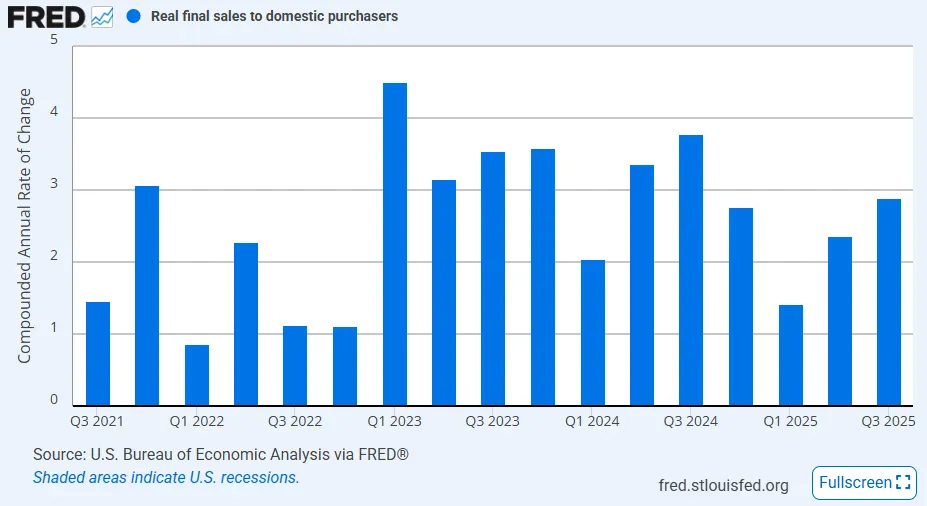
The interplay of inventory and trade were sources of volatility in Q1 and Q2 growth data, but the dynamics in Q3 were not as drastic. Net trade contributed 1.59 ppts to GDP growth as exports expanded at a SAAR of 8.8% and imports fell at a SAAR of -4.7%. This was slightly offset by a -$11.4 billion drop in private inventories, which contributed -0.22 ppts to growth. Excluding the positive contribution by trade, we see final sales to domestic purchasers growth at 2.9%, slower than the headline real GDP growth but still the strongest so far this year.
Price Indexes
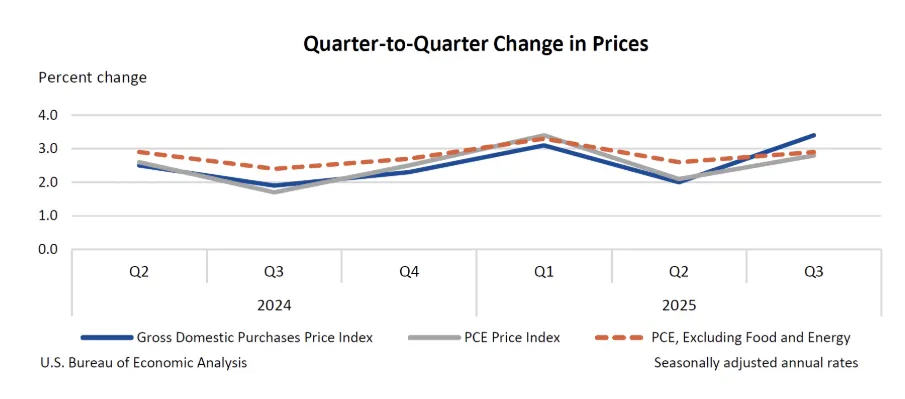
GDP data also comes with some price indexes, though these updates will be basically obsolete in the context of the current inflation outlook. The gross domestic purchases price index increased at a 3.4% annualized rate and was up 2.7% YoY in Q3 2025, accelerating from 2.3% YoY in Q2 to the highest level since Q3 2023. The Fed’s preferred inflation gauge, the core PCE price index, grew at a slower annualized pace of 2.9% and saw an acceleration from 2.7% YoY in Q2 to 2.9% YoY in Q3. These data points suggest that pricing pressures saw a significant increase in Q3 2025, which may or may not be traced back to tariffs. Indeed, the strong consumer spending impulse in the quarter could have been the source of upward pressure from the demand side.
Corporate Profits
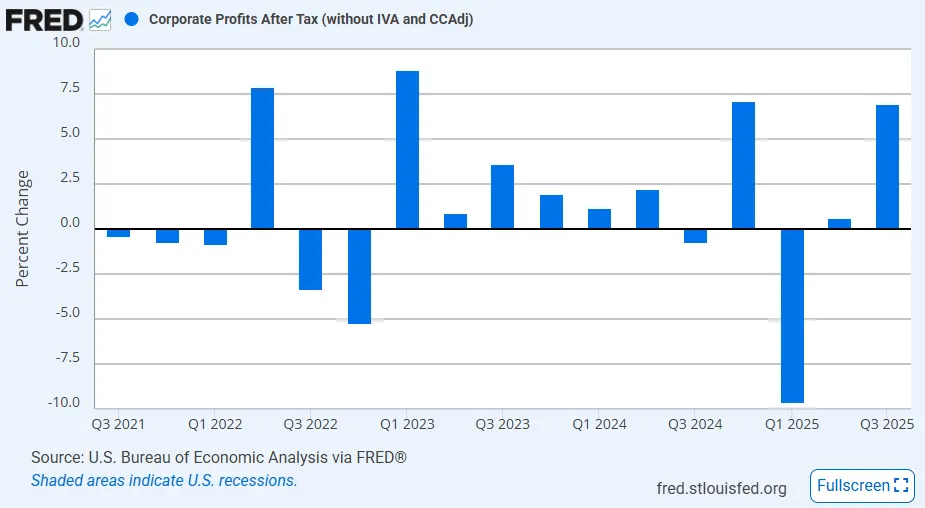
Since this first GDP report was not the advance estimate and more consistent with the traditional first revision, it included corporate profit data for Q3 2025. The data showed a strong $166.1 billion increase in overall corporate profits, well above the $6.8 billion gain in Q2 and the -$47.8 billion contraction in Q1. Domestic profits (after inventory adjustments) increased by $154.3 billion, with financial profits up $54.0 billion and nonfinancial profits up $100.4 billion. Overall, it is clear that corporations enjoyed a solid quarter of profits. After tax, inventory-adjusted profits increased 7.0% QoQ and were up 4.2% YoY.