

Logistics Managers’ Index: October 2025
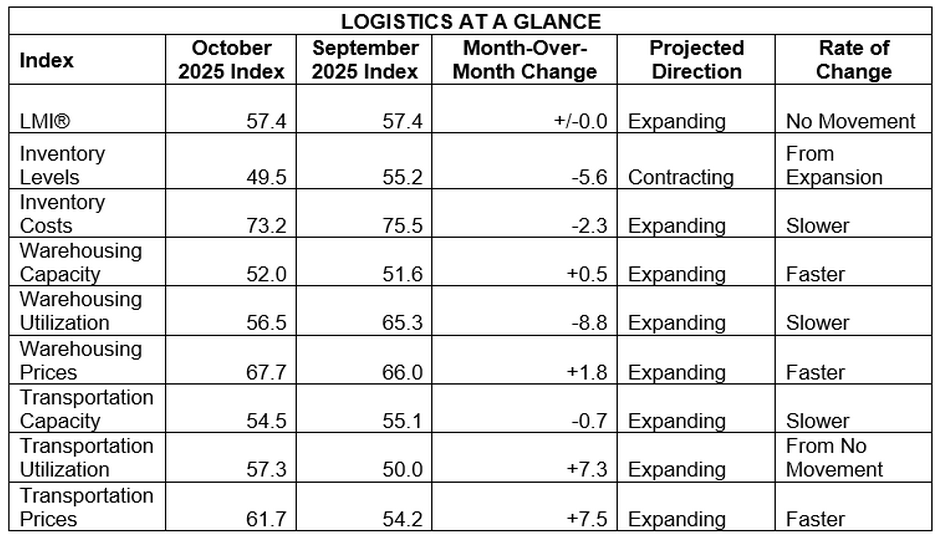
The Logistics Managers’ Index held steady at 57.4 in October 2025 (unchanged MoM), reflecting offsetting trends of easing inventory and warehousing activity balanced by a sharp rebound in transportation.
-
Inventory Levels fell -5.6 pts to 49.5, entering contraction as goods move downstream for holiday sales.
-
Inventory Costs decreased -2.3 pts to 73.2, still signaling strong upward cost pressure despite lower volumes.
-
Warehousing Capacity rose +0.5 pts to 52.0, a slight loosening consistent with reduced storage demand.
-
Warehousing Utilization dropped -8.8 pts to 56.5, indicating slower growth in warehouse usage.
-
Warehousing Prices increased +1.8 pts to 67.7, suggesting pricing remains firm despite marginally softer utilization.
-
Transportation Capacity slipped -0.7 pts to 54.5, showing slower expansion.
-
Transportation Utilization jumped +7.3 pts to 57.3, reflecting a surge in freight movement late in the month.
-
Transportation Prices rose +7.5 pts to 61.7, ending the two-month negative freight inversion as demand picked up.
-
Downstream retailers led the rebound, with Transportation Prices at 70.0 versus 56.4 upstream, as consumer demand drove seasonal freight flows.
-
The LMI remained below its long-run average (61.4) for the eighth consecutive month, though late-October readings showed stronger expansion at 60.3.
-
Researchers noted this pattern mirrors 2018’s seasonal dynamics, when downstream freight held steady despite upstream weakness tied to tariffs.
-
The report suggests inventories are finally being drawn down, easing warehousing tightness and reviving transportation activity, bringing logistics flows back to a more “dynamic, seasonally consistent” pattern.
-
Respondents expect the overall LMI to rise to 64.6 over the next year, anticipating leaner inventories but stronger price growth across costs, warehousing, and transportation.