


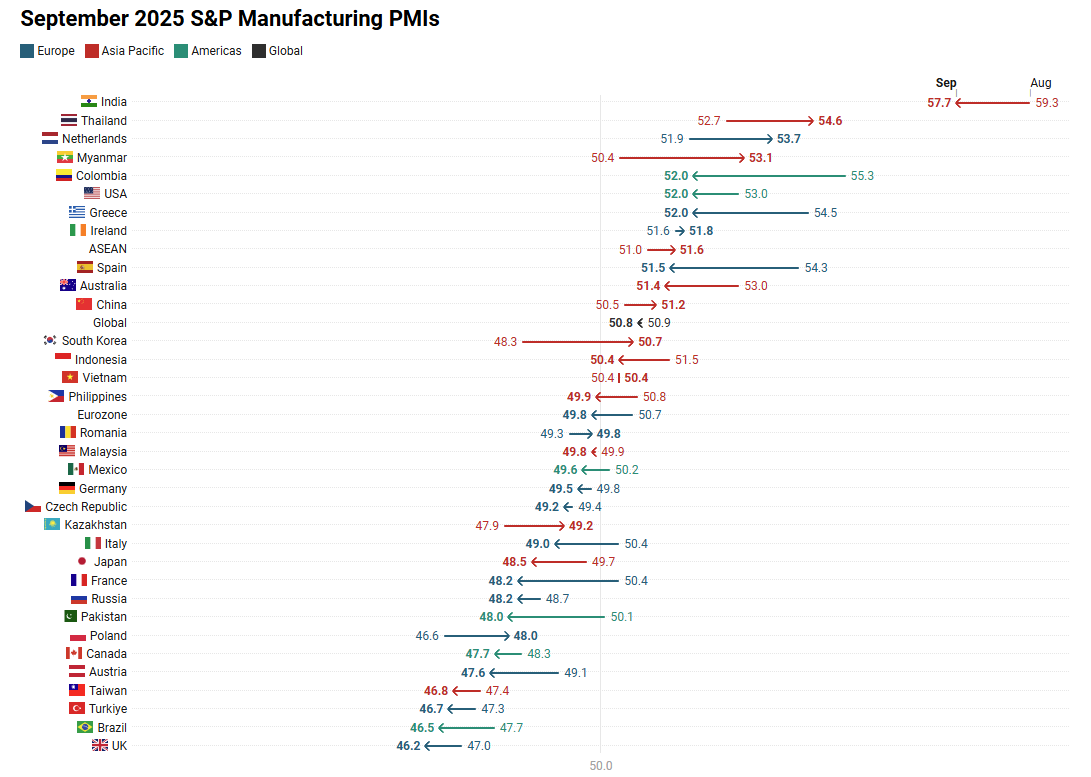
S&P Global Manufacturing PMIs: September 2025
Global - 10/1/2025
Asia Pacific
- Australia - 9/30/2025
- Malaysia - 10/1/2025
- ASEAN - 10/1/2025
- Myanmar - 10/1/2025
- Philippines - 10/1/2025
- Thailand - 10/1/2025
- Vietnam - 10/1/2025
- Indonesia - 10/1/2025
- Japan - 10/1/2025
- Taiwan - 10/1/2025
- China - 9/30/2025
- India - 10/1/2025
- Russia - 10/1/2025
- Kazakhstan - 10/1/2025
- South Korea - 10/1/2025
- Pakistan - 10/1/2025
Europe
- Austria - 9/26/2025
- Ireland - 10/1/2025
- Netherlands - 10/1/2025
- Romania - 10/1/2025
- Turkiye - 10/1/2025
- Poland - 10/1/2025
- Spain - 10/1/2025
- Czechia - 10/1/2025
- Italy - 10/1/2025
- France - 10/1/2025
- Germany - 10/1/2025
- Eurozone - 10/1/2025
- Greece - 10/1/2025
- UK - 10/1/2025
North & South America
Key Results
China
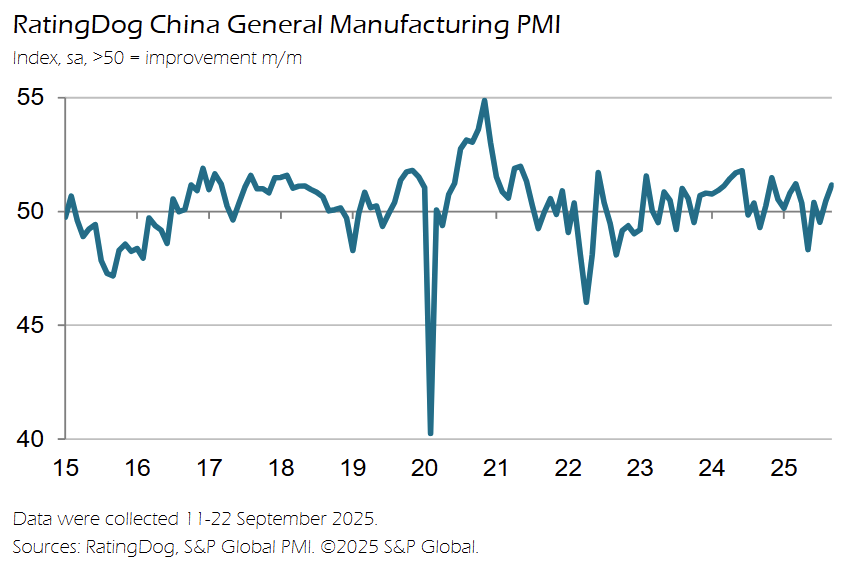
China’s Manufacturing PMI rose to 51.2 in September 2025 (from 50.5 in August), marking the fastest pace of expansion in six months, supported by stronger new orders and rising export demand.
-
New orders increased at the quickest pace since February, driven by better domestic demand, promotional efforts, and new product launches; new export orders grew slightly for the first time since March.
-
Production rose at the fastest rate in three months, reflecting stronger inflows of new work and continued capacity pressure.
-
Purchasing activity expanded solidly, the strongest since November 2024, leading to further inventory accumulation in both inputs and finished goods.
-
Backlogs of work grew at the quickest rate in several months, highlighting persistent strain on operating capacity.
-
Employment continued to decline, but the pace of job shedding eased as firms responded to rising workloads.
-
Input costs rose at the fastest rate in ten months, with metals and meat cited as key drivers; however, selling prices fell modestly as firms absorbed costs amid competitive pressures.
-
Business confidence improved to the highest level since March, with firms hopeful that demand, policy support, and business development will sustain growth, though sentiment remains below its long-run average.
Germany
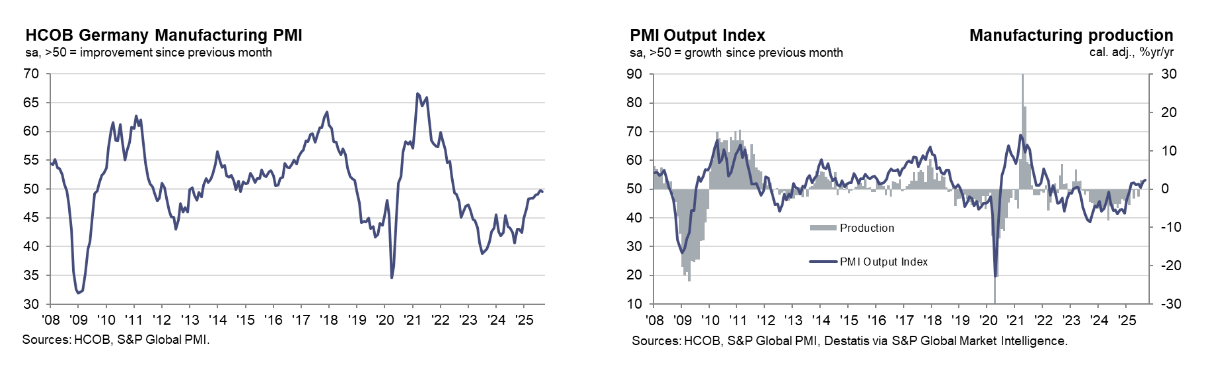
Germany’s Manufacturing PMI slipped to 49.5 in September 2025 (from 49.8 in August), a two-month low that underscores persistent contraction, though output growth reached its strongest pace since early 2022.
-
Output rose for the seventh straight month and at the fastest rate since March 2022, led by investment goods, though much of the support came from working through backlogs.
-
New orders fell for the first time in four months, with firms citing weak demand, foreign competition, and US tariffs; export sales were little changed after declining in August.
-
Employment declined further, with job cuts accelerating to the quickest pace since June 2025, extending a retrenchment trend that began in mid-2023.
-
Purchasing activity fell for the second consecutive month and at the fastest rate since March, while input inventories contracted more slowly and post-production inventories nearly stabilized.
-
Supplier delivery times lengthened for the first time since October 2022, reflecting delays in Asian shipments and supplier capacity constraints.
-
Input costs dropped at the fastest rate in three months, helped by a strong euro and supplier switching, while output prices fell modestly, with the decline easing to its weakest since May.
-
Business expectations for the year ahead fell to a nine-month low, weighed by geopolitical risks, external competition, and concerns over the domestic economy, keeping confidence below its long-run average.
Euro Area
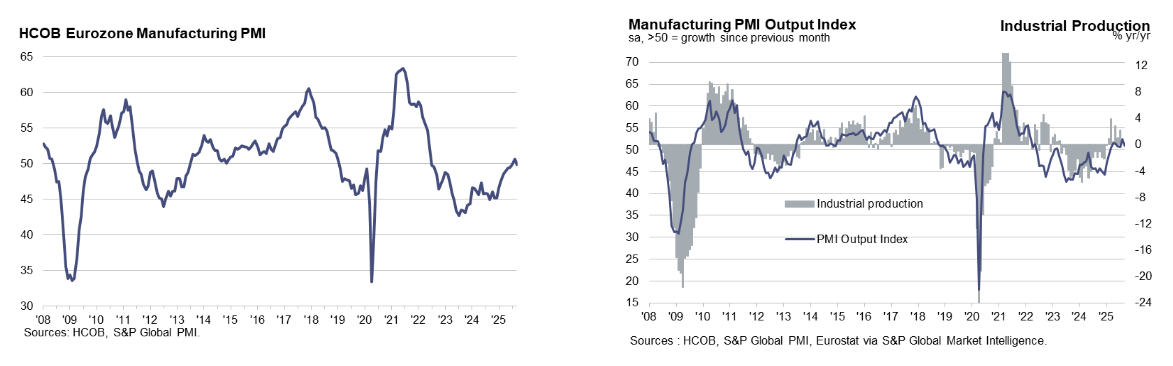
The HCOB Eurozone Manufacturing PMI fell back into contraction at 49.8 in September 2025 (from 50.7 in August), as new orders declined sharply and job cuts accelerated, though output growth persisted at a slower pace.
-
Output expanded for a seventh straight month, but the Output Index eased to 50.9 (from 52.5), signaling a softer pace of growth.
-
New orders decreased at the fastest rate in six months, reversing August’s rebound, with export demand falling for a third consecutive month.
-
Employment contracted at the quickest pace in three months, with firms also making deeper cuts to backlogged work.
-
Purchasing activity declined more rapidly, leading to the steepest reduction in input demand since April, while both pre- and post-production inventories continued to shrink.
-
Supplier delivery times lengthened for the first time in nearly three years, highlighting renewed supply chain pressures.
-
Input costs fell for the first time since June, though only marginally, while output prices declined for a fifth straight month amid ongoing discounting.
-
Business confidence remained positive overall but slipped to its weakest since April, as manufacturers grew more cautious about the outlook.
UK
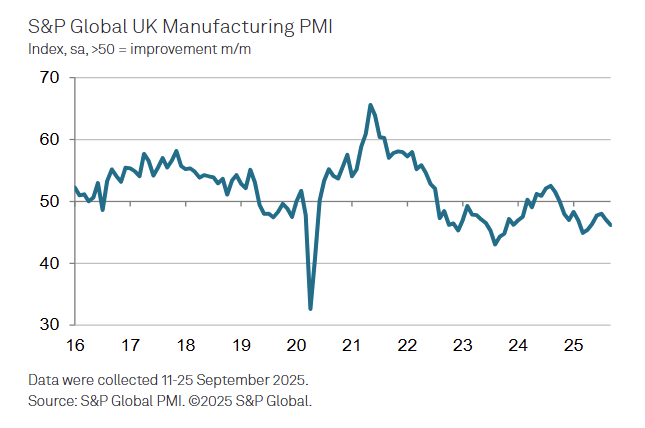
The S&P Global UK Manufacturing PMI fell to 46.2 in September 2025 (from 47.0 in August), a five-month low that underscored deeper contraction as output and new orders dropped more sharply.
-
Output declined for the eleventh straight month, with the fastest contraction since March, spanning consumer, intermediate, and investment goods.
-
New orders fell for the twelfth consecutive month and at one of the steepest rates in two years, weighed down by weak domestic demand, subdued client confidence, US tariff uncertainty, and higher costs.
-
Export orders contracted sharply, among the fastest declines in over two years, with reduced demand from the US, EU, Middle East, and Asia.
-
Employment fell for the eleventh straight month, with job losses across all categories of staff as firms cut costs in response to rising taxes and energy expenses.
-
Inventories of finished goods rose for the first time since January, driven by intermediate goods, while backlogs of work continued to shrink.
-
Supplier delivery times lengthened for the twenty-first month in a row, reflecting port congestion, shipping delays, supplier capacity issues, and shortages.
-
Price pressures eased, with both input cost and output charge inflation slowing to nine-month lows across all major product categories.
-
Business confidence stayed relatively subdued, as weak demand, policy uncertainty, and global trade headwinds weighed on the outlook, despite hopes that lean inventories and new product launches might support a future recovery.
US
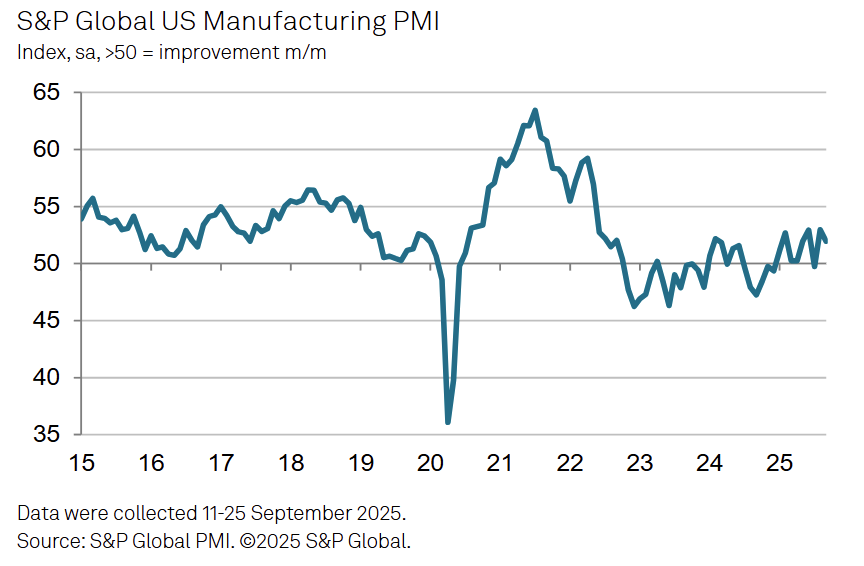
The S&P Global US Manufacturing PMI fell to 52.0 in September (from 53.0 in August), indicating a slower pace of expansion amid softer demand and ongoing tariff pressures.
-
New orders rose for a ninth straight month but only modestly, marking growth below the survey average, while export sales declined for a third month in a row due to tariff impacts, particularly with Canada and Mexico.
-
Output expanded for a fourth consecutive month, though at a weaker pace than August, with production exceeding new orders and leading to a buildup of finished goods inventories.
-
Employment rose solidly as firms filled vacancies and expanded labor capacity, contributing to the steepest drop in backlogs in five months.
-
Input costs remained elevated as tariffs pushed vendor prices higher, though the rate of input price inflation eased slightly compared with August.
-
Selling price inflation slowed to an eight-month low, as weaker demand and competitive pressures limited firms’ ability to pass on costs.
-
Supplier delivery times lengthened further in September due to tariff-related delays, reinforcing ongoing supply-side uncertainty.
-
Business confidence improved modestly compared to August, supported by expectations for reshoring and stronger demand, despite concerns about trade policy and federal uncertainty.