


US Employment Situation: August 2025
Establishment Data
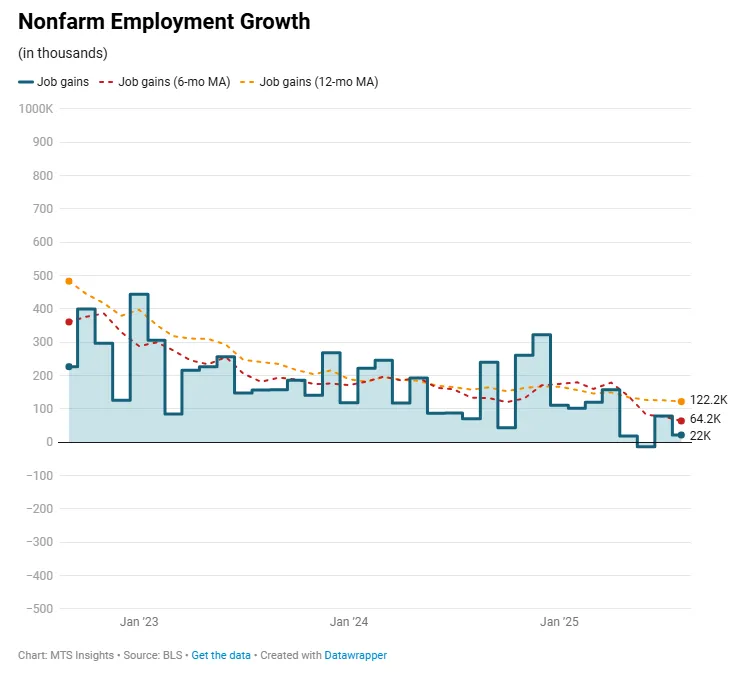
US nonfarm payroll employment came in weak again in August, increasing by just 22,000, which is a deceleration from the 79,000 jobs added in July and well below the consensus estimate of 75,000. This number looks more like the soft prints in May and June than the bounce back in July, suggesting that there is a real slowdown in hiring that can’t be ignored. With this print, the three-month average of job gains remains below 30,000 for the second straight month. The details of the report tell a similar story of the headline employment number being carried by a few industries.
The first thing to note in the details is that there was a divergence between private and public sector hiring in August. Private payrolls increased 38,000, still below expectations of around 75,000 but notably stronger than the headline number. This means that government payrolls declined by -16,000, the second largest month behind May 2025 in the last three years. The shedding of jobs in the public sector was driven by the federal government as the Trump administration’s efforts to downsize the federal workforce continue to impact the labor market. So far this year, government payrolls (federal, state, and local) have only increased by 8,000. In the same period last year, government payrolls increased by 323,000.
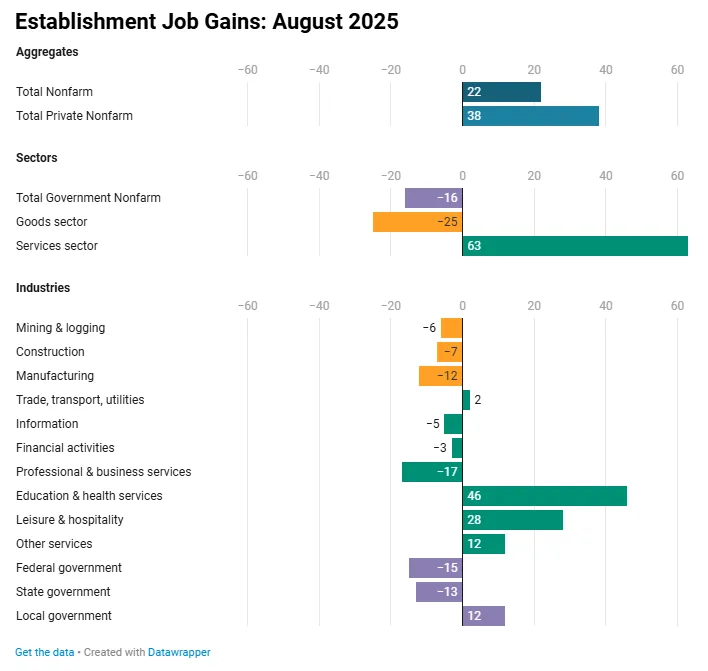
Within the private sector, hiring conditions weren’t particularly strong. The goods sector saw a decline in employment for the fourth straight month at -25,000, which is also the worst decline since October 2024 and the second worst since March 2023. All three industries tracked in the goods sector lost jobs, including the manufacturing sector (-12,000), which is also on a four-month streak of job losses. Offsetting the decline in goods sector employment was a 63,000 increase in the services sector, which looks like a solid increase, but the sector’s gains were driven primarily by two industries: education & health services (+46,000) and leisure & hospitality (+28,000). The other services industries saw job losses or no growth, including professional services (-17,000) and information (-5,000). The conclusion is one that we have seen before: payroll employment gains are being propped up by two industries, education & health services, and leisure & hospitality.
Household Data
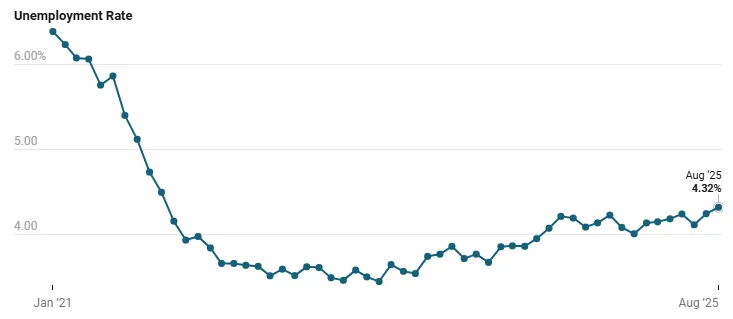
Alongside a weakening in hiring came an increase in the unemployment rate in the Household data. The unemployment rate ticked up 0.1 ppts to 4.3% in August, in line with the consensus forecast. The more precise increase in the rate was about 7.5 bps, or an increase from 4.25% to 4.32%. In terms of raw numbers, the was a 148,000 increase in the unemployed population and an even larger 288,000 increase in the over-employed population. And overall, there was a strong 436,000 increase in the labor force, which caused the labor force participation rate to tick up 0.1 ppt to 62.3%, reversing a trend of a participation rate that has been falling since April. These general statistics all suggest that the supply side of the labor market is loosening but not at an alarming rate.
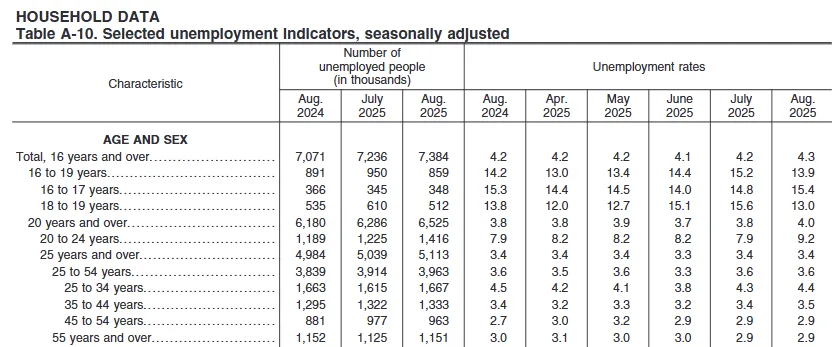
While the overall unemployment rate only saw a gradual increase, there were some interesting dynamics for certain age groups.
- The first thing to note was a -1.3 ppts drop in the unemployment rate for the 16 to 19 year old segment after spiking 1.8 ppts over the summer. While this could be tracked to changes related to the school year, this data is seasonally adjusted, so volatility like this shouldn’t happen. I hypothesize that summer employment opportunities must have been thinner than usual for that group, which resulted in the exaggerated moves.
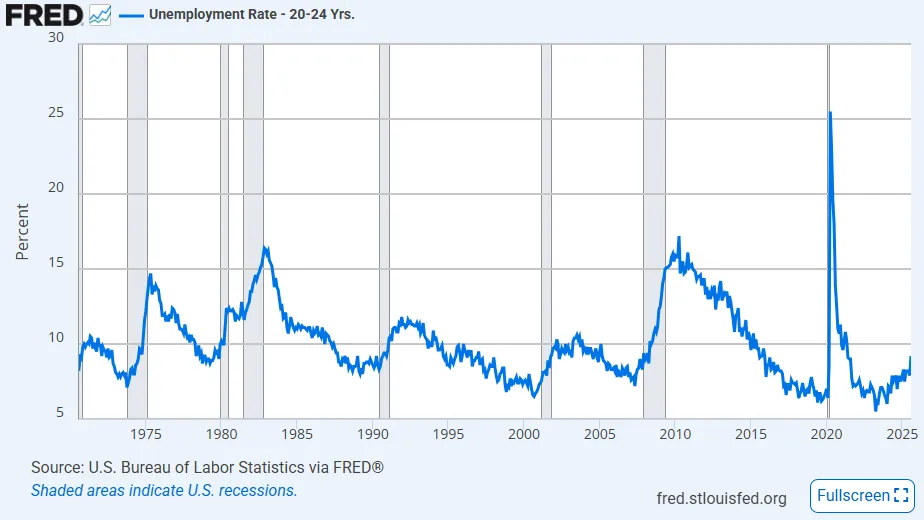
- Moving up to the next age segment, we see an even more concerning trend. The unemployment rate for 20 to 24-year-olds, correlating to individuals getting out of high school or college to join the workforce, jumped 1.3 ppts to 9.2%, the highest since May 2021. A surge in joblessness in this segment typically only happens when there is a recession coming or currently happening. However, there is a chance that this instance could be an exception since AI is increasingly encroaching on young professionals’ abilities to find an entry-level job.
- Finally, there are the prime age (25 to 54 years) and 55+ age segments, which both stand out as stronger than the two younger segments. In August, the prime age unemployment rate remained unchanged at 3.6%, even though there was an increase of about 50,000 in the raw values. The monthly trend was similar for the 55+ segment, where the unemployment rate remained at 2.9%. Most significantly, both of these segments have seen no increase in their unemployment rates in the last year, suggesting that the labor market for more skilled and established workers is actually quite solid.
These details matter because they show how broad labor market trends are playing out across different groups. In effect, there are two labor markets unfolding: one where younger workers are struggling to find jobs and falling behind in starting their careers and financial lives, and another where prime-age and older workers feel relatively secure and are not facing the same risks of layoffs. As noted earlier, weakness in younger cohorts has historically been a reliable signal of recession risk, often more telling than a small uptick, such as a 0.1 ppt increase, in the overall unemployment rate.
Wage Growth
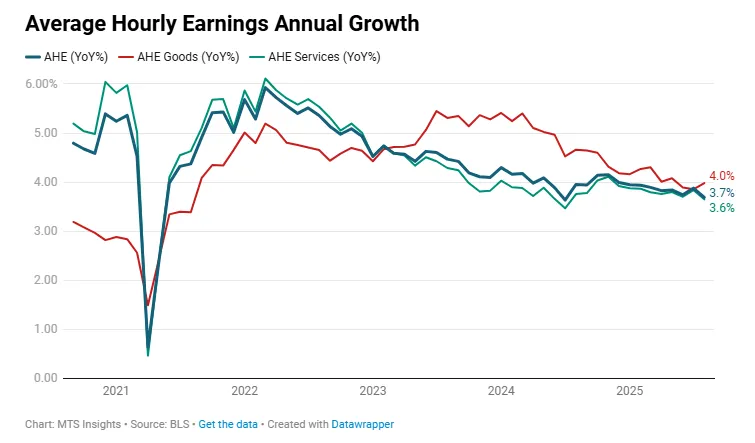
The wage growth data from the Establishment data was mostly consistent with the cooling in hiring seen in the headline job gains numbers. Average hourly earnings (AHE) increased 0.3% MoM in August, and the annual increase slowed from 3.9% YoY in July to 3.7% YoY, matching June for the lowest rate since July 2024. The cooling in wage growth came from the services sector, where AHE increased 0.3% MoM and was up 3.6% YoY (down from 3.8% YoY). This was partially offset by a 0.4% MoM increase in goods sector AHE growth, which caused the annual rate to tick back up to 4.0% YoY. Overall, wage growth does continue to be a bit sticky as it hasn’t returned to the post-pandemic lows last summer, but since it is in a gradual decline, it isn’t a focus for the Fed, which is more concerned about layoffs picking up, leading to a higher unemployment rate.