


US Employment Situation: June 2025
Establishment Data
After the ADP private payrolls miss on Wednesday, there was an ominous air surrounding the BLS report this morning. However, that just made the upside surprise in the BLS report that much more impactful for markets. The headline job gains in the BLS report came in at 147,000, beating expectations of a 110,000 increase and proving the resiliency of the US labor market. As if that wasn’t bullish enough, the BLS reported upward revisions totaling 16,000 of April and May data as opposed to the usual downward revisions. The gains in June bring some momentum back to payroll growth as it pushed the 3-month average up to 150,000,
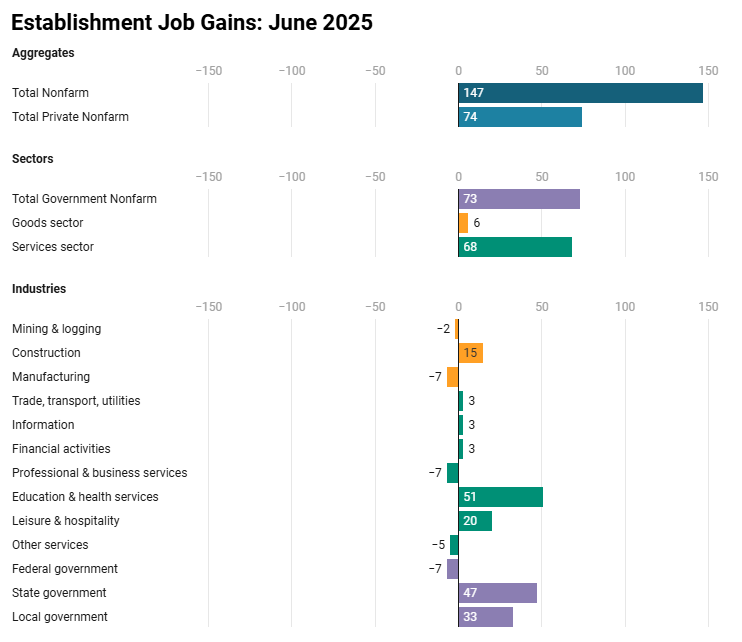
The optimism does get dulled down a bit when looking at the details of the Establishment survey. The main disappointment was that only half of the headline payroll growth came from increases in private payrolls. The increase in private payrolls of 74,000 in June is the lowest since October 2024 (but it is well above the ADP June number of -33,000). The goods sector created just 6,000 jobs while the services sector created 68,000, with almost all of the gains coming from education & health services (+51,000) and leisure & hospitality (+20,000). Similar to the ADP report, the professional & business services industry lost jobs but to a lesser degree (-7,000 in the BLS report and -56,000 in the ADP report).
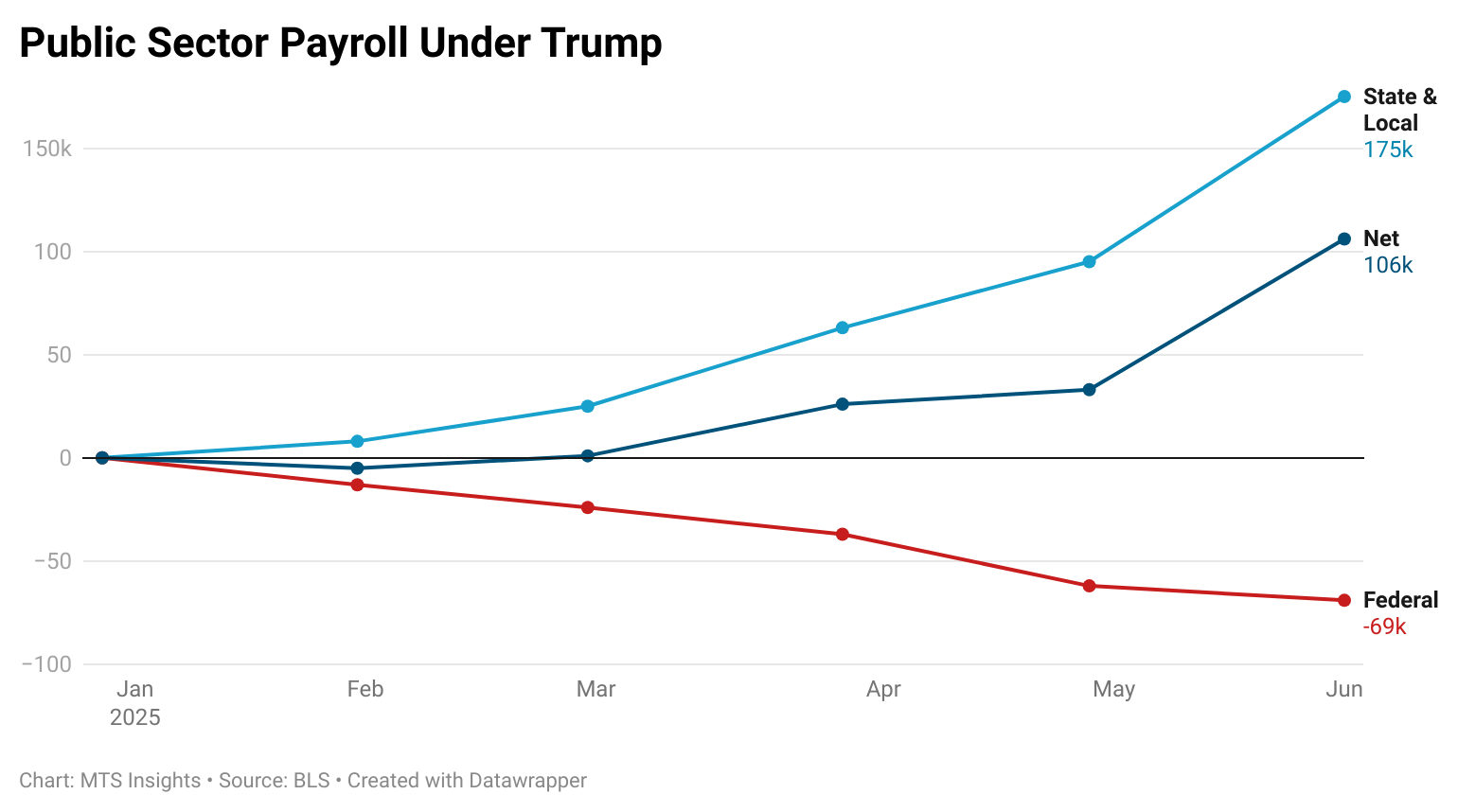
Indeed, that means that government payrolls increased 73,000, the highest one-month gain since March 2024. With the Trump administration still working to shrink the size of the federal government, federal payrolls dropped another -7,000. These losses were offset by strong hiring in state and local governments, which added 47,000 and 33,000 jobs, respectively. This trend of rising state & local payrolls and falling federal payrolls has been visible in every jobs report under Trump. In total, public sector payrolls have increased by 106,000 in the last five months, with state & local driving that gain.
After reading the details, the Establishment data does not look as strong as the headline number suggests. Private payroll growth continues to lose momentum. While the 3-month average of total nonfarm payroll growth increased, the 3-month average for private payroll growth slowed to 115,000, the lowest since October 2024 and Q3 2024, when the average dipped below 50,000 at one point. However, the numbers do feel a bit less disappointing given the ADP number that set expectations lower than what the consensus forecast for private payroll growth was. That context shifted how the market perceived and reacted to the Establishment data.
Household Data
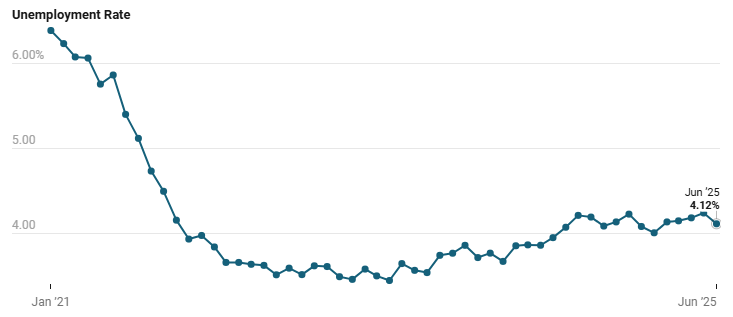
The Household data in the June jobs report was more of a bright spot than the Establishment data as the unemployment rate surprised. While the consensus forecast expected a rise in the unemployment rate, it actually fell by -12 bps to 4.12%, the lowest it has been since January. The decline in the jobless rate came from a 93,000 increase in the number of employed, and a -222,000 drop in the total number of unemployed. In addition to a drop in unemployment, labor force participation declined by -130,000 with the labor force participation rate down -0.1 ppts to 62.3%, the lowest since December 2022.
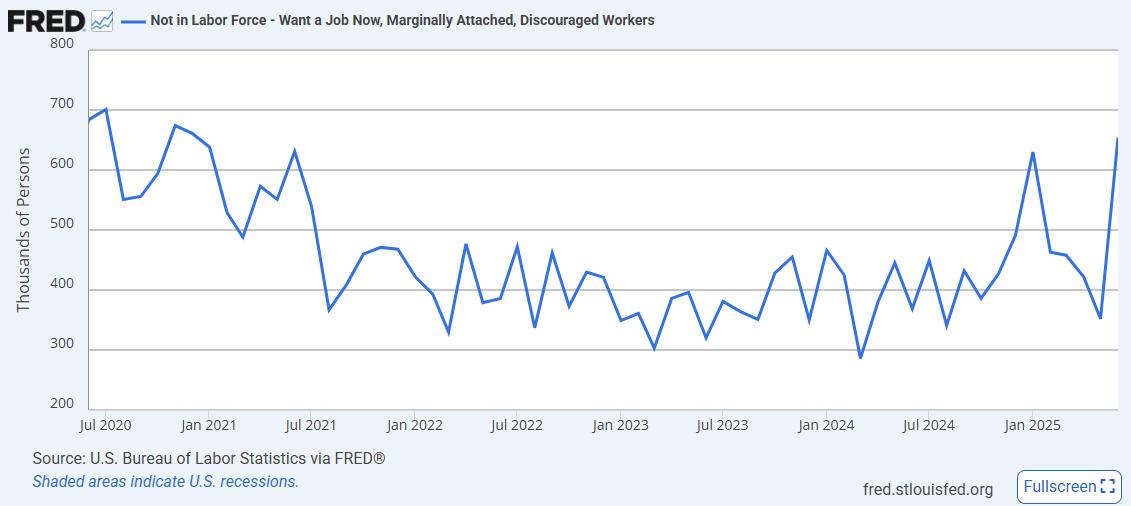
The dynamics suggest the increase in inactivity came about because some of the unemployed workers became discouraged in their job hunt. Indeed, the BLS reported a large 256,000 increase in the total number of discouraged workers which reached 637,000. That total is the highest since December 2020. When factoring discouraged workers into the unemployment rate (U-4), the rate of joblessness remained unchanged at 4.5%.
While that alternate measure of joblessness does paint the data in a different light, there are some details that are more encouraging. In the segmentation of unemployment based on reason for unemployment, the June numbers suggested that the composition of unemployment shifted towards those who left their job (+121,000 in June) than those who lost their jobs (-164,000 in June). This is consistent with an increase in the quits rate that was evident in the JOLTS data earlier this week.
Wage Growth
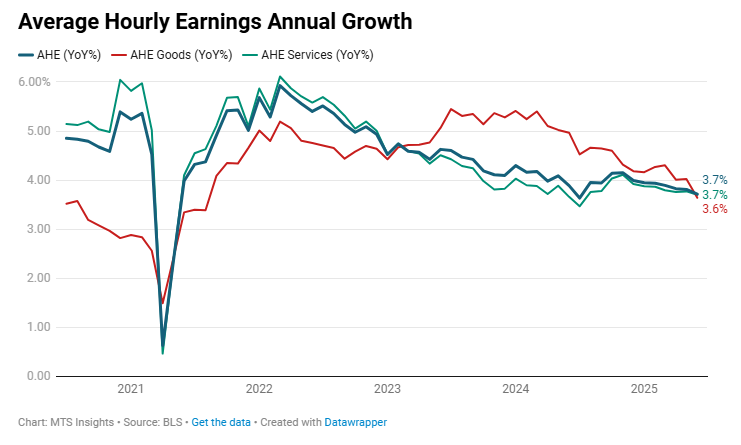
Wage growth was tepid in June across both sectors of the economy, showing evidence that inflationary pressures from labor costs continued to cool. In June, average hourly earnings increased just 0.22% MoM with goods sector wages up just 0.11% MoM and services wages up 0.22% MoM. The headline wage growth number was below expectations of a 0.3% MoM increase. The annual increase in average hourly earnings dropped to 3.7% YoY, below expectations of a 3.9% YoY increase. Goods sector annual wage growth dropped to 3.6% YoY, the lowest since August 2021, while service sector annual wage growth ticked down to 3.7% YoY, roughly where it was in Q3 2024.
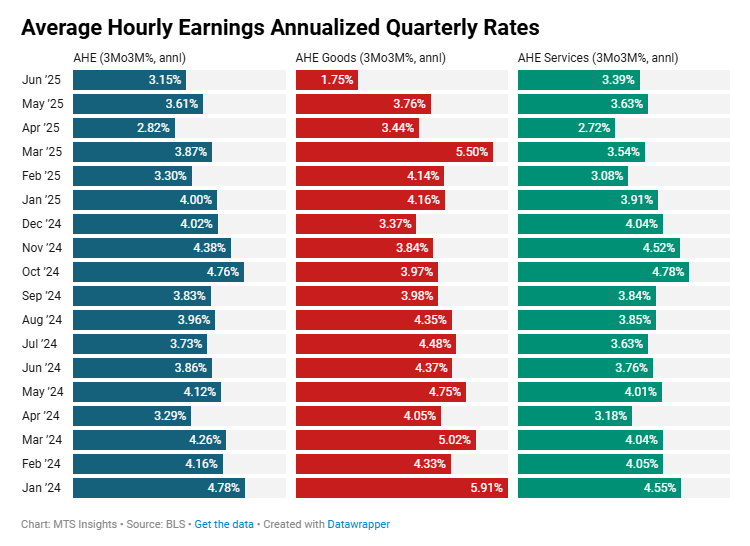
The trend in goods sector wages is actually getting a bit concerning. The annualized three-month change of hourly earnings for the goods sector has dropped to just 1.75% after trending around 3-4% earlier this year. This suggests there might be a significant divergence developing between the goods and services sector that is being hidden by the fact that the US economy is heavily services-oriented. It would not surprise me if the goods sector is nearing a recession due to tariffs and trade policy.