


US Employment Situation: April 2025
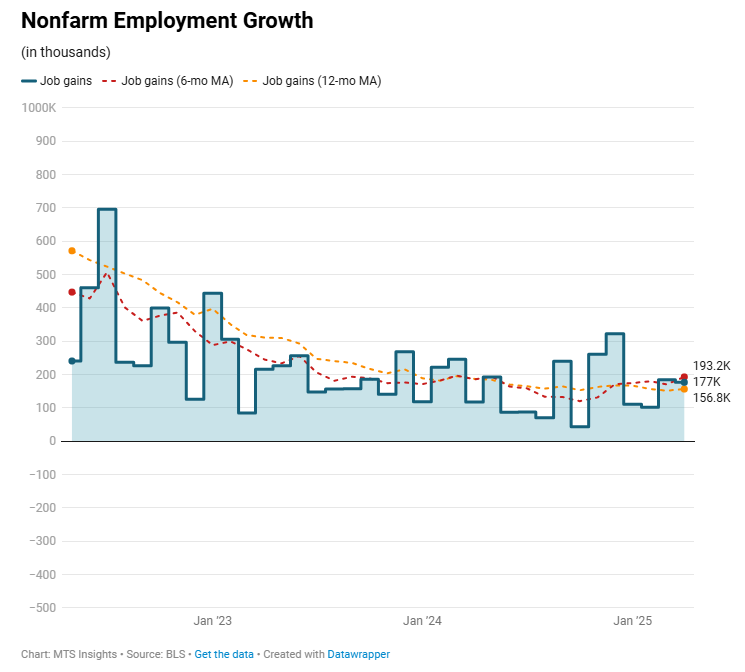
A better-than-expected April jobs report suggests that tariffs and uncertainty have not impacted the labor market yet. While there are some subtle signs of weakness, the market is taking the data in stride, factoring in slightly better growth expectations and more pauses by the Fed.
Establishment Data
The US added 177,000 jobs in April, beating expectations of a smaller increase of 130,000 and just slightly slower than the pace of employment growth in March. The last two months of job growth have been just under double the first two months of 2025, but they fall short of the strong end to 2024. While the April gain was strong, the BLS revised down February and March gains by -15,000 to 102,000 and by -43,000 to 185,000 respectively. This means that if you combine the -58,000 jobs lost to revisions with the April increase, employment growth was about in line with consensus expectations.
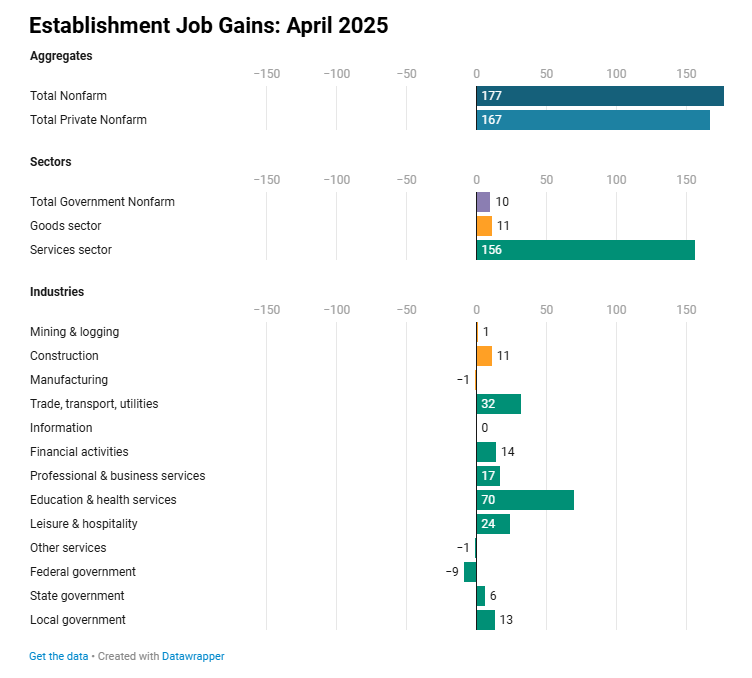
Private employment continued to take the lead in the labor market, adding 167,000 jobs in April, which was also ahead of analysts’ forecasts. The gains were concentrated in the service sector which added 156,000 jobs, led by private education & health services (+70,000) and, to a lesser extent, leisure & hospitality (+24,000). The goods sector managed a much smaller gain of 11,000 with construction leading within the sector. The manufacturing industry saw a decline of -1,000 jobs which means that it only added 2,000 in the last two months. This includes a decline of -4,700 auto manufacturing jobs in April and -1,100 jobs in March.
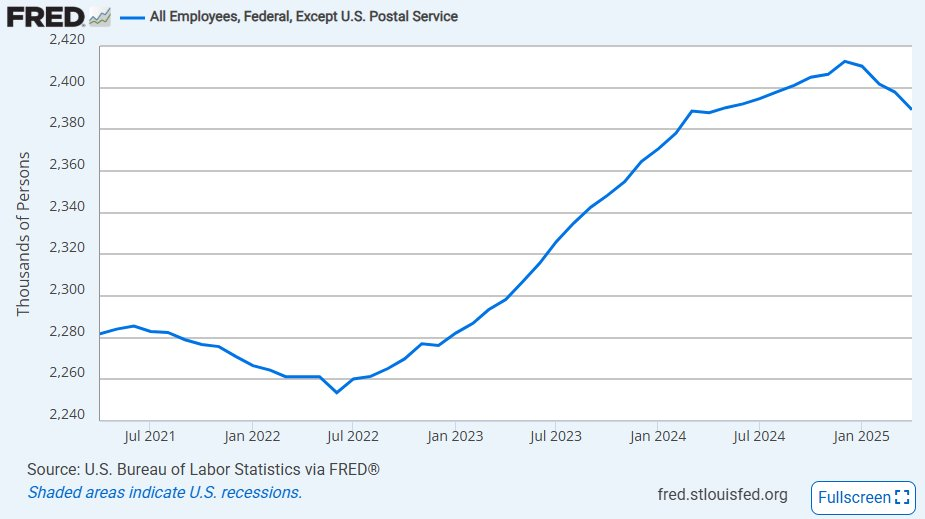
Government payroll growth was low at 10,000 in April. However, the impact of the Trump administration’s workforce cuts was apparent as the federal government reported a decline of -9,000 jobs in April. That was offset by a 13,000 increase in state & local governments. So far this year, federal government employment (excluding the US Postal Service) has fallen -23,000 to just under 2.39 million. In other words, DOGE and the Trump administration has reduced the federal workforce by about 1% in three months.
In general, the Establishment data looks generally solid as the pace of job growth over the last three months remains above 150,000 with the pace of private payroll growth just under that. There hasn’t been a broad immediate reaction to the uncertainty and confusion brought about by the tariffs and trade policies. However, there do appear to be some weak spots. The retail trade industry lost -1,800 jobs in April which could be a reaction by the industry to an impending supply crunch from elevated tariff rates. Similarly, auto manufacturing, an industry that Trump has specifically claimed to be focusing on, lost -4,700 jobs on expectations that the duties on imported auto parts will cause a surge in costs that will likely threaten demand in the coming months.
Household Data
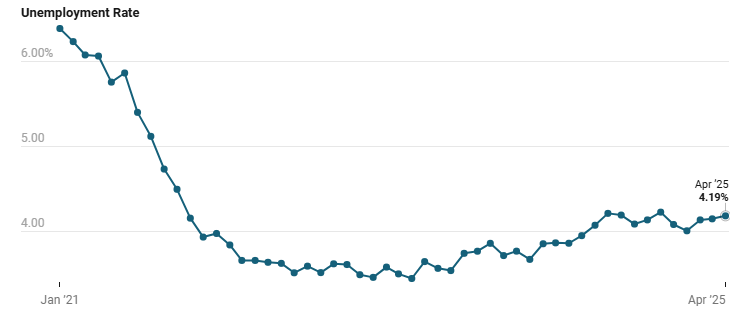
The Household Survey data reflected the solid nature of the Establishment data. Total employment surged 436,000 in April as a significant increase in participation led to those individuals finding work. At the same time, total unemployment increased by 82,000, but that wasn’t enough to see the unemployment rate tick up past 4.2%. However, the two decimal point reading of the unemployment rate did increase, rising 4 bps to 4.19% in April. Essentially, the “weak” 4.2% reading in March that resulted from rounding became a more “firm” 4.2% reading in April.
As mentioned, a strong increase in participation was observed last month with the participation rate increasing 0.1 ppts to 62.6%. Because most of the new entrants found employment, the employment ratio also ticked up 0.1 ppts, reaching 60.0%. This also resulted in a decline in workers marginally attached to the labor force (-71,000) and discouraged workers (-95,000) in April.
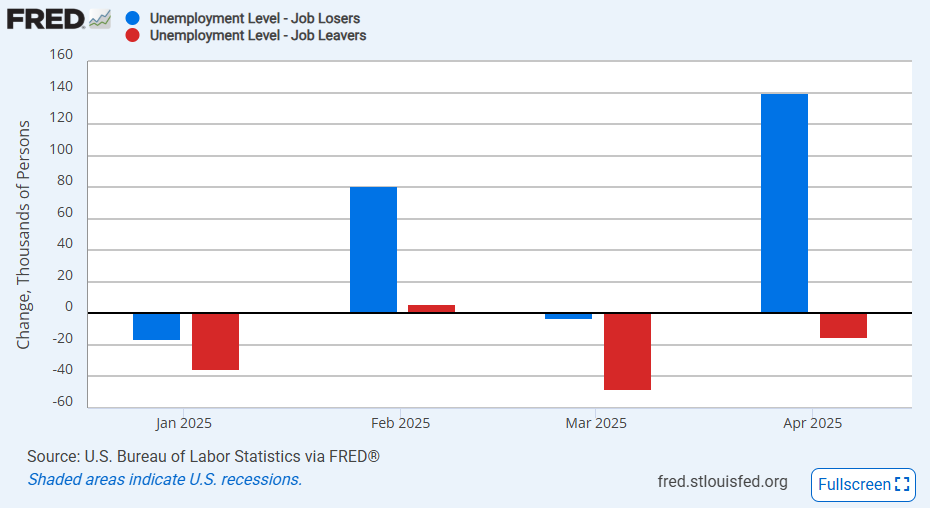
There are some details in the data that are point to some underlying weakness. The total number of individuals reporting unemployment due to losing their jobs or temp jobs (”job losers”) jumped 140,000 while those voluntarily leaving their jobs (”job leavers”) fell -15,000. So far this year, the population of “job losers” has increased 202,000 while the total number of “job leavers” is down -92,000. A labor market is typically weakening when individuals are quitting their jobs less frequently, and losing their jobs more frequently.
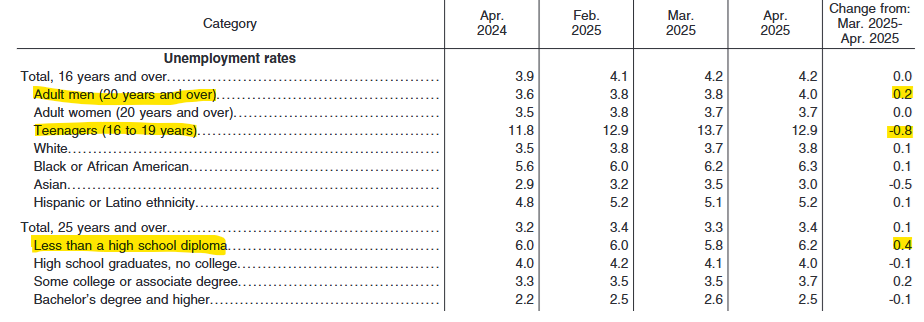
Additionally, while there was no growth in the headline unemployment rate, there were some important segments where unemployment increased. The unemployment rate for adult men, aged 20 years and over, increased 0.2 ppts to 4.0% and is up 0.4 ppts in the last year. Within the prime age workers segment, there was an increase in the unemployment rate of individuals without a high school diploma by 0.4 ppts to 6.2% which means it is now up over the last year. Offsetting these rises in unemployment was a sharp decline of -0.8 ppts in the teen unemployment rate (16-19 years old) which is typically volatile month-to-month.
Wage Growth
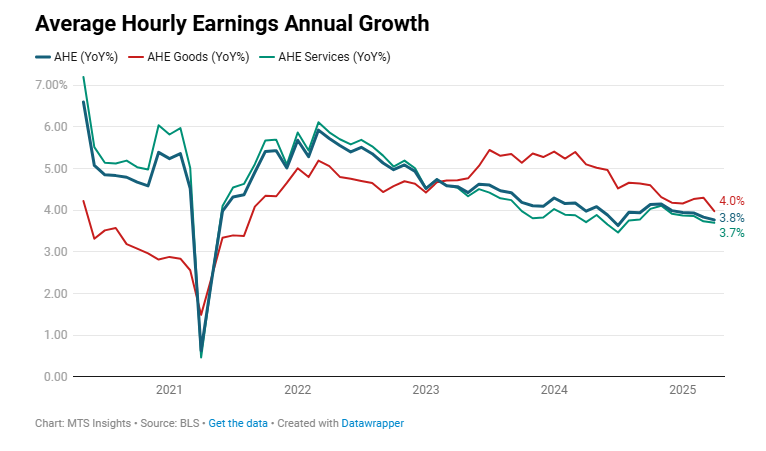
The BLS update on wage growth showed a pretty significant short-term trend of gradual easing, especially in the services sector. On an annual basis, average hourly earnings increased 3.8% YoY in April, which was unchanged from March thanks to rounding. Both goods and services wage growth slowed as well. The more interesting dynamic was in the short-term measures. The annualized 3-month growth rate of average hourly earnings was reported at just 2.59% in April, the first time its been below 3% for over a year. In the services sector, annualized 3-month wage growth was just 2.49%. If these short-term trends continue, then we will start to see a pretty significant deceleration in the longer-term annual rate which will feed into the Fed’s data. I believe this is likely to happen as firms opt to cut down on labor costs as they see their nonlabor costs rise.