


Federal Reserve Monetary Policy Decision: July 2026
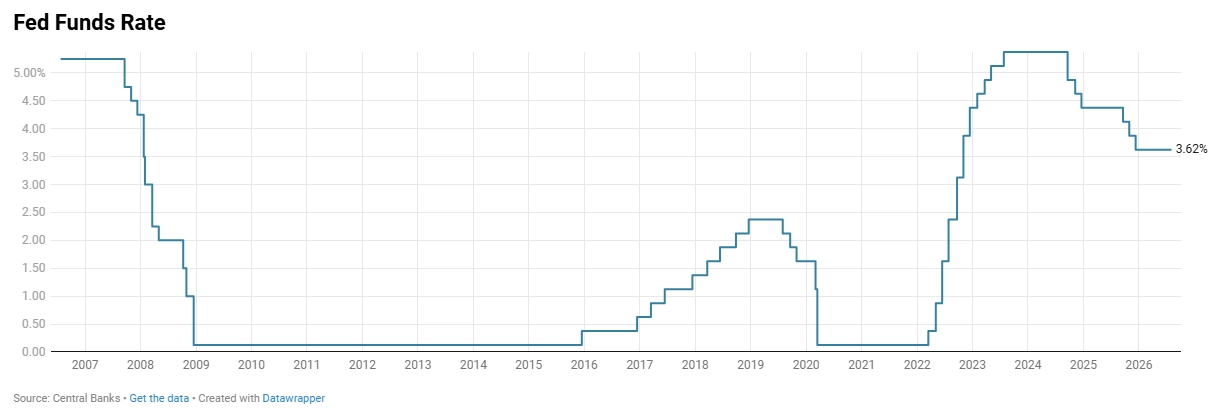
The Federal Reserve held the federal funds rate unchanged at 3.50%–3.75% for a fifth consecutive meeting, despite three votes for a +25 bps hike, reflecting a patient majority alongside growing concern over renewed inflation risks.
-
The FOMC maintained the federal funds target range at 3.50%–3.75%, extending the pause that followed three rate cuts in late 2025. The decision indicates that most members still view the current policy setting as sufficiently restrictive while economic and inflation conditions develop.
-
Hammack, Kashkari, and Logan dissented in favor of a +25 bps increase, producing the first decision since 2016 with at least three dissents in the same direction. The split shows that a significant minority favored acting preemptively against renewed inflation pressures.
-
The July policy statement remained just over 130 words and was nearly identical to June’s statement, apart from the voting details and a minor wording change. The limited revisions reinforced Chair Kevin Warsh’s shift away from forward guidance and toward a more data-dependent communication strategy.
-
The FOMC retained its assessment that the Middle East conflict has increased uncertainty and that supply shocks, particularly in energy, have contributed to higher inflation. The unchanged language suggests developments since June were not sufficient to alter the Committee’s stated economic assessment or policy stance.
-
Warsh said the Fed was not relying heavily on June’s softer-than-expected CPI report, emphasizing that policy decisions are based on broader inflation trends rather than a single release. This maintained a hawkish emphasis on persistent above-target inflation despite the decision to hold rates.
-
Warsh argued that higher nominal and real Treasury yields since the June meeting had tightened financial conditions and performed some of the work of a policy-rate increase. This was a comparatively dovish justification for holding rates, as market-driven tightening reduced the perceived need for immediate Fed action.
-
The Chair said the Fed would assess whether energy-driven price increases spread into underlying inflation, wages, and expectations rather than automatically responding to the initial supply shock. This indicates that broader second-round effects, rather than headline inflation alone, are central to the near-term reaction function.
-
Warsh declined to validate market expectations for a September hike and said financial-market pricing would inform but not determine the decision. The absence of clear confirmation, combined with repeated references to tighter financial conditions, gave the press conference an overall dovish tilt despite forceful language supporting the 2% inflation target.