

NOAA National Climate Report: June 2026
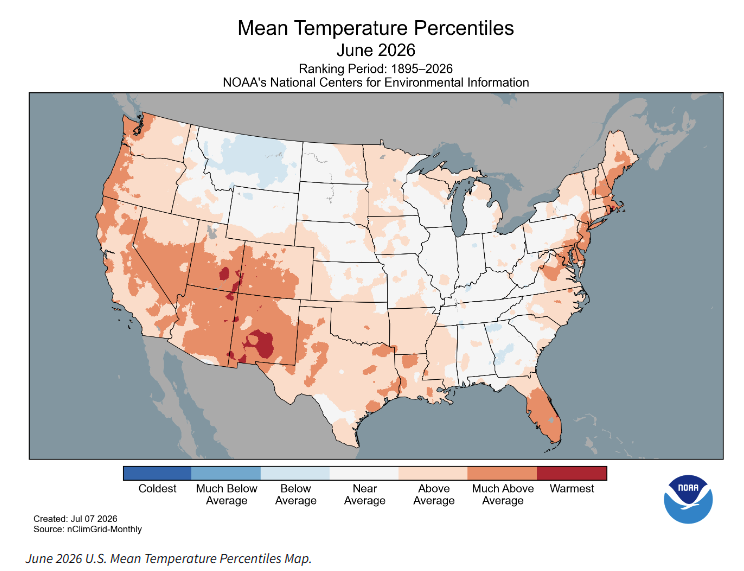
June brought another month of unusually warm conditions across the U.S., while the first half of 2026 continues to highlight a growing divide between the drought-stricken West and wetter parts of the Midwest. Severe weather also remained elevated, with tornado activity reaching historic levels across several Midwestern states.
- The contiguous U.S. averaged 70.6°F in June, +2.2°F above the 20th-century average, ranking in the warmest third of the 132-year record. Much of the West, Southwest, Mid-Atlantic and Northeast recorded above-average temperatures, while the Southwest tied its 5th-warmest June on record.
- The first half of 2026 has been particularly hot and dry across the West. The West and Southwest recorded their warmest January-June period on record, while receiving less than 70% of normal precipitation. Nevada, Arizona, Utah, Wyoming and Colorado received only 50-67% of average precipitation during the first six months of the year.
- National precipitation was mixed. The CONUS received 3.23 inches in June, +0.31 inches above average, ranking in the wettest third of the historical record. Meanwhile, Michigan recorded its wettest January-June on record, while nine East Coast states from South Carolina to Massachusetts experienced one of their eight driest starts to a year.
- Severe weather remained active across the Midwest. NOAA's Storm Prediction Center logged 374 preliminary tornado reports during June, with Illinois (91), Indiana (69) and Missouri (32) each recording their highest June tornado totals on record.
- Drought coverage improved nationally but remains a concern in the West. According to the U.S. Drought Monitor, 47.8% of the CONUS was in drought at the end of June, down 10.5 percentage points from the beginning of the month. However, drought persists across much of the interior West and is expected to continue expanding across portions of the Northwest and Rockies during July.
- Assessing the U.S. Temperature and Precipitation Analysis in June 2026