

NOAA National Climate Report: July 2026
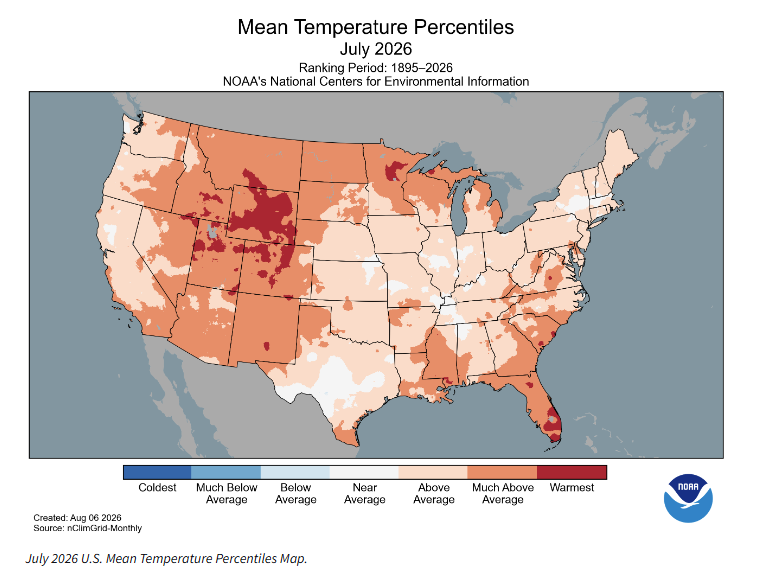
July 2026 was the warmest month ever recorded across the contiguous U.S., with the average temperature reaching 76.9°F (+3.3°F vs. the 20th-century average), while precipitation totaled 2.55 inches (-0.23 inches vs. average), reflecting widespread heat alongside mixed regional rainfall patterns.
-
The contiguous U.S. averaged 76.9°F in July, +3.3°F above the 20th-century average, making it the warmest July and warmest month in the 132-year record, surpassing the previous records set in July 1936 and July 2012.
-
Above-average temperatures covered the entire CONUS, with every state at least +1.0°F above average and all ranking in the warmest third of their historical July records. Thirteen states recorded one of their five warmest Julys, while Wyoming posted its warmest July and warmest month on record at +5.1°F above average.
-
Daytime maximum temperatures averaged 89.5°F (+2.9°F vs. average), ranking as the sixth-warmest on record, while overnight minimum temperatures averaged 64.2°F (+3.7°F vs. average), establishing a new record for warmest average nighttime temperatures, highlighting persistent overnight warmth.
-
CONUS precipitation averaged 2.55 inches, 0.23 inches below the 20th-century average, placing July in the driest third of the historical record, although localized heavy rainfall still produced major flooding events in areas including the Texas Hill Country and eastern New York.
-
Drought affected 48.5% of the CONUS as of the August 4 U.S. Drought Monitor update, +0.7 ppts from the end of June. Drought expanded across parts of the Northwest, Plains, Upper Midwest, and Northeast, while conditions improved in portions of the Southeast, Mid-Atlantic, and Lower Mississippi Valley.
-
Alaska averaged 51.8°F (-0.9°F vs. the 1925–2000 average), marking its coolest July since 2008, while precipitation totaled 4.30 inches (+1.02 inches vs. average), with southern areas experiencing notably wetter-than-average conditions.
-
Hawaiʻi averaged 69.4°F (+0.6°F vs. the 1991–2020 average) and received 5.20 inches of precipitation (+0.56 inches vs. average). Year-to-date rainfall reached 59.82 inches (173.9% of normal), making January–July the wettest start to a year on record for the state.
-
NOAA's August outlook favors above-average temperatures across much of the central and southern U.S., while drought is expected to persist or expand across parts of the Northwest, Plains, Upper Midwest, Puerto Rico, and the U.S. Virgin Islands, although improvement is anticipated in portions of the interior West, Southwest, and much of the East Coast.
-
Assessing the U.S. Temperature and Precipitation Analysis in July 2026