

NOAA Global Climate Report: April 2026
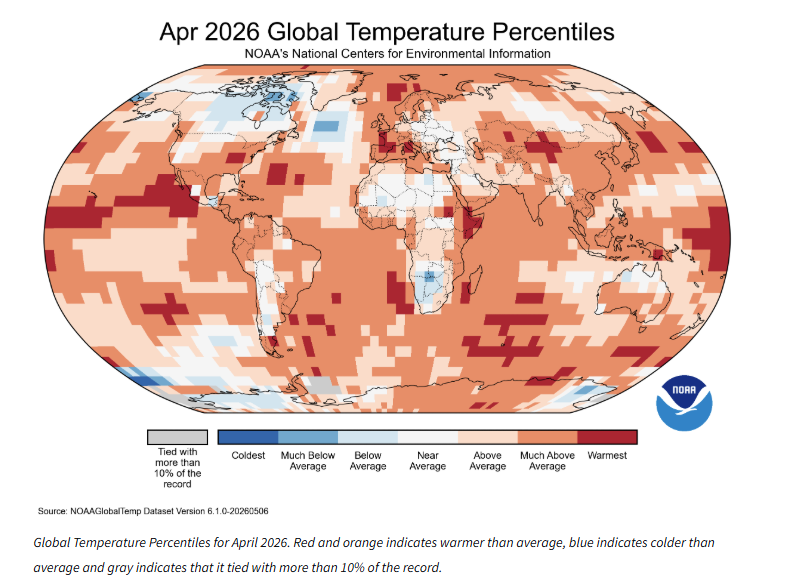
Global surface temperatures were +1.12°C (+2.02°F) above the 20th-century average in April 2026, ranking as the fourth-warmest April on record amid persistent global warmth.
- April 2026 ranked as the fourth-warmest April on record, trailing only 2024, 2025, and 2020, with all top 10 warmest Aprils occurring since 2016, indicating a strong concentration of recent extreme warmth.
- This marked the 50th consecutive April with above-average global temperatures, highlighting a prolonged period of sustained positive temperature anomalies.
- Ocean temperatures were the second-warmest on record for April while land temperatures ranked seventh-warmest, showing broadly elevated temperatures across both surface types.
- Above-average temperatures covered most global land and ocean areas, with notable anomalies of at least +2.0°C observed across the Arctic, Antarctica, parts of the U.S., Europe, Asia, Africa, and Australia, indicating widespread geographic intensity.
- The January–April global temperature ranked as the fifth highest on record, reinforcing the persistence of elevated temperatures into 2026 and supporting projections for another top-five warm year.
- Northern Hemisphere snow cover was below average, with Eurasia recording its eighth-lowest extent on record (-460,000 square miles vs average), reflecting significant regional snow deficits.
- Global sea ice extent was the fifth smallest on record at 7.63 million square miles (-590,000 vs average), with the Arctic recording its second-smallest April extent and Antarctica also below average, indicating continued weakness in polar ice coverage.
- Global tropical cyclone activity was near average with four named storms, three reaching major strength, including an early-season Category 5-equivalent storm, indicating typical overall activity but notable intensity in specific cases.
- Assessing the Global Temperature and Precipitation Analysis in April 2026