
WTO World Merchandise Trade: Q3 2025
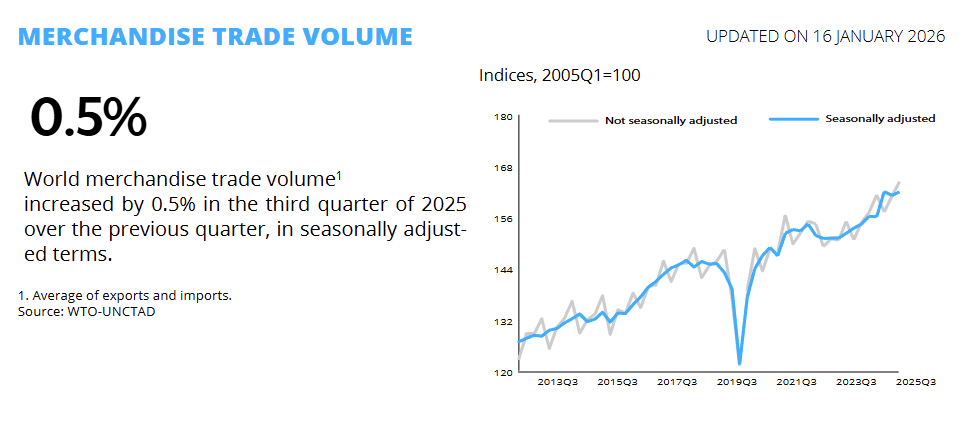
Merchandise trade grew 0.5% quarter-on-quarter and 3.6% year-on-year in the third quarter of 2025 on a seasonally-adjusted volume basis. By comparison, the dollar value of trade was up 7.5% year-on-year in the same period, highlighting a widening gap between growth in nominal and real terms (see Chart 1). Stronger growth in value terms than in volume terms was partly due to currency depreciation, as the US dollar fell 1.9% year-on-year in value against a broad basket of currencies in the third quarter. Dollar depreciation tends to inflate the dollar value of trade flows denominated in other currencies, for example intra-EU trade.
- For the year through September 2025, merchandise trade volume was up 4.5% compared to the same period in 2024. This is stronger than the headline forecast of 2.5% for 2025 in the WTO Secretariat's most recent forecast from last October. In the same January-September period, the value of merchandise trade was up 6.5% year-on-year. Although a weaker dollar contributed to merchandise trade growth in value terms, import frontloading ahead of expected tariff hikes and surging demand for AI-related goods were more significant factors.
- In the first three quarters of 2025, trade in AI-related goods, such as chips, semiconductors and data transmission equipment - most of which are exempted from the new tariffs - increased almost 20% year-on-year in value terms. While AI-related goods made up around 15% of world merchandise trade in the first three quarters of 2025, they accounted for 42% of year-on-year merchandise trade growth during the period.
- Trade in non-AI goods also continued to expand, up 4.4% year-on-year in value terms in the first three quarters of 2025. A key driver was the skyrocketing price of gold, which serves as a safe-haven investment in times of economic uncertainty. Medicines and pharmaceuticals, particularly anti-obesity drugs and vaccine inputs, also contributed to the increase, particularly in the first quarter, as imports surged in North America ahead of expected tariff hikes.
- In the first nine months of 2025, Asia recorded the strongest year-on-year growth in export volumes (9.5%), followed by Africa (6.1%) and South and Central America and the Caribbean (5.7%). Exports also increased in the Middle East (5.3%) and North America (2.3%) but declined slightly in Europe (-0.3%) and moderately in the Commonwealth of Independent States (CIS), including certain associate and former members states (-1.7%) (see Chart 2).
- On the import side, the fastest growth was observed in South and Central America and the Caribbean (13.2%) and Africa (12.7%), more than twice the pace seen in the Middle East (6.2%) and Asia (6.0%). North American imports grew by an average of 5.4%, while Europe recorded more modest growth of 2.4%. The weakest import performance was in the CIS, at just 0.5%.