

GEP Global Supply Chain Volatility Index: January 2026
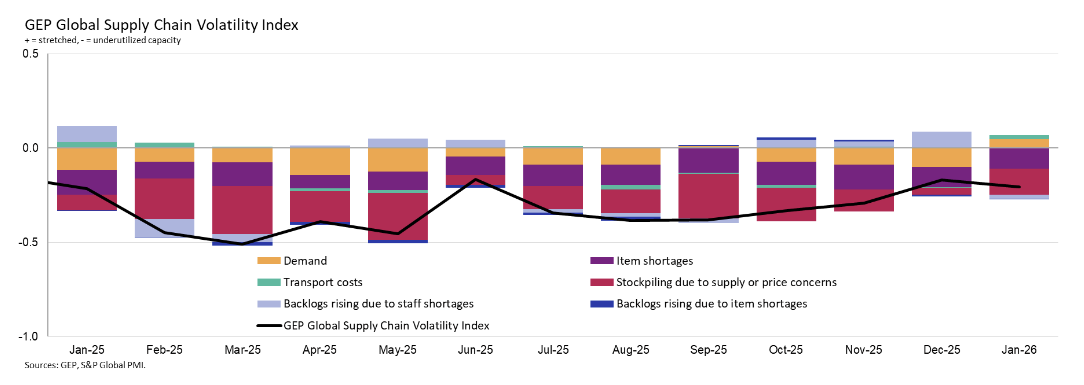
The GEP Global Supply Chain Volatility Index signaled a marked rebound in global manufacturing demand in January 2026, with Asia at 0.12 (from -0.20) and North America at 0.06 (from -0.37), indicating a shift from underutilized to stretched supply capacity in key regions.
-
Asia’s index rose to 0.12 (from -0.20), marking the busiest supply chain conditions since November 2024, as manufacturers in China, Japan, Korea, India, and across ASEAN increased purchasing volumes in response to improved order books.
-
North America’s index climbed to 0.06 (from -0.37), the most stretched supplier capacity in just over 18 months, reflecting renewed momentum in U.S. manufacturing and greater appetite for inventory building.
-
Europe’s index fell to -0.27 (from -0.17), signaling increased spare capacity and continued reluctance among firms to restock, though the downturn in purchasing showed tentative signs of easing.
-
The U.K. index declined to -0.17 (from 0.12), indicating a shift back to underutilized supply chains at the start of 2026 and a weakening in manufacturing conditions.
-
Globally, demand for commodities, raw materials, and intermediate goods rose by its strongest margin in almost four years, underscoring a broad-based pickup in procurement activity.
-
Inventory stockpiling tied to price or supply concerns remained muted globally, though inventory building increased in North America while Europe continued destocking, highlighting regional divergence.
-
The global items-in-short-supply indicator stayed below its long-run average for nearly two-and-a-half years, suggesting fewer-than-normal material shortages, while labor shortages also remained below typical levels, indicating staff constraints were not limiting production.
-
Transportation costs increased at the start of the year amid rising global oil prices, pointing to renewed cost pressures within logistics channels.