

UK Public Sector Borrowing: December 2025
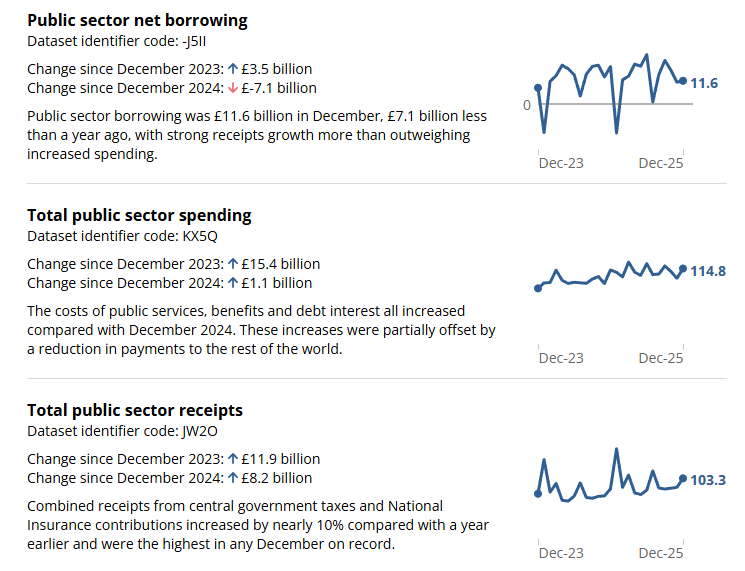
Borrowing - the difference between total public sector spending and income - was £11.6 billion in December 2025; this was £7.1 billion or 38.0% less than December 2024 and the 10th highest December since monthly records began in 1993 (not adjusted for inflation).
- Borrowing in the financial year to December 2025 was £140.4 billion; this was £0.3 billion or 0.2% less than in the same nine-month period of 2024, but still the third-highest April to December borrowing on record (not adjusted for inflation), after those of 2020 and 2024.
- Borrowing in the financial year to December 2025 was provisionally estimated at 4.6% of gross domestic product (GDP); this was 0.2 percentage points less than in the same nine-month period of 2024.
- The current budget deficit - borrowing to fund day-to-day public sector activities - was £5.8 billion in December 2025; this brings the total current budget deficit in the financial year to December 2025 to £94.9 billion, which is £1.6 billion or 1.6% less than in the same nine-month period of 2024.
- Public sector net debt excluding public sector banks - a measure of the amount of money owed to the UK private sector and overseas less any liquid assets held - was provisionally estimated at 95.5% of GDP at the end of December 2025; this was 0.9 percentage points more than at the end of December 2024 and remains at levels last seen in the early 1960s.
- Public sector net financial liabilities excluding public sector banks - which considers a wider range of financial assets and liabilities than net debt - were provisionally estimated at 85.0% of GDP at the end of December 2025; this was 2.5 percentage points more than at the end of December 2024, but 10.5 percentage points less than for public sector net debt.
- Central government net cash requirement (excluding UK Asset Resolution Ltd and Network Rail) - the additional cash needed to be raised from the financial markets to finance activities - was £14.5 billion in December 2025; this was £4.9 billion or 25.2% less than in December 2024.