

GEP Global Supply Chain Volatility Index: December 2025
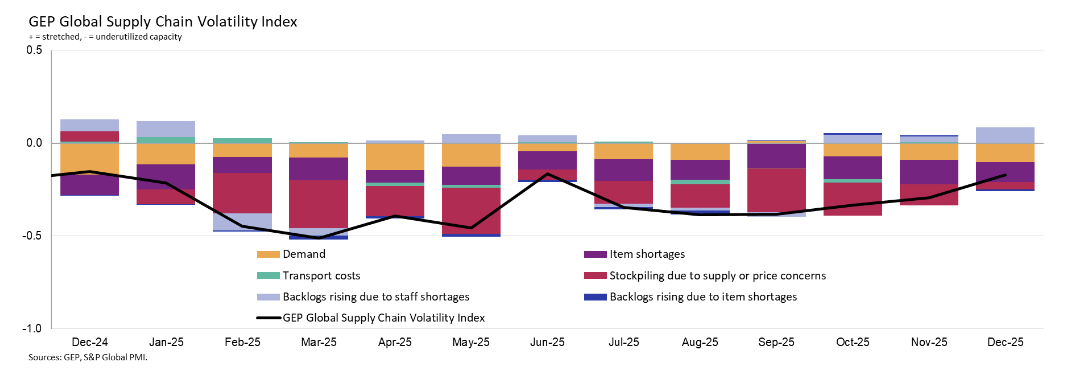
The GEP Global Supply Chain Volatility Index improved to -0.17 in December 2025 (highest since June 2025), but remained negative, signaling continued underutilized global supply capacity heading into 2026.
-
The global index edged up to -0.17, but underlying details continued to point to softening global manufacturing demand, especially across the Western economies.
-
North America’s index fell to -0.37, indicating underused supplier capacity, as manufacturers reduced procurement at the fastest pace since May 2025 and logged a sixth consecutive month of weakening input demand.
-
North American weakness was described as broad-based, with Mexico posting the steepest contraction, reinforcing the report’s message of regional manufacturing pullback.
-
Europe’s index rose to -0.17 (highest since June 2025), with the report attributing the improvement partly to labor-related constraints that impeded order completion, even as purchasing volumes continued to deteriorate.
-
European factory purchasing registered its sharpest decline in nine months, led by pronounced cutbacks in Germany, where weak demand pipelines continued to weigh on orders.
-
Asia’s index slipped to -0.20 from -0.16, but the report emphasized greater resilience in Asian factory purchasing, with improving input demand in South Korea, Vietnam, and Taiwan, and stabilizing buying activity in China.
-
The U.K. index rose to 0.12, signaling stretched supply chain capacity for the first time in almost a year and a half, making it the only region cited in expansionary territory.
-
Inventory stockpiling tied to supply or price concerns remained below average, with the report noting strong item availability, helping keep price pressures contained and limiting demand for buffer inventories.
-
Material shortages remained below the long-run average (continuing a pattern of more than two years), consistent with few shortage-related disruptions across supply chains.
-
Labor shortages rose to a 14-month high and were above the long-run average, with the report noting the pressure was centered on Europe, while global transportation costs remained in line with long-term averages.