

GEP Global Supply Chain Volatility Index: November 2025
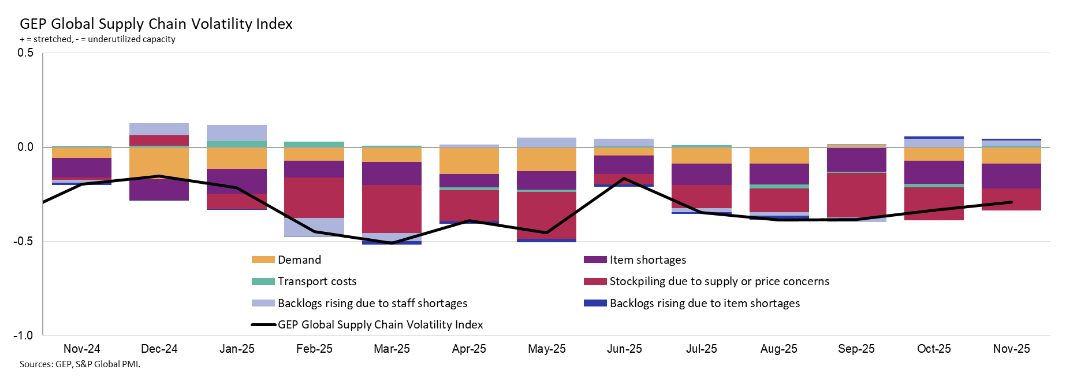
The GEP Global Supply Chain Volatility Index registered -0.29 in November 2025, up modestly from October but still indicating meaningful underutilization of global supply capacity as manufacturers cut back purchasing heading into 2026.
-
North America’s index fell to -0.53 (from -0.45), the sharpest regional deterioration, pointing to the weakest manufacturing demand since March as firms reduced input orders.
-
Asia’s index improved to -0.16 (from -0.30), reflecting slightly less spare capacity overall, though Chinese factory purchasing continued to decline and remained a major regional drag.
-
Europe’s index dipped to -0.33 (from -0.25), signaling persistent fragility across major industrial economies, particularly Germany and France, where firms made deeper purchasing cutbacks.
-
The U.K. index rose to -0.20 (from -0.80), marking its highest level in a year and suggesting early signs of stabilization after a prolonged manufacturing downturn.
-
Global factory demand weakened further, with slower purchasing of commodities and intermediate goods driven by softness in China, the U.S., and key European markets.
-
Inventory accumulation stayed historically low, indicating little concern about price spikes or supply risks and continued preference for lean stock strategies.
-
Material shortages remained well below trend, showing broad availability of goods and minimal sourcing challenges for manufacturers.
-
Labor shortages held only slightly above long-run norms, implying limited labor-related constraints on production capacity.
-
Transportation costs edged higher MoM, but remained broadly in line with historical averages, reinforcing the overall picture of slack rather than strain in global supply chains.