


S&P Global Manufacturing PMIs: November 2025
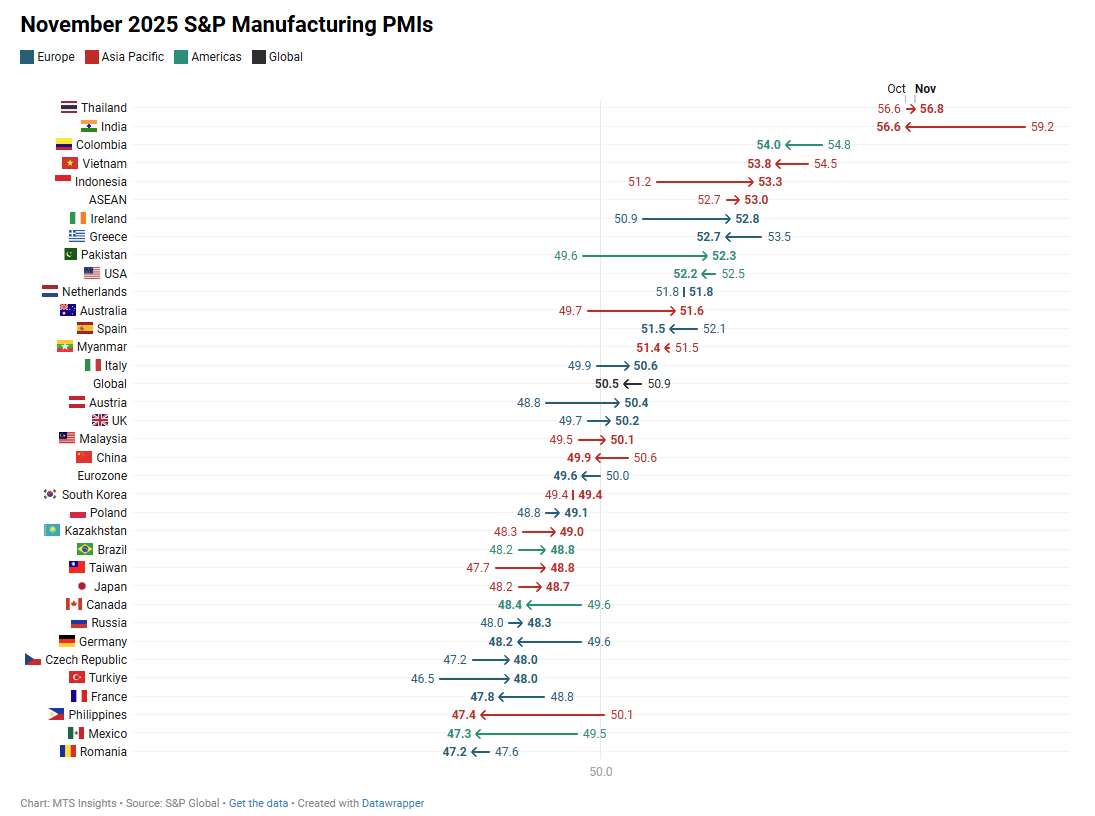
Global - 12/1/2025
Asia Pacific
- Australia - 11/30/2025
- Malaysia - 12/1/2025
- ASEAN - 12/1/2025
- Myanmar - 12/1/2025
- Philippines - 12/1/2025
- Thailand - 12/1/2025
- Vietnam - 12/1/2025
- Indonesia - 12/1/2025
- Japan - 12/1/2025
- Taiwan - 12/1/2025
- China - 12/1/2025
- India - 12/1/2025
- Russia - 11/1/2025
- Kazakhstan - 12/1/2025
- South Korea - 12/1/2025
- Pakistan - 12/1/2025
Europe
- Austria - 11/26/2025
- Ireland - 12/1/2025
- Netherlands - 12/1/2025
- Romania - 12/1/2025
- Turkiye - 12/1/2025
- Poland - 12/1/2025
- Spain - 12/1/2025
- Czechia - 12/1/2025
- Italy - 12/1/2025
- France - 12/1/2025
- Germany - 12/1/2025
- Eurozone - 12/1/2025
- Greece - 12/1/2025
- UK - 12/1/2025
North & South America
Key Results
ASEAN
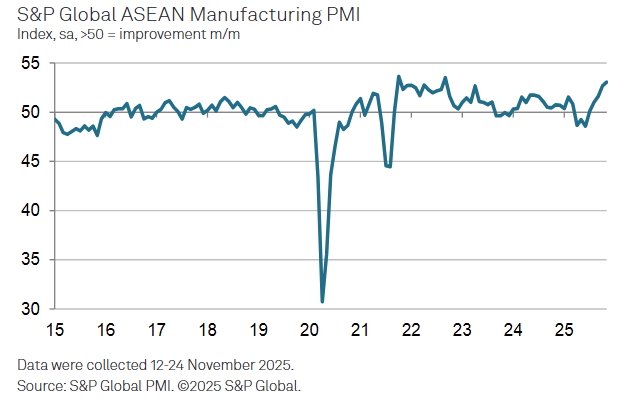
The S&P ASEAN Manufacturing PMI rose to 53.0 in November (from 52.7 in October), marking the third-strongest reading on record and signaling a clear acceleration in regional factory activity.
-
Output and new orders both expanded at faster and historically strong rates, underscoring broad momentum in domestic demand.
-
International orders declined again, showing that external demand lagged even as total new business strengthened.
-
Purchasing activity grew at the fastest pace since March 2024, extending its expansion streak to four months as firms supported rising production needs.
-
Employment increased for the third consecutive month, but gains were only fractional, contributing to capacity pressures and a record rise in backlogs.
-
Input costs rose sharply and at the fastest pace in nearly a year, prompting firms to raise output prices, though both inflation rates remained historically subdued.
-
Business confidence stayed positive and little changed compared with October, but remained below the long-run average, reflecting cautious optimism about future output.
China
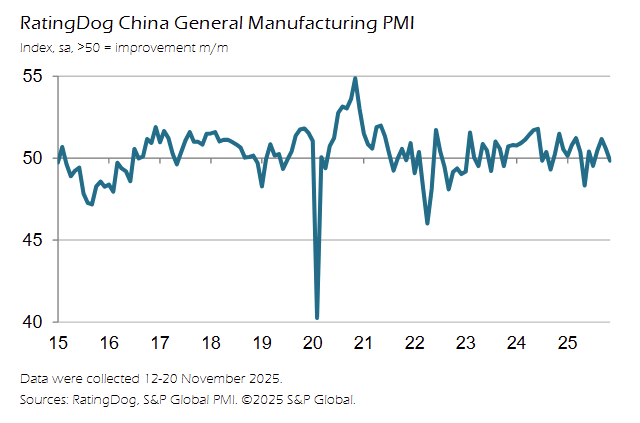
China’s Manufacturing PMI fell to 49.9 in November (from 50.6 in October), marking a slight contraction as production stalled and new orders slowed to near-neutral levels.
-
Output growth came to a halt after three months of expansion, reflecting softer new business inflows and weaker momentum in domestic demand.
-
Total new orders were broadly unchanged, while new export orders rose at the fastest pace in eight months, supported by improved overseas demand and new product launches.
-
Employment returned to contraction, with staffing levels declining marginally as firms cut costs through both resignations and redundancies.
-
Purchasing activity fell for the first time since June, and stocks of purchases dropped at the quickest pace since December 2023, showing caution toward inventory accumulation.
-
Finished goods inventories declined at the fastest rate in nearly three years, indicating firms were reducing holdings amid softer demand conditions.
-
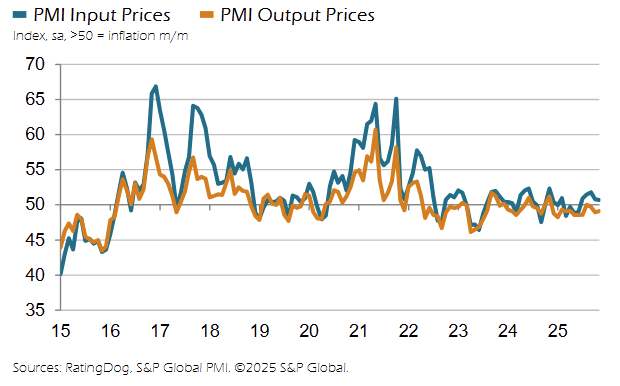
Input costs continued to rise, driven largely by higher metal prices, though the rate of inflation eased to a five-month low; output prices fell further as manufacturers offered discounts.
-
Supplier delivery times shortened, helped by reduced purchasing volumes and better coordination with suppliers.
-
Business confidence improved compared with October, with firms citing expected support from government policies and upcoming product launches as reasons for optimism about future output.
India
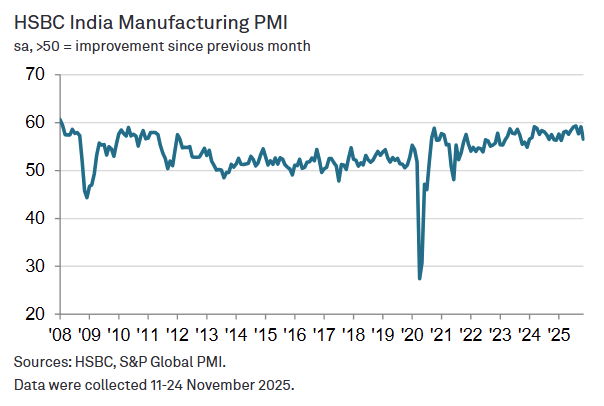
India’s S&P Manufacturing PMI fell to 56.6 in November (from 59.2 in October), marking the slowest improvement since February but still indicating strong expansion relative to long-run norms.
-
New orders rose at a substantial pace but eased to a nine-month low, with firms citing challenging market conditions, delayed project starts and stronger competition.
-
Output expanded sharply but at the weakest rate since February, as softer demand for some product lines tempered gains from efficiency improvements and new business.
-
New export orders increased at the mildest pace in over a year despite broader strength across Africa, Asia, Europe and the Middle East, showing a clear loss of external momentum.
-
Employment rose for the 21st straight month but at the slowest rate in the current expansion, as firms adjusted hiring in line with softer sales growth.
-
Input cost inflation eased to a nine-month low and output charge inflation to an eight-month low, allowing firms to limit price increases.
-
Purchasing activity continued to grow, supporting another accumulation of input inventories, though the pace of stock-building slowed to a nine-month low.
-
Finished goods inventories fell as firms met demand directly from existing stocks, reflecting relatively subdued pressure on capacity.
-
Business confidence declined to its lowest level since mid-2022, with survey evidence pointing to concerns about competition and weaker demand conditions.
Eurozone
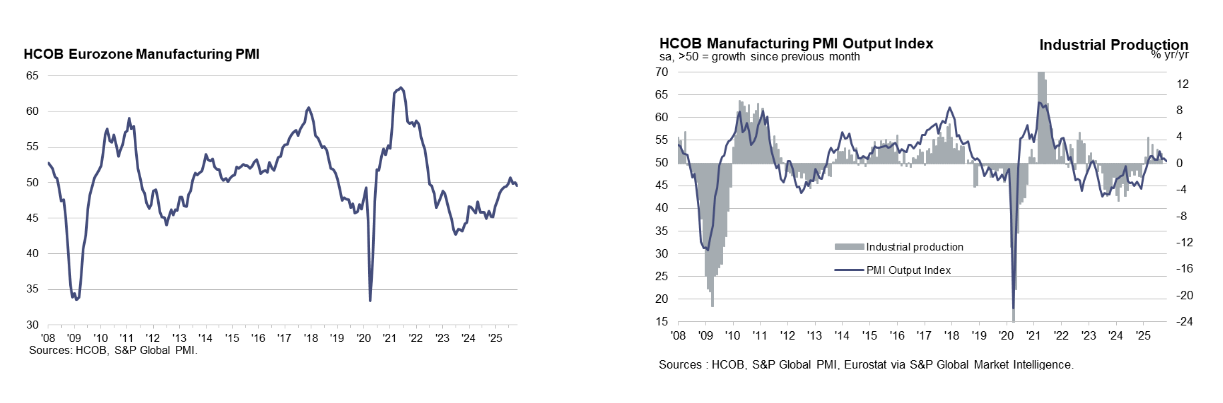
The Eurozone S&P Manufacturing PMI slipped to 49.6 in November (from 50.0 in October), marking a renewed but mild contraction amid softer demand and weaker conditions in Germany and France.
-
The Output Index eased to 50.4 (from 51.0), its weakest reading in nine months, showing that production growth persisted but at a slower and marginal pace.
-
New orders declined again after stabilising in October, reflecting fresh demand headwinds; new export orders also fell for a fifth straight month.
-
Employment fell at the sharpest rate since April, while purchasing activity and inventories contracted more quickly, indicating more aggressive retrenchment across factories.
-
Stocks of finished goods dropped at the fastest pace in almost four and a half years, suggesting firms relied heavily on inventories to support output.
-
Supplier delivery times lengthened to the greatest extent since October 2022, with firms reporting material shortages and difficulties sourcing internationally.
-
Input prices rose at the strongest rate since March following months of stability, yet output charges declined slightly, pointing to limited pricing power.
-
Business confidence improved and moved above its long-run average, with sentiment reaching the highest level since June despite ongoing operational softness.
-
Country performance was uneven: Ireland, Greece, the Netherlands, Spain, Italy, and Austria all recorded expansion, while Germany (48.2) and France (47.8) fell to nine-month lows and deeper into contraction.
UK
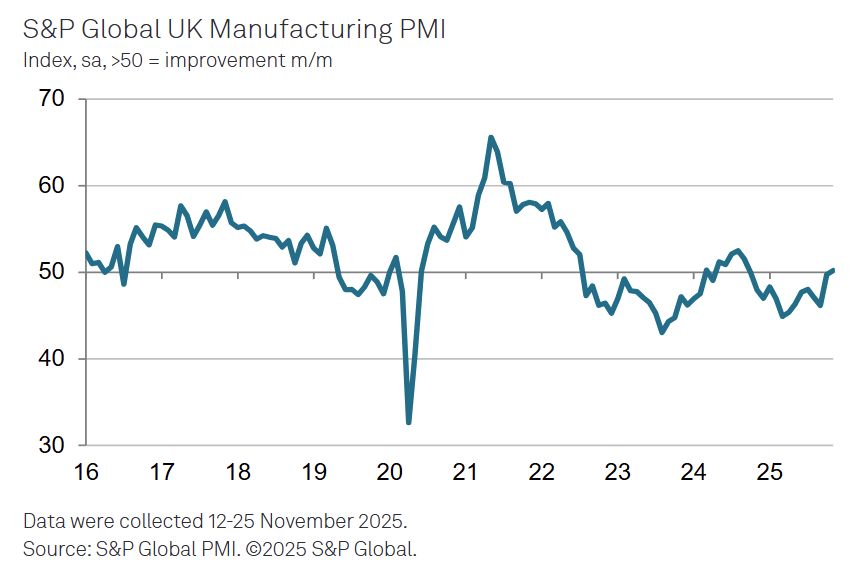
The UK Manufacturing PMI rose to 50.2 in November (from 49.7 in October), marking a 14-month high as production increased again and new orders stabilized after more than a year of declines.
-
Output expanded for a second straight month, though the rise was modest and driven mainly by investment goods; consumer and intermediate goods output continued to contract.
-
New orders were unchanged after a 13-month contraction, supported by stronger domestic demand, while new export orders fell for the forty-sixth month but at the slowest rate in a year.
-
Employment declined for the thirteenth month, with firms cutting full-time, part-time, agency and temporary roles amid cost pressures and uncertainty ahead of the Budget.
-
Backlogs fell at the quickest pace since April, highlighting excess capacity despite the upturn in production.
-
Supplier delivery times deteriorated at the fastest rate in almost a year due to vendor shortages, transport disruptions and customs delays.
-
Factory gate prices fell for the first time in more than two years as firms faced weak market conditions and discount pressure, while input cost inflation eased to its slowest pace since October 2024.
-
Stocks of purchases contracted and finished goods inventories were trimmed further, indicating ongoing caution in inventory management.
-
Business optimism rose to a nine-month high, with 56 percent of firms expecting higher output over the next year amid hopes for market stabilization, new technologies and planned expansions.
US
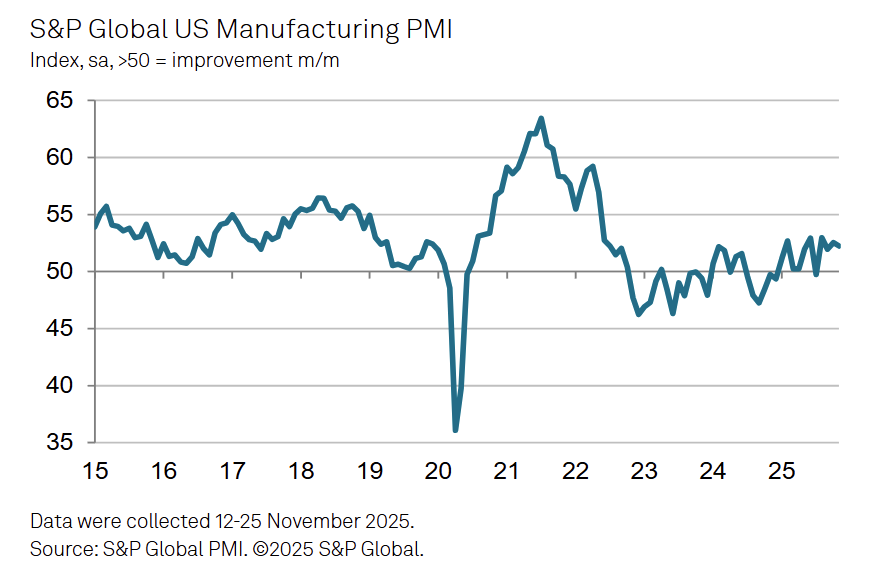
The US S&P Manufacturing PMI eased to 52.2 in November (from 52.5 in October), marking a fourth month of expansion but with softer demand growth and a record rise in finished-goods inventories.
-
Output rose at the fastest pace since August, supported by gains in both new and existing client orders, though the overall rise in demand was much slower than in October.
-
New export orders fell for a fifth straight month and at the steepest pace since July, reflecting ongoing tariff-related weakness in international sales.
-
Finished-goods inventories increased at the sharpest rate in the survey’s 18-year history, as production outpaced sales and firms reported weaker-than-expected demand.
-
Employment grew at the strongest pace in three months as firms filled vacancies and prepared for expected increases in production and sales.
-
Backlogs fell for a third month, indicating ample capacity and reinforcing that recent output gains were not driven by workload pressures.
-
Input buying rose only marginally, as earlier stockbuilding reduced the need for additional purchases; vendor delivery times lengthened for the third month amid border and tariff-related disruptions.
-
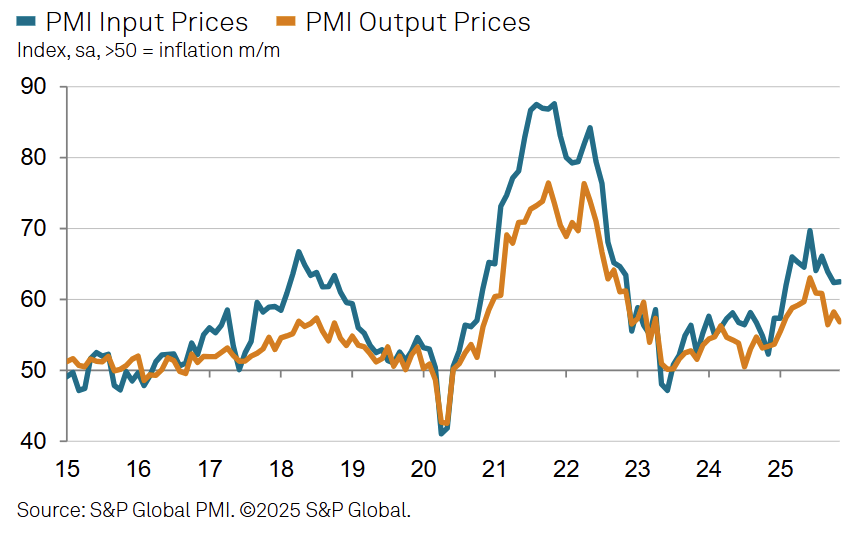
Input costs remained elevated, with metals frequently cited as a driver of price increases; selling price inflation eased and was among the lowest of the year as competition limited pass-through.
-
Business confidence improved to the highest level since June, supported by expectations of policy support, new product launches and increased government spending following the end of the shutdown.