


China NBS PMIs: November 2025
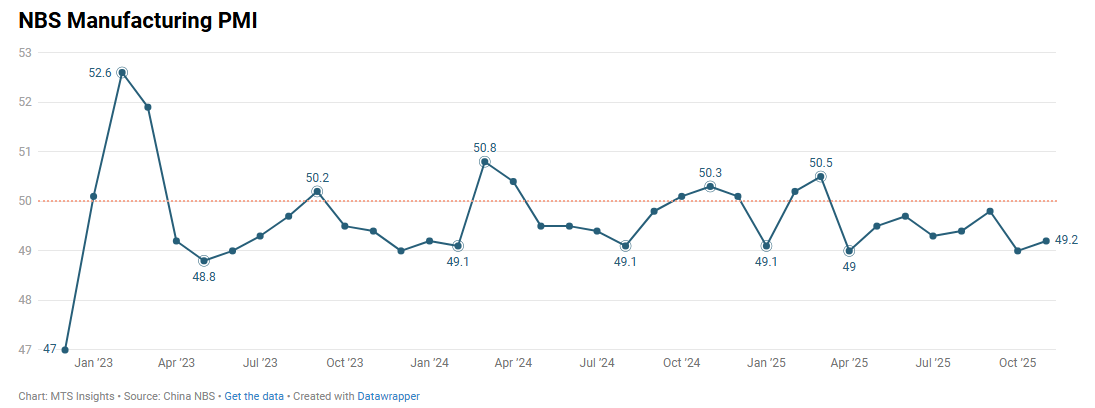
China’s Manufacturing PMI edged up to 49.2 in November 2025 (from 49.0 in October), marking a modest improvement but remaining below the 50 threshold, reflecting continued mild contraction with slightly better production and demand conditions.
-
The Production Index rose to 50.0 (from 49.7), reaching the critical point and indicating broadly stable manufacturing output.
-
New Orders increased to 49.2 (from 48.8), showing a small pickup in demand even as the index remained below the expansion threshold.
-
Raw Material Inventories held at 47.3, unchanged from October, signaling ongoing drawdowns of key inputs.
-
The Employment Index increased slightly to 48.4 (from 48.3), suggesting a marginal improvement in labor conditions but still indicating contraction.
-
Supplier Delivery Times rose to 50.1 (from 50.0), a slight acceleration that points to marginally faster logistics performance.
-
By firm size, the PMI for large enterprises fell to 49.3 (-0.6 pts), while medium and small firms improved to 49.1 (+2.0 pts) and 48.9 (+0.2 pts), respectively, with all categories remaining below 50.
-
Related indicators showed New Export Orders at 47.6 (from 45.9) and Imports at 47.0 (from 46.8), indicating mildly improved but still weak trade activity.
-
Input price momentum was steady, with the Purchase Price Index at 48.2 (from 47.5), while the Factory Price Index eased to 47.3 (from 48.1), suggesting subdued cost pressures and weak pricing power.
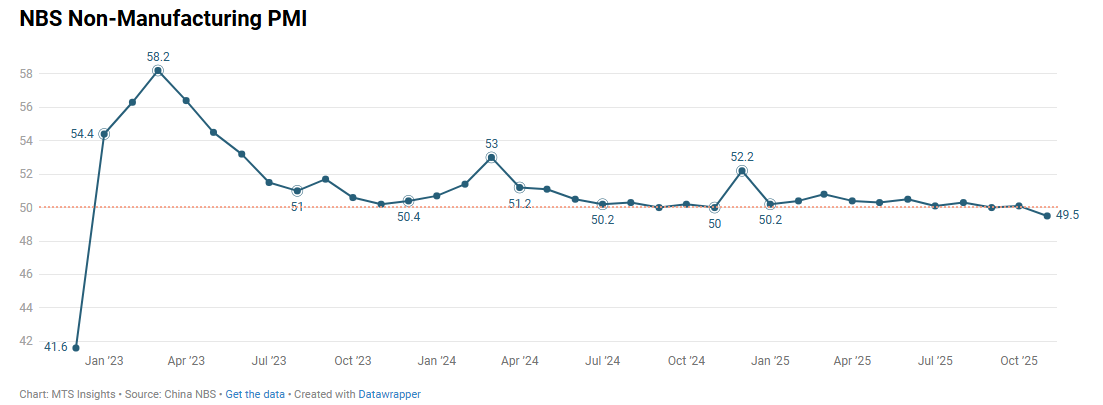
China’s Non-Manufacturing Business Activity Index fell to 49.5 in November (from 50.1 in October), reflecting a mild weakening in overall activity driven by softer service-sector momentum.
-
The services activity index declined to 49.5 (-0.7 pts), while construction activity rose to 49.6 (+0.5 pts), showing mixed sector performance.
-
New orders eased to 45.7 (-0.3 pts), remaining well below 50 and indicating continued weak demand across both services (45.6, -0.4 pts) and construction (46.1, +0.2 pts).
-
Input prices increased to 50.4 (+1.0 pt), with costs rising in both construction (49.7, +0.1 pt) and services (50.5, +1.1 pts), pointing to firmer input cost pressures.
-
The sales price index improved to 49.1 (+1.3 pts) but stayed below the critical level, suggesting that price declines persist but have narrowed.
-
Employment edged up to 45.3 (+0.1 pt), showing only a slight improvement; construction employment rose to 41.8 (+1.9 pts), while services dipped to 45.9 (-0.2 pts).
-
Business activity expectations remained strong at 56.2 (+0.1 pt), with confidence higher in construction (57.9, +1.9 pts) and slightly weaker in services (55.9, -0.2 pts).
-
Among auxiliary indicators, new export orders softened to 47.9 (-0.3 pts), orders in hand stayed flat at 43.6, and supplier delivery times held steady at 51.2, indicating stable logistics conditions.
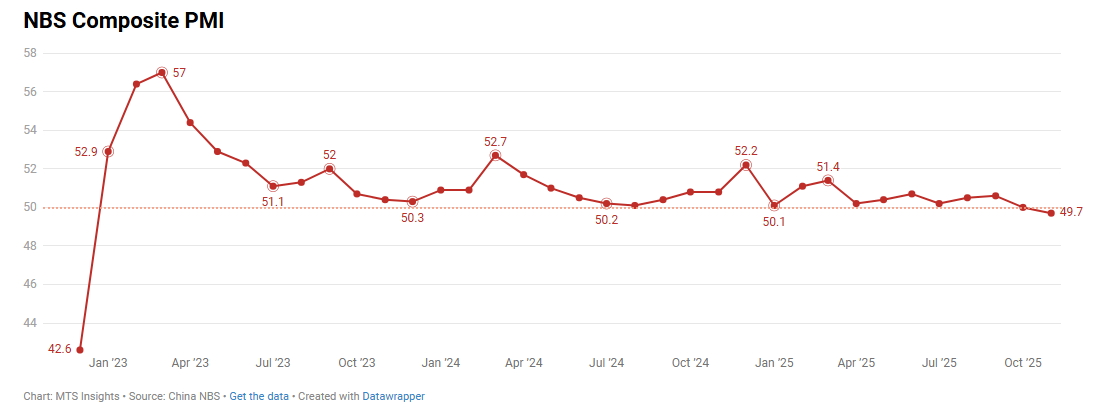
The Composite Index fell -0.3 pts to 49.7, the first time this index fell below 50 into contraction territory since December 2022.