


FOMC Minutes: October 2025 Meeting
Key takeaways from the FOMC Minutes for the October 28-29, 2025 meeting:
-
Market expectations were stable, with investors pricing a -25 bp cut in October and another -25 bp in December, and Treasury yields holding little changed, reflecting an unchanged macro outlook.
-
Inflation compensation moved lower, especially at shorter maturities, as staff models attributed the decline to temporary factors, while broad equity indexes rose on continued optimism around AI-driven earnings.
-
Money markets tightened, with repo rates rising relative to IORB and SRF take-up occurring on several days, signaling reserves were moving closer to ample and prompting discussion about ending balance sheet runoff soon.
-
Participants agreed that reinvestments should shift toward Treasury bills once runoff stops, with many favoring a longer-run SOMA composition that more closely matches the distribution of Treasury securities outstanding.
-
Staff estimated September PCE and core PCE at 2.8% YoY, noting both remained somewhat elevated, with tariff-related pressures expected to push inflation higher in 2025–26 before returning to a disinflation trend.
-
GDP growth was moderate in H1, with indicators suggesting continued expansion but limited visibility due to the government shutdown; consumption was firming but increasingly dependent on higher-income households.
-
Labor market indicators pointed to gradual cooling, with job gains slowing, unemployment edging higher, and businesses showing hesitation to hire or fire; participants noted weaker labor demand but still limited layoffs.
-
Financial conditions remained supportive, with equity gains, tight credit spreads, and robust issuance, though vulnerabilities in private credit and elevated asset valuations were noted.
-
Participants were divided on inflation risks, with some citing tariff pass-through and sticky services inflation, while others pointed to weaker labor markets and productivity gains as moderating forces.
-
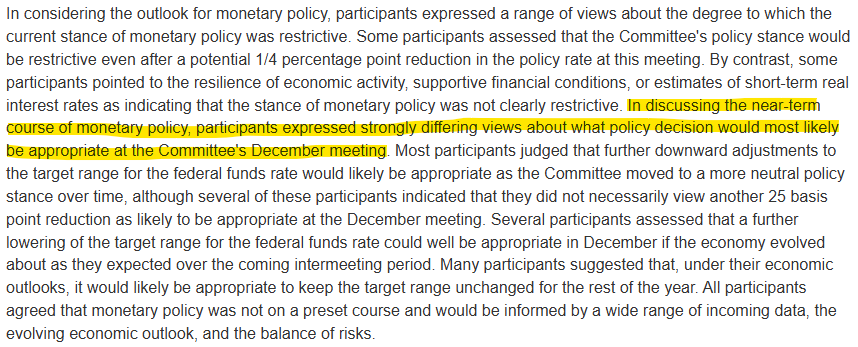
The Fed remained very divided on the December decision. Most participants judged further easing likely as policy moves toward neutral, though several cautioned that another cut in December was not guaranteed and emphasized the need for data-dependent decision-making.
-
Towards the end of the FOMC Minutes, we see two statements that highlight the division in the FOMC. We don't get exact numbers on each side, so "many" vs "most" is up to interpretation (in my opinion, "most" > "many").
-
Doves: "Many of these participants also judged that, with more evidence having accumulated that the effect on overall inflation of this year's higher tariffs would likely be limited, it was appropriate for the Committee to ease its policy stance in response to downside risks to employment."
-
Hawks: "Most participants noted that, against a backdrop of elevated inflation readings and a very gradual cooling of labor market conditions, further policy rate reductions could add to the risk of higher inflation becoming entrenched or could be misinterpreted as implying a lack of policymaker commitment to the 2% inflation objective."
-