

Monthly Budget Review: October 2025
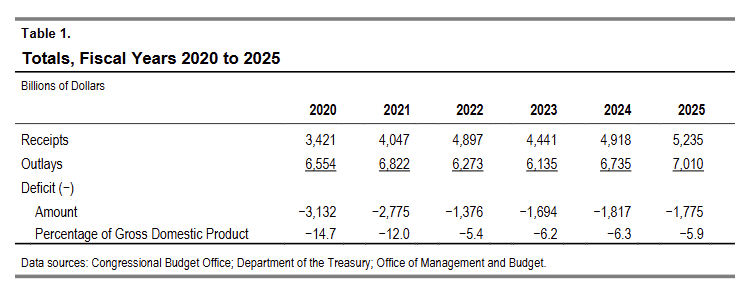
The U.S. federal budget deficit totaled $1.8 trillion in FY2025, a decline of -$41 billion (-2% YoY) from FY2024, reflecting stronger revenue growth and moderate spending increases, while net interest surpassed $1 trillion for the first time. The deficit equaled 5.9% of GDP (down from 6.3% in FY2024), and public debt rose to 99.8% of GDP (from 97.4%).
-
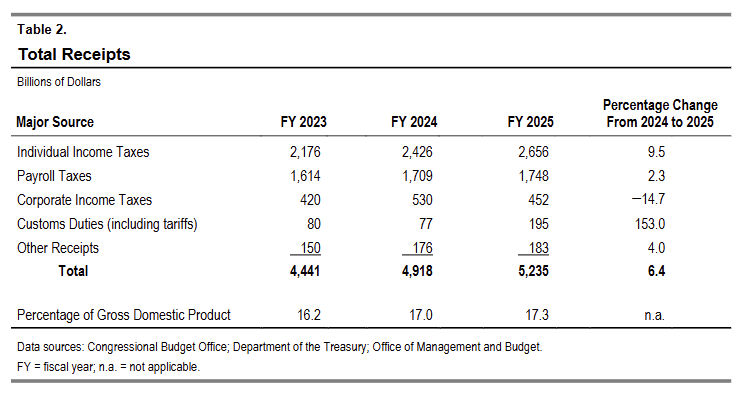
Total receipts rose +6% (+$317B YoY) to $5.23T, or 17.3% of GDP, matching the 50-year average. The gain was led by individual income taxes (+$230B, +9%), which rose to 8.8% of GDP, their second-highest share in decades.
-
Payroll tax receipts increased +2% (+$39B), while corporate income taxes fell -15% (-$78B) to 1.5% of GDP, partly reflecting larger deductions from the 2025 reconciliation act.
-
Customs duties and tariffs surged +153% (+$118B) to 0.6% of GDP, far above the long-run average of 0.2%, as new tariff measures took effect earlier in the year.
-
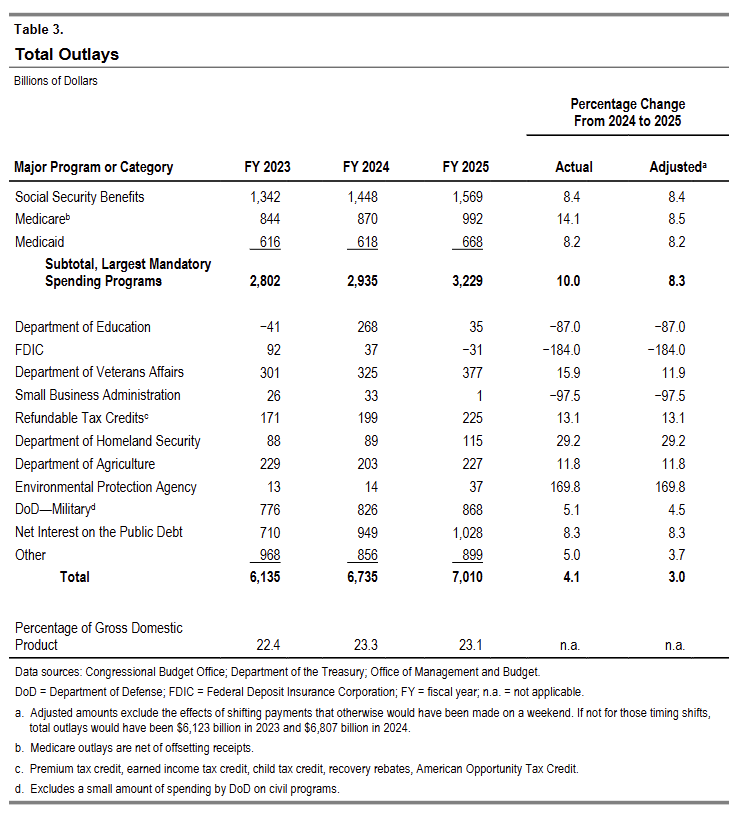
Total outlays increased +4% (+$275B YoY) to $7.01T, or 23.1% of GDP, slightly below FY2024’s ratio but above the 50-year average of 21.2%. Adjusted for timing shifts, outlays grew +3%.
-
The largest mandatory programs—Social Security (+$121B, +8%), Medicare (+$77B, +8%), and Medicaid (+$51B, +8%)—accounted for nearly all spending growth.
-
Net interest on the public debt jumped +8% (+$79B) to $1.03T, marking the first fiscal year above $1 trillion.
-
Several categories offset growth: Education outlays fell -87% (-$233B) due to federal student loan adjustments, FDIC spending dropped -184% (-$68B) as bank resolution costs normalized, and SBA spending plunged -98% (-$32B).
-
Among other areas, Veterans Affairs (+$40B, +12%), Defense (+$37B, +4%), Homeland Security (+$26B, +29%), and EPA (+$23B, +170%) saw notable increases.
-
CBO noted that if not for timing shifts from the previous year, the FY2025 deficit would have been 6% smaller rather than 2% smaller, underscoring the structural improvement in federal finances.