
UK Employment: October 2025 Report
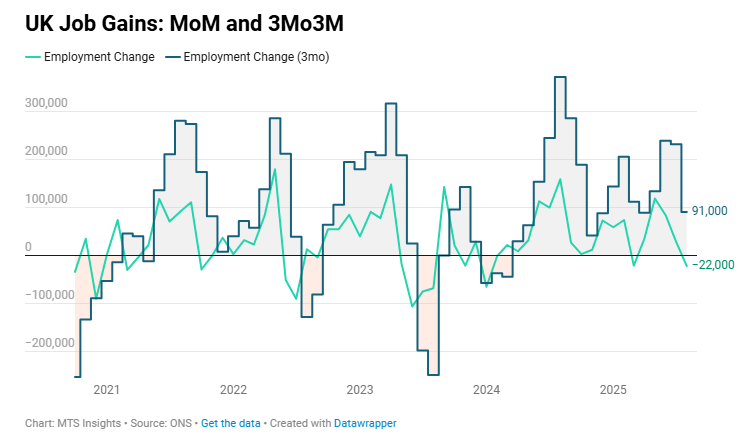
The UK added 91k jobs in the three months to August, down from the 232k increase in the three months to July and the smallest increase since April.
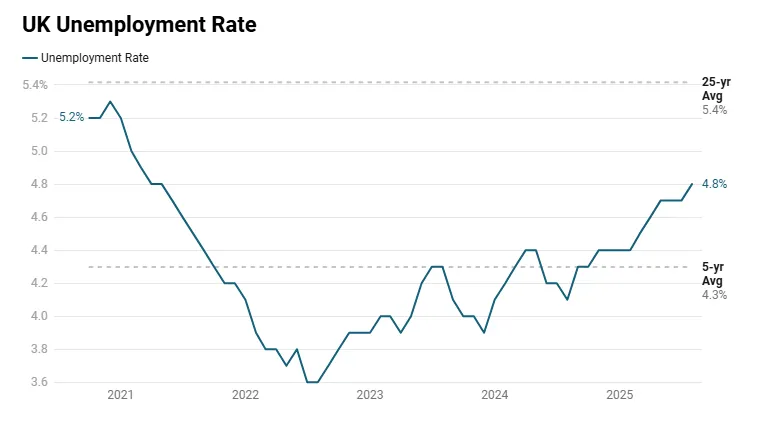
- The unemployment rate ticked up 0.1 ppt to 4.8% in August, slightly ahead of expectations of it remaining at 4.7%. This is the highest unemployment rate since May 2021.
- The economic inactivity rate dropped again, down -0.1 ppt to 21.0% in August and was down -0.7 ppts from a year ago.
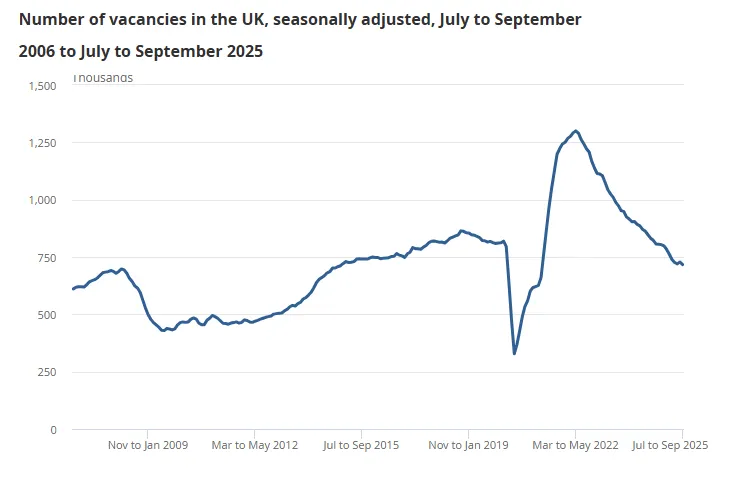
UK job vacancies fell -9k (or -1.3% QoQ) to 717k in Jul-Sep 2025 and were -13.8% YoY, extending a three-year slide and signaling further easing in labor-market tightness.
- This was the 39th consecutive quarterly decline, with vacancies now -78k (-9.8%) below the pre-COVID Jan-Mar 2020 level.
- The unemployment-to-vacancy ratio rose to 2.4 in Jun-Aug (from 2.3 in the prior quarter and 1.7 a year earlier), indicating looser hiring conditions.
- Quarterly moves were mixed across industries: 9 of 18 sectors fell, led by real estate activities (-20.6% QoQ); the largest volume drop was in human health & social work (-10k), followed by accommodation & food service (-5k).
- On a YoY basis, vacancies declined in 16 of 18 sectors, with construction showing the steepest fall (-25.9% YoY).
- Relative to pre-pandemic levels, 12 sectors were lower, including wholesale & retail trade, repair of motor vehicles and motorcycles (-37k, -28.3%).
- By firm size, the biggest quarterly decrease was among businesses with 10-49 employees (-8k, -7.0% QoQ); all size bands recorded YoY declines, led again by the 10-49 group (-26k, -19.9% YoY).
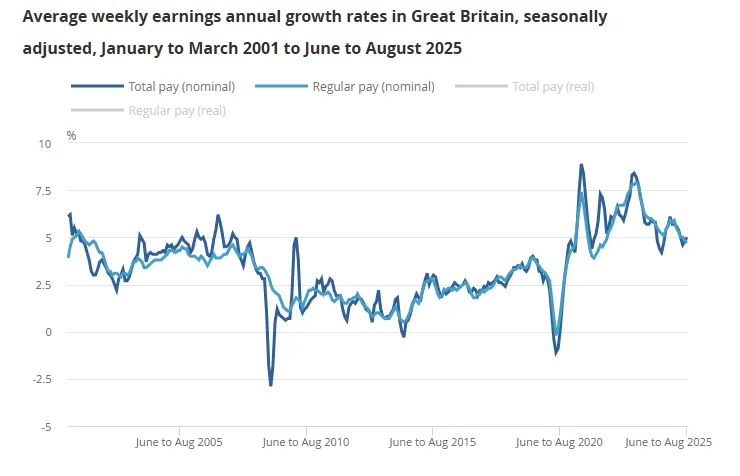
UK average weekly earnings rose 4.7% YoY (vs 4.7% YoY expected) for regular pay in August, down from 4.8% YoY in July and the lowest annual growth since May 2022.
- Total pay increased 5.0% YoY (vs 4.7% YoY) in August, up from 4.8% YoY previously as growth in bonus pay appears to have accelerated.
- In real terms (CPIH-adjusted), regular pay grew +0.6% YoY and total pay +0.8% YoY, both remaining positive for a second consecutive quarter.
- Using CPI as the deflator, real regular pay increased +0.9% YoY and total pay +1.2% YoY, up slightly from the prior period.
- Average weekly earnings reached £682 for regular pay and £733 for total pay, continuing a steady long-term upward trend.
- Public sector regular pay rose +6.0% YoY, boosted by timing effects of earlier pay settlements, while private sector pay growth eased to +4.4% YoY, its lowest since late 2021.
- Total pay rose +5.8% YoY in the public sector and +4.8% YoY in the private sector.
- Among industries, the wholesaling, retailing, hotels, and restaurants sector showed the second-strongest regular pay growth (+5.9% YoY), while finance and business services recorded the weakest (+2.9% YoY).
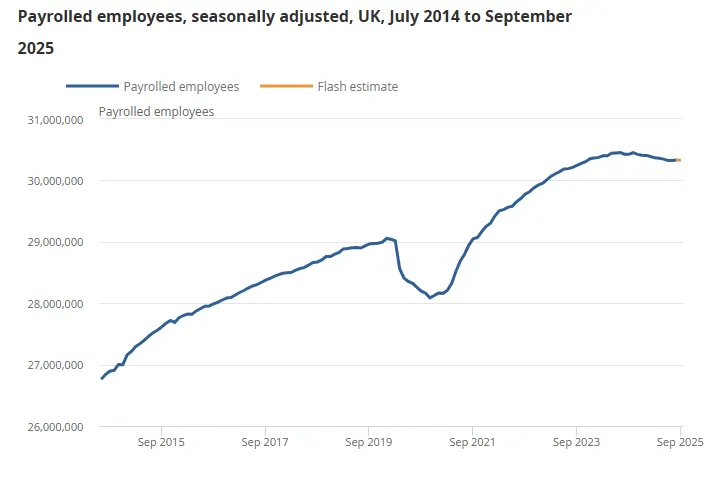
UK payrolled employment edged down -10k (0.0%) MoM in September 2025 to 30.3 million, and was -100k (-0.3%) lower YoY, extending the gradual softening seen since 2022.
- August 2025 data were revised upward from -8k to +10k MoM after incorporating additional RTI submissions.
- The health and social work sector added +45k employees YoY, the largest gain across industries.
- Accommodation and food service activities saw the sharpest decline, with employment down -59k YoY.
- Median monthly pay rose +5.5% YoY in September 2025, with transportation and storage posting the strongest growth (+8.0% YoY) and professional, scientific, and technical activities the weakest (+3.0% YoY).
- The ONS noted that employment growth has been trending lower since early 2022, following post-pandemic recovery highs in 2021.