
US Retail Sales: August 2025
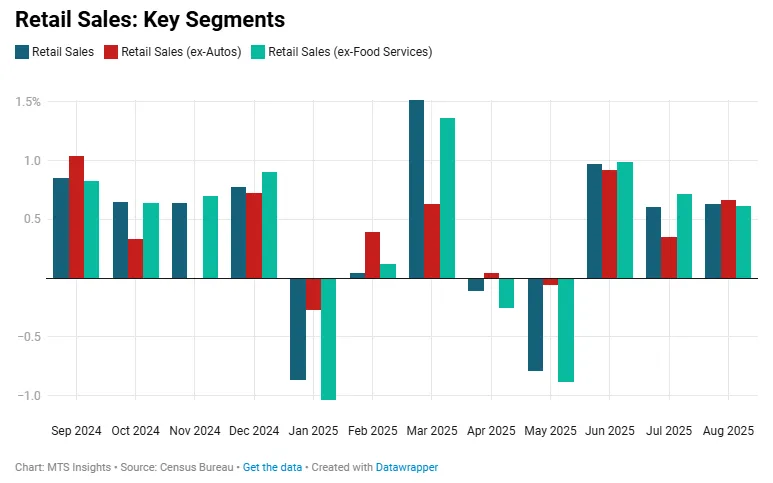
Consumers continued to show their resilience in August as retail sales came in above expectations in the second month of Q3 2025. The headline sales total increased by 0.6% MoM, ahead of the consensus forecast of just 0.2% MoM. Adding to the strength in the report was an upward revision in July's monthly growth from 0.5% MoM to 0.6% MoM. Overall, the summer months have brought about a strong trend in the retail sector with monthly growth averaging around 0.75% from June to August. Sales in those three months are up 1.0% over the March-May period and up 4.5% YoY.
The August retail sales number was heavily affected by the large auto segment as well. Retail sales of motor vehicles & parts were up 0.5% MoM, slightly behind the headline pace as the auto market cooled down from volatility seen earlier this year, caused by tariffs. Affordability is also a concern and has put a bit of a dampener on auto spending over the summer. The segment’s sales over the last three months were down by -0.4% MoM compared to the March-May period. However, on an annual basis, auto sales are up 5.6% YoY.
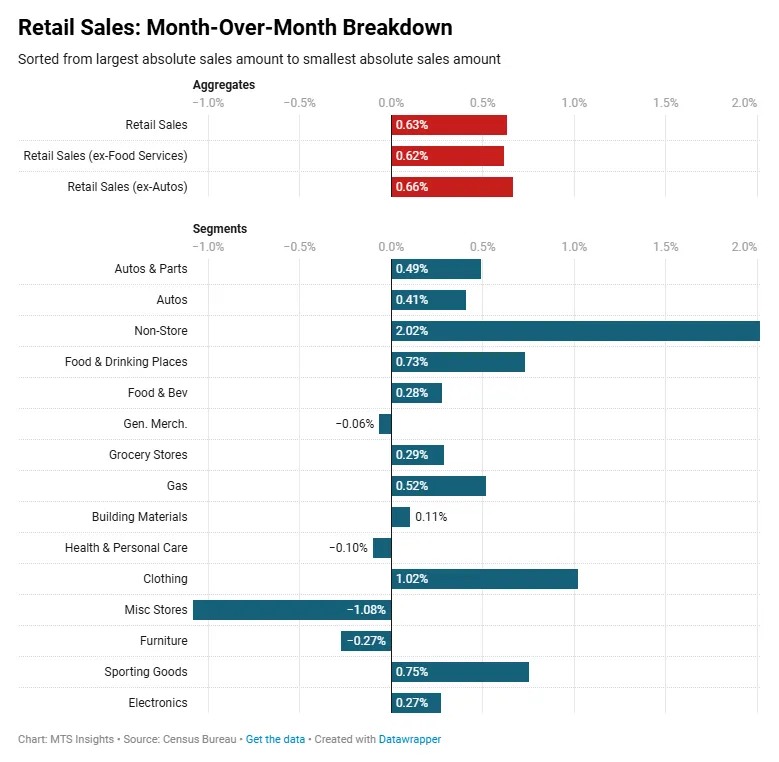
Outside of the auto segment, sales growth was even stronger than the headline rate, up 0.7% MoM, ahead of expectations of a 0.4% MoM increase. Here’s how the segments break down:
- The non-store segment of sales, the second largest segment, played a major role in driving sales growth in August. It saw a sharp 2.0% MoM increase, the largest one-month increase since September 2024. Removing this segment and the auto segment, sales growth was just 0.3% MoM in August and averaged 0.5% MoM in the summer months.
- Food & drinking place sales growth was 0.7% MoM in August and has been pretty strong over the summer. However, the solid growth in August looks tamer after a slight -0.1% MoM drop in July. Regardless, spending on this segment is up a healthy 6.5% YoY.
- Sales growth in various non-discretionary segments was a bit tamer. The food & beverage (+0.3% MoM), general merchandise (-0.1% MoM), and gas station (+0.5% MoM) segments all saw increases in August below the headline rate. When adjusted for inflation, these smaller gains suggest flat volume growth.
- Real estate-related segments looked to be some of the weakest segments in August. Furniture sales dropped -0.3% MoM during the month, though this did come after a 1.6% MoM increase in July. This segment may also have been affected by tariff-related volatility since furniture purchases tend to be infrequent and on the larger side. Building materials sales were up just 0.1% MoM in August and fell -0.9% during the summer months. Both tariffs and housing sector weakness are likely to continue to weigh on sales here in the near future.