


S&P Global Manufacturing PMIs: March 2025
Global - 4/1/2025
Asia Pacific
- Australia - 3/31/2025
- Malaysia - 4/2/2025
- ASEAN - 4/2/2025
- Myanmar - 4/1/2025
- Philippines - 4/2/2025
- Thailand - 4/1/2025
- Vietnam - 4/1/2025
- Indonesia - 4/2/2025
- Japan - 4/1/2025
- Taiwan - 4/1/2025
- China - 4/1/2025
- India - 4/2/2025
- Russia - 4/1/2025
- Kazakhstan - 4/1/2025
- South Korea - 4/1/2025
- Pakistan - 4/3/2025
Europe
- Austria - 3/27/2025
- Ireland - 4/1/2025
- Netherlands - 4/1/2025
- Romania - 4/1/2025
- Turkiye - 4/2/2025
- Poland - 4/1/2025
- Spain - 4/1/2025
- Czechia - 4/1/2025
- Italy - 4/1/2025
- France - 4/1/2025
- Germany - 4/1/2025
- Eurozone - 4/1/2025
- Greece - 4/1/2025
- UK - 4/1/2025
North & South America
Key Results
Australia
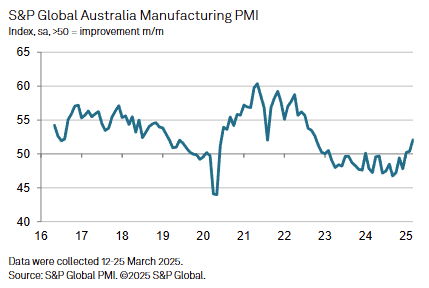
Australia’s S&P Manufacturing PMI increased 1.7 pts to 52.1 in March, the highest since October 2022.
- Production increased at the highest rate since October 2022, and new order growth was the strongest since November 2022.
- Employment growth was the strongest in two years as production and new order growth was strong.
- Manufacturing confidence was the 2nd-strongest since August 2022.
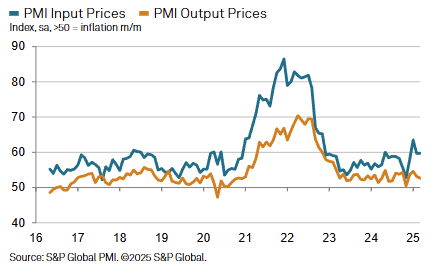
- Average input costs rose at a pace that was steep and unchanged from February amid reports of higher raw material, transport and finance costs.
- The rate of selling price inflation eased since February, however, as Australian manufacturers partially absorbed cost increases in a bid to support sales as competition intensified.
China
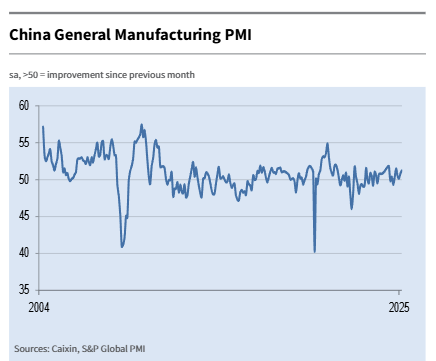
China’s S&P Manufacturing PMI improved to a 4-month high in March, up 0.4 pts to 51.2. This is consistent with the slight improvement in the NBS Manufacturing PMI.
- Production accelerated for the third straight month as both domestic and foreign demand conditions improved. Export orders increased at the largest rate since April 2024.
- The improvement in activity led to employment increasing for the first time in 19 months.
- Supplier discounts and reductions in certain raw material costs contributed to the first fall in average input prices in six months.
- The reduction in cost burdens enabled Chinese manufacturers to reduce their factory gate prices in March.
France
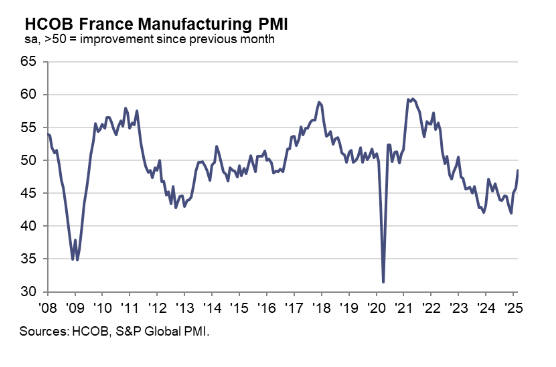
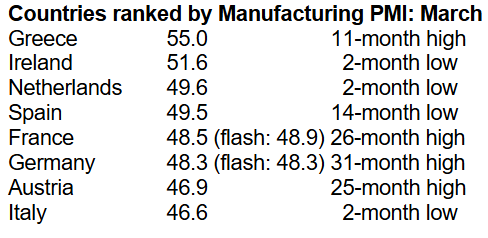
France’s S&P Global Manufacturing PMI increased 3.0 pts to 48.5 in March, the highest in 26-months.
- The declines in new orders and outputs were the slowest in roughly three years with consumer goods manufacturing being the main bright spot.
- Employment declined at the softest rate since June 2023.
Germany
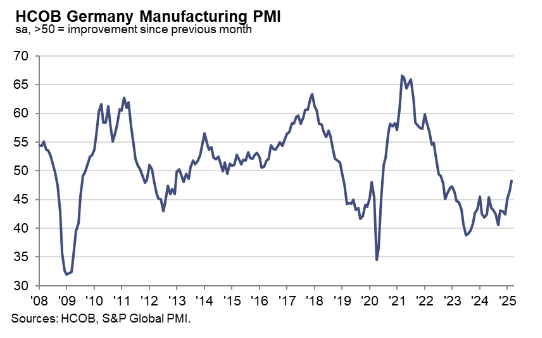
The S&P Global Germany Manufacturing PMI jumped 1.8 pts to 46.5, a 31-month high, and the Output Index jumped 3.2 pts to 52.1, a 36-month high.
- Production not only rose for the first time in almost two years, but the rate of growth was the quickest recorded since March 2022.
- New orders grew for the first time in three years as stronger domestic orders were reported while export orders were slightly lower.
- Looking ahead, March's survey results showed an upward revision to manufacturers' growth expectations. Firms were the most upbeat for more than three years, buoyed by the prospect of greater infrastructure spending
- The declines in manufacturers' purchasing activity and stocks of inputs eased at the end of the opening quarter, with the former exhibiting its slowest reduction since August 2022.
- The rate of decline in input prices was slightly slower than in February, as was also the case for factory gate charges.
Eurozone
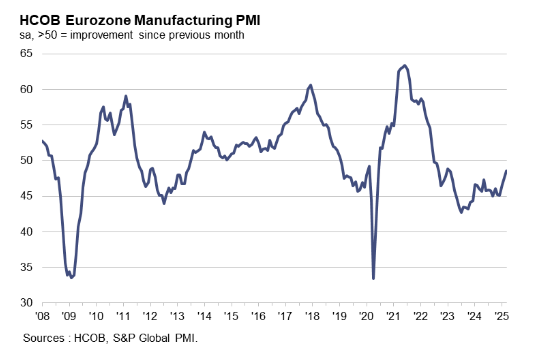
With manufacturing recoveries in Germany and France noted in their PMIs, the Eurozone S&P Manufacturing PMI increased 1.0 pts to 47.6, a 26-month high, with the Output index up 1.6 pts to a 34-month high of 50.5.
- Production levels increased for the first time since March 2023 and the strongest since May 2022.
- New factory orders fell in March, as they have done continuously for almost three years, but the rate of decline was the weakest over this period.
- Export markets remained a drag on sales performances, with demand from foreign clients decreasing further. That said, the pace of contraction was the softest since April 2022.
UK
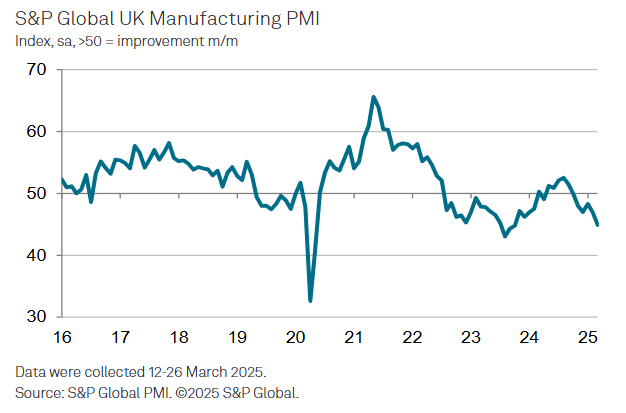
The UK S&P Manufacturing PMI fell -2.0 pts to 44.9, the lowest in 17 months as production declined at the fastest pace since October 2023.
- Business optimism was at weakest level since November 2022.
- The UK manufacturing sector saw steeper drops in output, new orders and new export business.
US
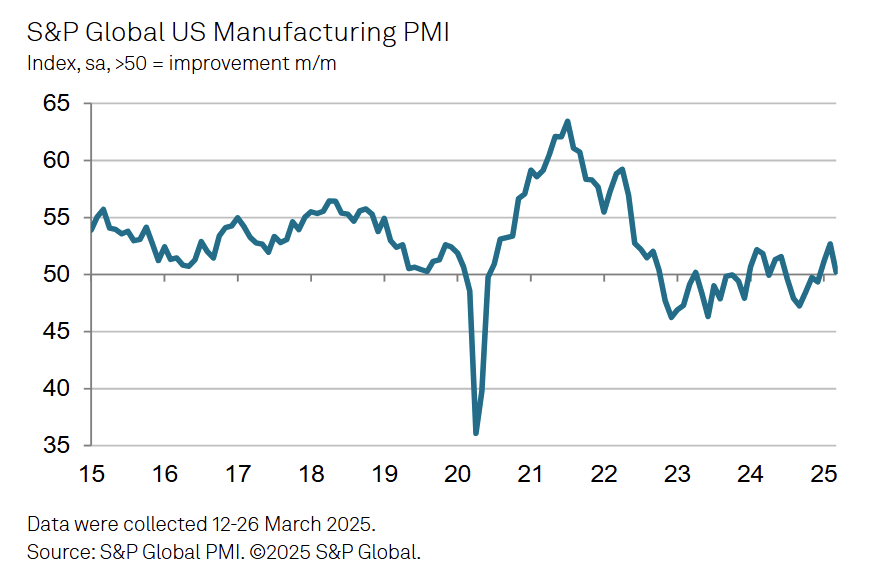
The US S&P Manufacturing PMI fell -2.5 pts to 50.2 in March, above expectations of a decline to 49.8.
- Production declined for the first time since following a strong increase in February which aligned with firms front-running tariffs.
- This served to weigh on new order book growth, which was modest overall in March and the lowest of the year so far.
- Confidence in the outlook softened again in February, dropping for a second successive month to its lowest level since December.
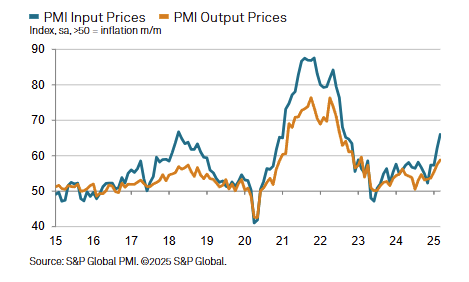
- Overall, input price inflation spiked higher in March, hitting its highest level since August 2022.
- The steep increase in input prices fed through to a greater rise in manufacturing selling prices during March. The latest data showed that output price inflation picked up for a fourth successive month to a 25-month high.