

Paychex Small Business Employment Watch: July 2026
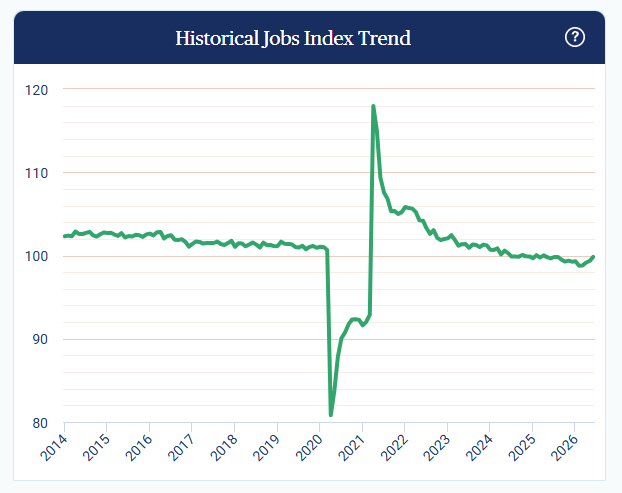
The Paychex Small Business Jobs Index rose +0.49 pts MoM to 99.83 in June 2026 and +0.18 pts YoY, reaching its highest level since August 2025 and signaling improving small business hiring momentum.
-
The national jobs index increased to 99.83 (+0.49 pts MoM), marking its highest reading since August 2025 and indicating continued strengthening in small business employment growth.
-
On a YoY basis, the index rose +0.18 pts, representing the first positive 12-month change since March 2022 and suggesting hiring conditions have improved compared with a year earlier.
-
Small business employment growth accelerated for a fourth consecutive month, marking the first four-month streak of improvement since November 2020.
-
The Midwest remained the strongest region with an index of 100.24, extending its lead to 25 consecutive months, while the West climbed +1.22 pts MoM to 100.00 as both the Pacific and Mountain divisions gained more than one point.
-
All four regions improved over the past three months, with the West posting the largest quarterly gain at +1.95 pts, indicating broad-based regional improvement.
-
Indiana led all states with an index of 101.46, reclaiming the top position and posting the strongest three-month increase (+3.15 pts). California rose above 100 (100.01) for the first time since March 2024, while Washington remained the weakest state at 98.75 despite positive recent momentum.
-
Seventeen of the 20 states analyzed increased their pace of small business employment growth during the past quarter, highlighting widespread improvement across state labor markets.
-
Education and Health Services remained the strongest sector with an index of 100.68, while Leisure and Hospitality increased +1.68 pts MoM to 99.55, reaching its highest level in two years after ranking among the bottom two sectors for nearly two years.
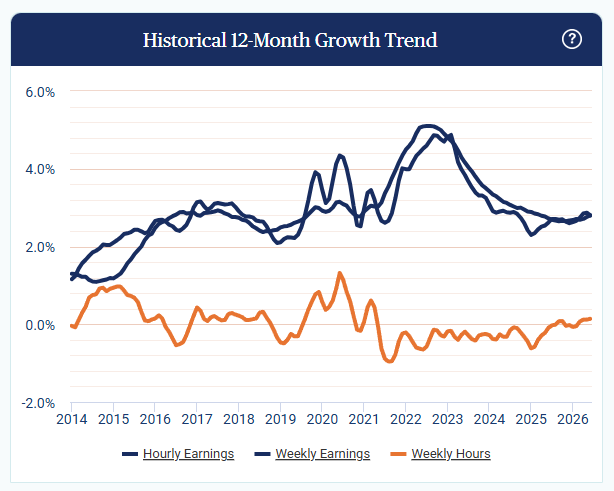
Hourly earnings growth rose to +2.80% YoY in June, while weekly earnings growth slowed to +2.80% YoY and weekly hours worked increased +0.14% YoY, indicating moderate wage gains alongside continued improvement in labor utilization.
-
Hourly earnings growth edged up to +2.80% YoY in June, while one-month annualized growth accelerated to +3.23%, showing firmer short-term wage momentum despite annual growth remaining below 3% for a 20th consecutive month.
-
Weekly earnings growth moderated to +2.80% YoY, with one-month annualized growth slowing to +2.39%, indicating slightly softer overall earnings momentum than the hourly measure.
-
Weekly hours worked increased +0.14% YoY and remained positive for a fourth consecutive month, pointing to continued improvement in labor utilization among small businesses.
-
The Northeast led all regions in hourly earnings growth at +2.98% and weekly earnings growth at +2.88%, while one-month annualized hourly earnings growth exceeded 3% in every region, indicating broadly stronger near-term wage growth.
-
The South recorded the weakest hourly earnings growth at +2.64% for a 13th consecutive month, but led weekly hours worked growth at +0.28%, showing stronger labor utilization despite comparatively softer wage gains.
-
Indiana led states in both hourly earnings growth (+4.34%) and weekly earnings growth (+4.09%) and was the only state above 4% in either measure. Tennessee (+3.87%) and New York (+3.15%) ranked next in hourly earnings growth, while all states remained above 2%.
-
Pennsylvania ranked second lowest in hourly earnings growth (+2.25%), weekly earnings growth (+1.94%), and weekly hours worked growth (-0.29%), highlighting comparatively weak earnings and hours trends.
-
Manufacturing led sectors in hourly earnings growth at +3.09%, while Construction led weekly earnings growth at +3.47% and hours worked growth at +0.53%. Education and Health Services remained the weakest sector, with hourly earnings growth of +2.16%, weekly earnings growth of +2.00%, and a more than five-year stretch of negative hours growth.