


Bank of Japan Monetary Policy Decision: July 2026
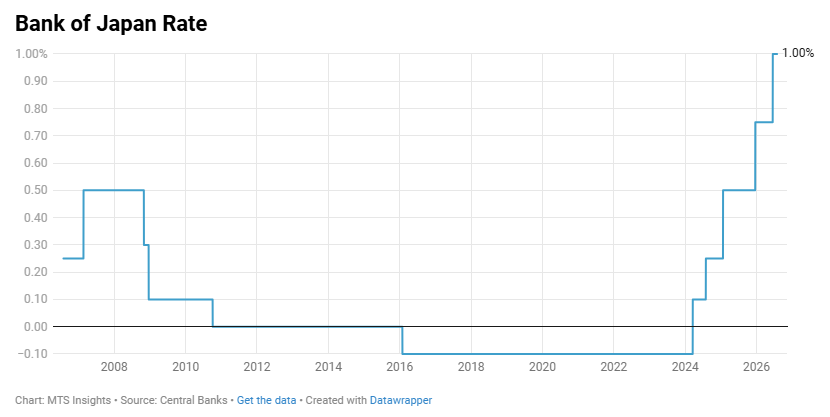
The Bank of Japan voted 8–1 to maintain the overnight call rate at around 1.0%, while projecting moderate economic growth and core inflation clearly above 2% from the second half of FY2026 amid higher energy costs and persistent wage-price pressures.
-
The Policy Board maintained the uncollateralized overnight call rate at around 1.0% by an 8–1 vote, indicating that the majority favored keeping the current policy setting unchanged.
-
One member proposed raising the overnight rate by +25 bps to around 1.25%, citing increased upside risks to prices from overseas demand shocks and changing global financial conditions, but the proposal was defeated.
Summary of the July 2026 edition of the Outlook for Economic Activity and Prices:
-
Japan’s economy is expected to continue growing moderately in FY2026, although at a slower pace, as higher crude oil prices weigh on activity while government measures, accommodative financial conditions, and stronger global AI-related demand provide support.
-
Economic growth is projected to strengthen moderately from FY2027 as the adverse effects of high crude oil prices fade and the cycle between income growth and spending gradually becomes stronger.
-
Core CPI inflation, excluding fresh food, is expected to accelerate to clearly above +2% YoY from the second half of FY2026, driven by energy and goods prices, continued wage pass-through, higher semiconductor-related costs, and the recent depreciation of the yen.
-
Core CPI inflation is then projected to ease toward around +2% later in the forecast period as the effects of elevated crude oil prices diminish, while underlying inflation gradually reaches a level broadly consistent with the 2% target between the second half of FY2026 and FY2027.
-
Real GDP growth projections were broadly unchanged from the previous outlook, while the FY2026 core CPI forecast was lowered due partly to government measures reducing household electricity and gas costs during the summer.
-
Risks to economic activity were assessed as broadly balanced, while inflation risks remained tilted to the upside, particularly from Middle East developments, global AI-related demand, exchange-rate movements, stronger wage- and price-setting behavior, and rising medium- to long-term inflation expectations.
-