
 Global
/
S&P Global
Global
/
S&P Global
Commodity Price & Supply Indicators
About
-
December 1st, 2026 · 11:00 AM
-
January 4th, 2027 · 11:00 AM
-
February 1st, 2027 · 11:00 AM
-
March 1st, 2027 · 11:00 AM
-
April 1st, 2027 · 11:00 AM
-
May 3rd, 2027 · 11:00 AM
-
June 1st, 2027 · 11:00 AM
-
July 1st, 2027 · 11:00 AM
-
August 2nd, 2027 · 11:00 AM
-
September 1st, 2027 · 11:00 AM
-
October 1st, 2027 · 11:00 AM
Latest Releases
12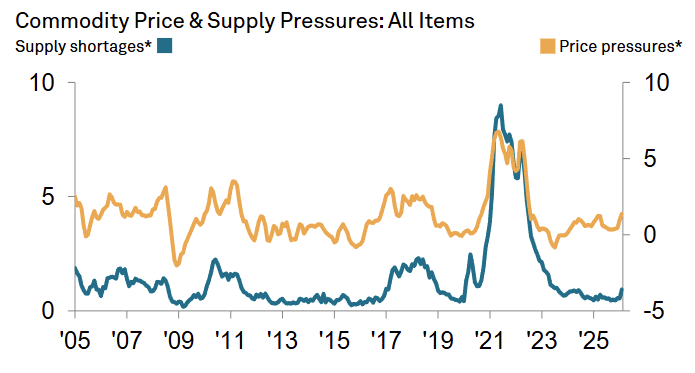
The Global PMI Commodity Price Pressures Index rose to 1.4 in February (from 1.0 in January), marking the strongest global manufacturing input price pressures since July 2022 and the first reading above the long-run average in ten months.
-
The February reading of 1.4 represented an increase from 1.0 in January and signaled the strongest reports of rising commodity prices since July 2022, indicating a renewed acceleration in global manufacturing input costs early in 2026.
-
Eleven of the 26 monitored commodities registered price increases above the long-run trend, highlighting that price pressures were widespread across multiple input categories.
-
Semiconductor prices recorded the most pronounced increase, with price pressures running about 10.8 times the long-run trend, representing the strongest semiconductor pricing pressure since November 2022.
-
Electrical items experienced the sharpest increase in prices in just over three years, indicating significant cost increases across electronics-related manufacturing inputs.
-
Industrial metals also showed elevated pricing pressure, with aluminium and copper registering above-average price increases and both indices reaching multi-year highs.
-
The Global Supply Shortages Index rose to 0.9 in February, indicating that supply shortfalls were only slightly below the long-run average and at their highest level since June 2024.
-
Transport capacity saw the most pronounced shortages, with freight availability reported to be in short supply nearly four times as often as usual, indicating tight logistics conditions.
-
Electrical items and copper also experienced elevated supply shortages, with reported constraints roughly twice the long-run trend and reaching the highest levels in 30 months and 45 months respectively.
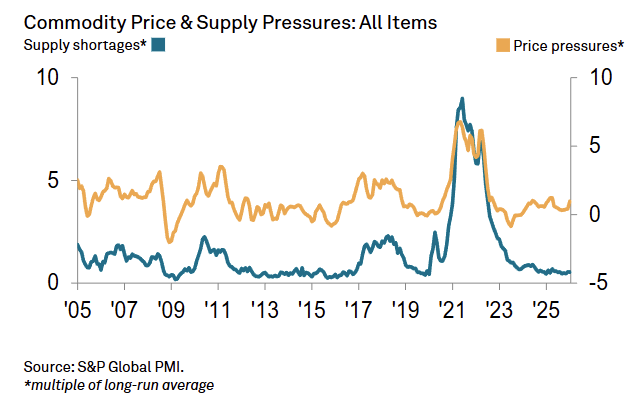
The Global Price Pressures Index jumped to 1.0 in January (from 0.4 in December), indicating a return to long-run average cost pressure levels across manufacturing inputs.
-
Reported price pressures reached their highest level since April 2025, showing a sharp acceleration in global commodity cost momentum at the start of 2026.
-
Seven of 26 monitored commodities recorded above-trend price increases, led by semiconductors, where price pressures ran around eight times the long-run norm, highlighting concentrated inflation in this segment.
-
Electrical items, copper, and aluminium also saw above-average price rises, with copper posting its strongest increase since June 2021, signaling notable strength in industrial metals.
-
Several other commodities experienced softer conditions, with five registering slight price declines, led by polyethylene, indicating that pricing pressures were not universal.
-
The Global Supply Pressures Index edged down slightly to 0.5 (from 0.6), suggesting overall supply constraints remained broadly stable.
-
Transport reported the most pronounced supply shortfalls, reaching a four-month high and nearly four times the long-run average, pointing to localized logistics tightness.
-
Semiconductor and electrical items also showed marginally above-normal shortfalls, while most other commodities reflected generally adequate supply availability.
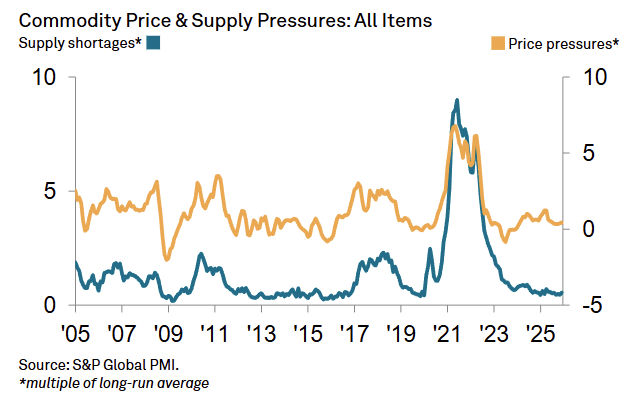
The Global Price Pressures Index eased to 0.4 in December (from 0.5 in November), remaining well below its long-run average and reflecting broadly muted global commodity pricing conditions.
-
Semiconductor prices surged sharply, with reported price pressures nearly nine times above the historical norm and marking the strongest uplift outside the post-pandemic spike, highlighting concentrated cost pressure in this segment.
-
Aluminium and Copper recorded above-trend price increases for a third consecutive month, indicating persistent strength in select industrial metals despite softer conditions elsewhere.
-
Most other commodities saw subdued pricing, as muted manufacturing activity limited broader input cost pressures across global markets.
-
The Global Supply Shortages Index rose to 0.6 (from 0.5), signaling a modest uptick in supply constraints but still consistent with generally healthy material availability.
-
Above-average supply shortfalls were limited to Transport, Copper, and Stainless Steel, underscoring that supply stress remained narrow rather than widespread.
-
Oil prices declined in December amid expectations of a production surplus in 2026, helping offset cost pressures from metals and easing broader commodity price momentum.
-
Overall conditions pointed to a bifurcated commodity landscape, with intense pressures in semiconductors and select metals contrasted against broadly subdued pricing and supply dynamics elsewhere.
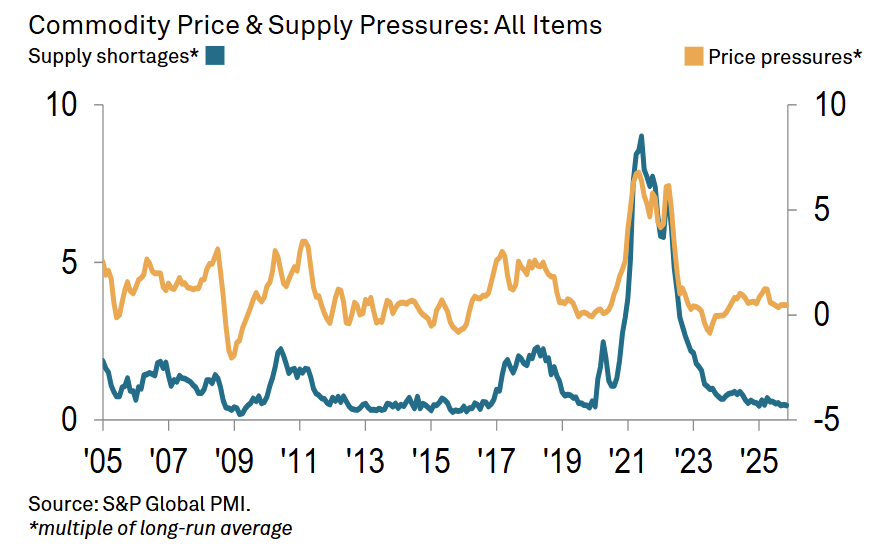
The Global Price Pressures Index held at 0.5 in November (unchanged from October), marking a third straight month of subdued pricing and supply conditions across global manufacturing.
-
Nine of the 26 tracked commodities saw price declines, though decreases were marginal, underscoring broadly soft input cost pressures.
-
Semiconductors recorded the strongest above-average price pressures among all commodities, followed by Electrical Items and Aluminium.
-
Price pressures for Electrical Items rose to their highest level in nine months, indicating a localized uptick within an otherwise muted landscape.
-
The Global Supply Shortages Index also held at 0.5, remaining at half the long-run average for a fifth consecutive month.
-
Electrical Items and Aluminium were the only commodities with above-average supply shortfalls, with Electrical Item shortages reaching their highest point since July 2024.
-
Transport prices increased to their largest extent since July, contributing to slightly firmer cost pressures in a few categories.
-
Polyethylene and Polypropylene led the commodities with falling prices, reinforcing the overall picture of easing raw material costs heading into year-end.
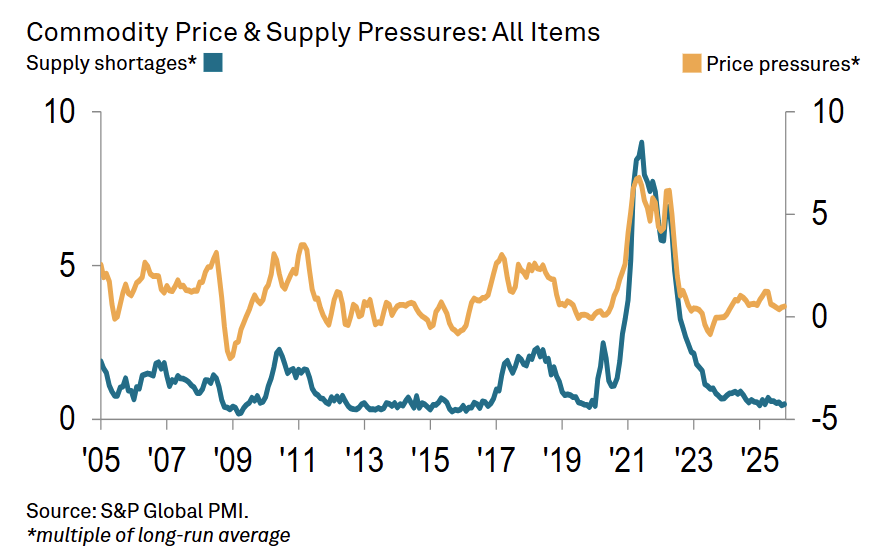
The Global Price Pressures Index held steady at 0.5 in October 2025, showing continued subdued inflation in manufacturing inputs, while the Global Supply Shortages Index also remained unchanged at 0.5, indicating stable and below-average supply constraints.
-
Semiconductors recorded the strongest price pressures, rising to the highest level since February 2023 and over five times the long-run average, highlighting a key outlier in an otherwise muted commodity landscape.
-
Electrical items were among the few other commodities to see above-average price gains, while Oil, Polyethylene, and Polypropylene registered price declines.
-
Only four of 26 tracked commodities reported price increases above their long-run norms, underscoring broadly stable input costs across the manufacturing sector.
-
Supply shortages stayed muted for the 26th consecutive month, with shortfalls for most materials well below historical averages.
-
Semiconductors were again the only commodity with above-average supply shortages, reaching their highest level in 16 months but still below the 2021 peaks.
-
Overall, the report signaled that global manufacturing input markets remained balanced, with localized tightness in semiconductors offset by easing pressures elsewhere.
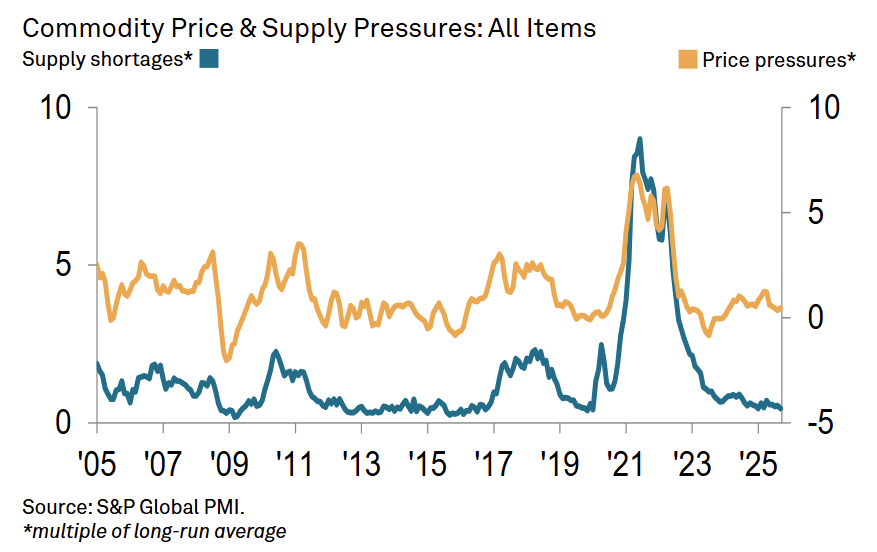
The Global Price Pressures Index rose slightly to 0.5 in September 2025 (from 0.4 in August), while the Global Supply Shortages Index held steady at 0.5, with both remaining well below their long-run averages and signaling subdued pressures in global manufacturing.
-
Only three of 26 tracked commodities saw above-average price increases, led by Semiconductors, which posted their fastest rise since April, while Electrical Items recorded the highest share of price reports in six months.
-
Four commodities registered price declines, with Polyethylene falling for a sixth straight month, alongside Polypropylene, PVC, and Stainless Steel.
-
Supply shortages were unchanged from August, remaining at about half their historical average, indicating broadly stable supply conditions.
-
Transport was the only category to show above-average shortfalls, with shortages nearly four times the long-run norm.
-
Overall, the data indicate that both price and supply pressures in global manufacturing remained muted at the end of the third quarter.