China Retail Sales
About
Latest Releases
12
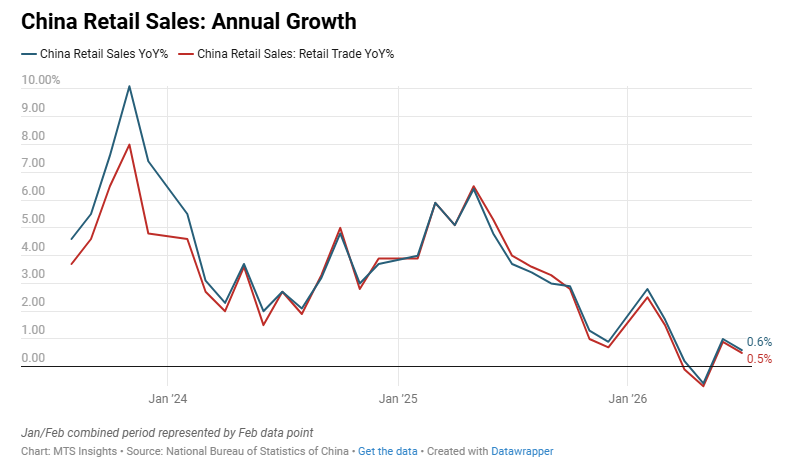
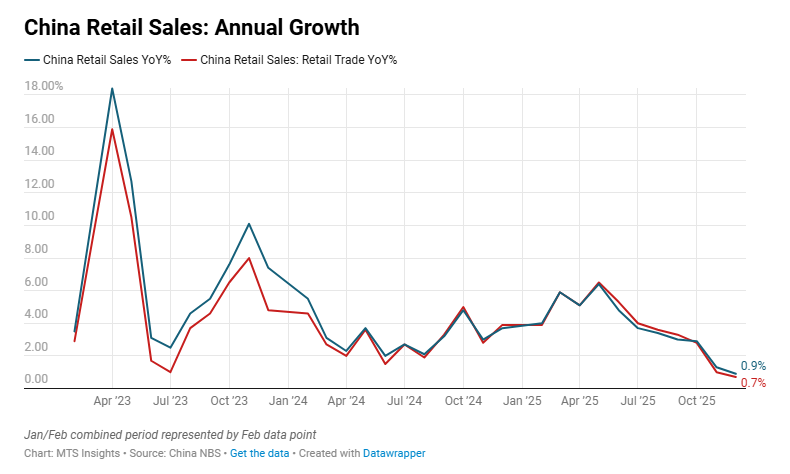
China’s retail sales increased +0.06% MoM and +0.6% YoY in July 2026, while January–July sales rose +1.2% YoY, indicating consumer spending remained subdued with autos and several discretionary categories continuing to weigh on growth.
-
Total retail sales reached ¥3.90 trillion in July, up +0.6% YoY and just +0.06% MoM, while January–July sales totaled ¥28.77 trillion, up +1.2% YoY, showing only modest overall consumption growth.
-
Retail sales excluding automobiles rose +2.5% YoY in July and +2.7% YoY year-to-date, materially outperforming the headline measure and highlighting the continued drag from vehicle sales.
-
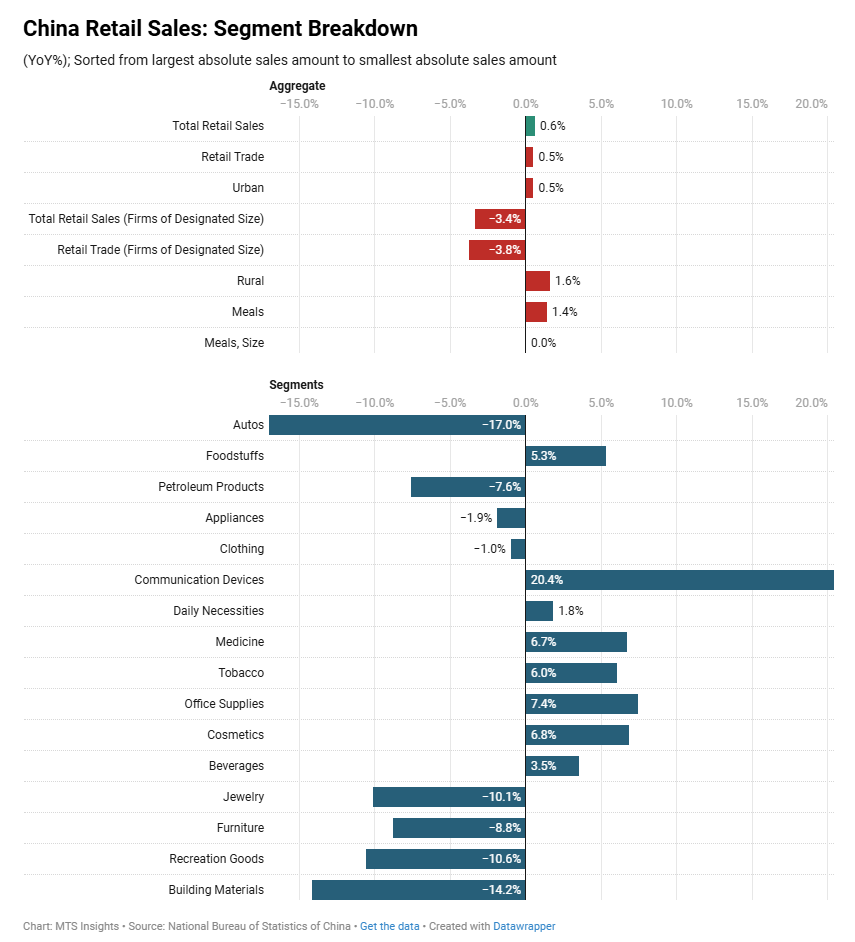
Urban retail sales increased +0.5% YoY in July and +1.1% YTD, while rural retail sales rose +1.6% YoY and +2.4% YTD, indicating stronger spending growth outside urban areas.
-
Goods retail sales increased +0.5% YoY in July and +1.1% YTD, while catering revenue rose +1.4% YoY and +2.6% YTD, showing services-related consumption continued to grow faster than goods spending.
-
By store type, convenience store sales increased +6.1% YoY YTD and supermarket sales rose +3.8%, while specialty stores (-1.8%), department stores (-2.4%), and brand specialty stores (-9.3%) all remained in contraction.
-
Online retail sales of goods and services rose +4.8% YoY YTD, including +4.6% growth in online goods and +5.2% in online services. Online food sales increased +16.9%, clothing +5.8%, and daily goods +1.1%.
-
Category performance remained highly uneven in July. Communication equipment rose +20.4% YoY, cultural and office supplies +7.4%, cosmetics +6.8%, medicines +6.7%, and tobacco and alcohol +6.0%, while autos fell -17.0%, building materials -14.2%, sports and entertainment products -10.6%, jewelry -10.1%, furniture -8.8%, and petroleum products -7.6%.
-
Retail sales at units above designated size fell -3.4% YoY in July, while goods sales within those units declined -3.8%, indicating weakness remained concentrated among larger formal retailers even as some categories posted solid gains.


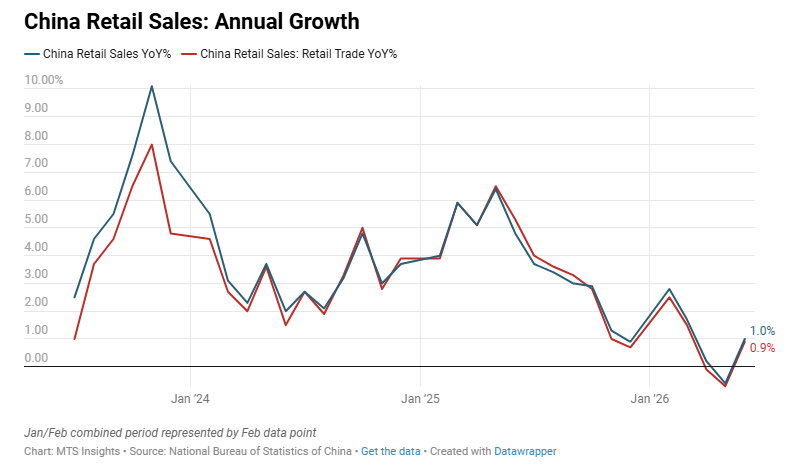
China's retail sales of consumer goods increased +0.38% MoM and +1.0% YoY in June, while first-half retail sales rose +1.3% YoY, indicating consumer spending remained modest despite stronger growth in several categories.
-
Total retail sales of consumer goods rose +0.38% MoM in June after declining -0.17% MoM in May. On an annual basis, sales increased +1.0% YoY to ¥4.27 trillion, while first-half retail sales reached ¥24.87 trillion, up +1.3% YoY.
-
Retail sales excluding automobiles increased +3.0% YoY in June and +2.8% YoY in the first half of the year, outperforming headline retail sales and indicating that weakness in vehicle purchases continued to weigh on overall consumer spending.
-
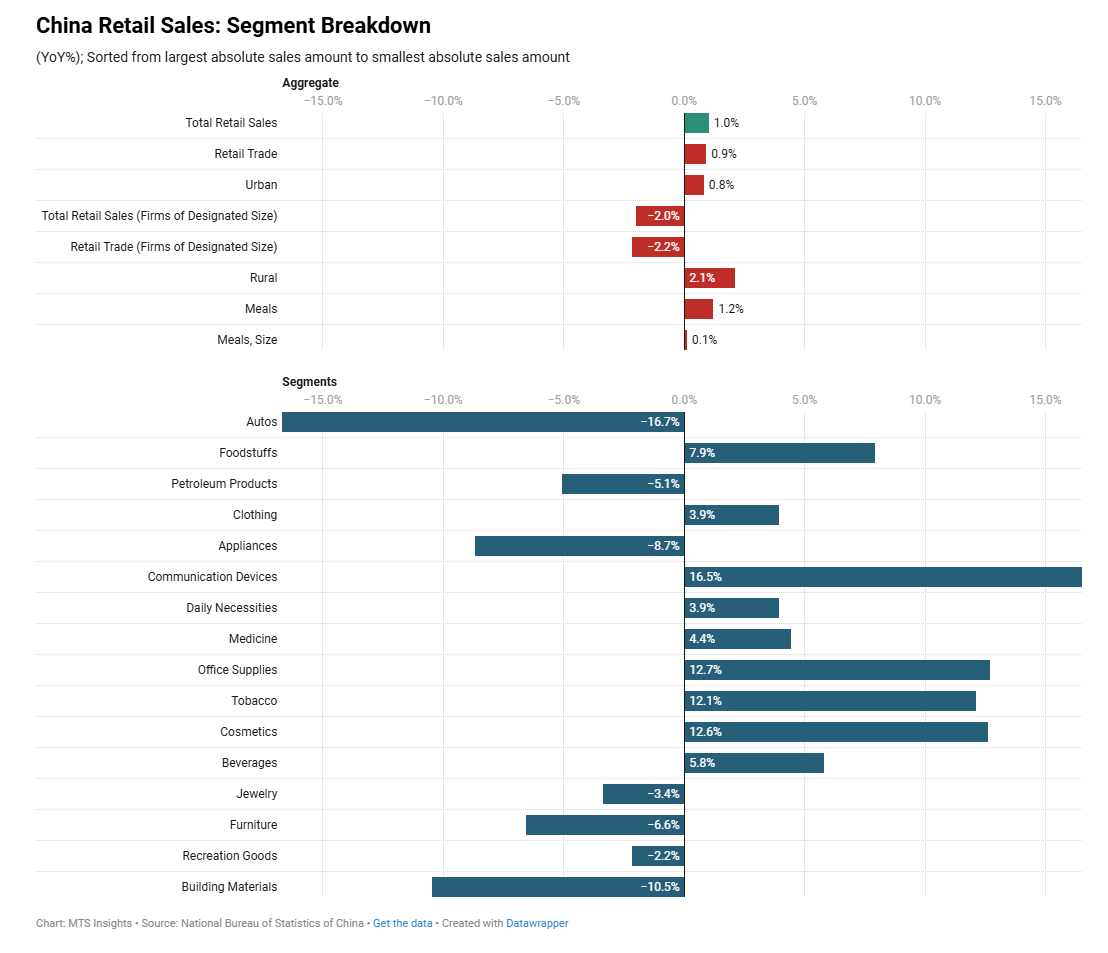
Urban retail sales rose +0.8% YoY in June and +1.2% YoY in the first half, while rural retail sales increased +2.1% YoY in June and +2.5% YoY year-to-date, with rural consumption continuing to grow at a faster pace than urban areas.
-
Goods retail sales increased +0.9% YoY in June and +1.1% YoY year-to-date, while catering revenue rose +1.2% YoY in June and +2.8% YoY in the first half, showing services-related consumption continued to outperform goods spending.
-
Retail sales growth remained strongest at convenience stores (+6.6% YoY) and supermarkets (+3.8% YoY) in the first half, while specialty stores (-1.5%), department stores (-2.1%), and brand specialty stores (-8.7%) all recorded annual declines.
-
Online retail sales of goods and services rose +5.2% YoY in the first half, including +4.8% growth in online goods sales and +6.0% growth in online services. Online sales of food (+16.8% YoY) and clothing (+6.2% YoY) were among the strongest-performing categories.
-
Consumer spending remained mixed across major product categories in June. Communication equipment (+16.5% YoY), cultural and office supplies (+12.7%), cosmetics (+12.6%), tobacco and alcohol (+12.1%), and food (+7.9%) posted strong gains, while automobiles (-16.1%), home appliances (-8.7%), building materials (-10.5%), furniture (-6.6%), petroleum products (-5.1%), sports and entertainment products (-2.2%), and jewelry (-3.4%) all declined on an annual basis.


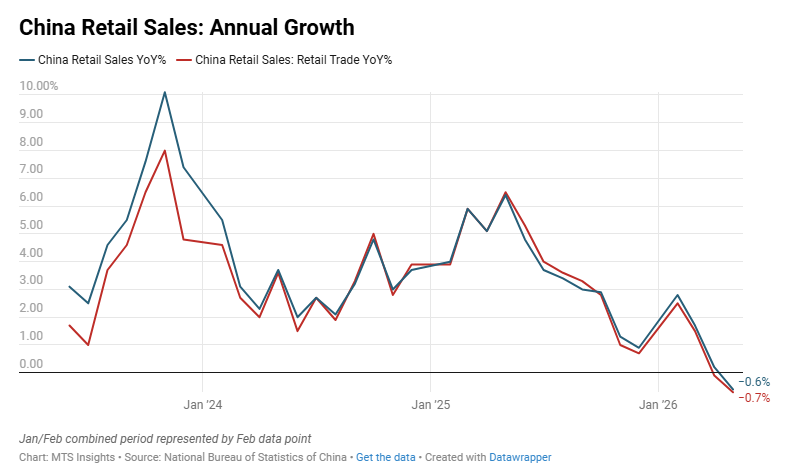
China's retail sales unexpectedly contracted -0.6% YoY in May, marking the first annual decline since December 2022 and highlighting ongoing weakness in consumer demand.
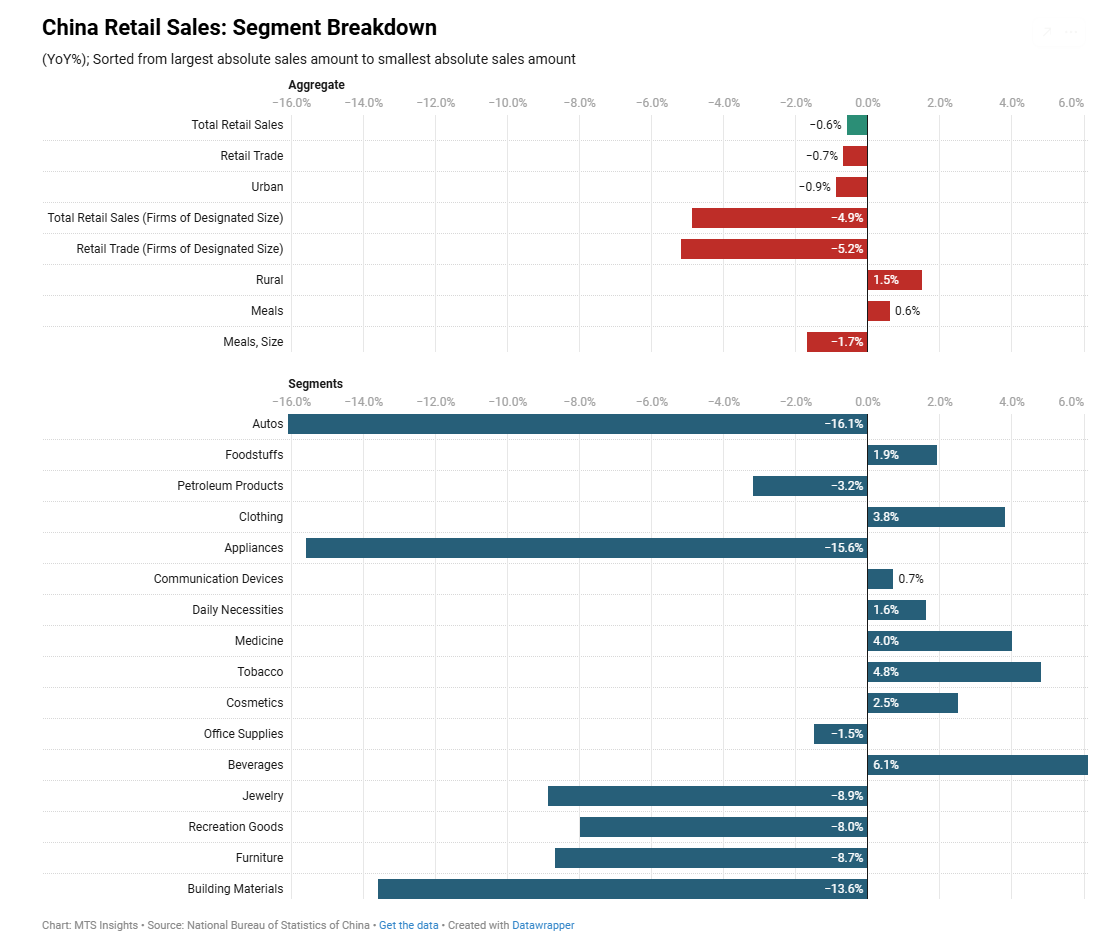
- The downturn was heavily influenced by the auto sector, where sales fell -16.1% YoY. Excluding automobiles, retail sales still rose 1.1% YoY, suggesting consumer spending remains weak but not collapsing.
- Several discretionary categories also struggled. Home appliances sales fell -15.6% YoY, building materials dropped -13.6%, furniture declined -8.7%, and sports & entertainment products fell -8.0%. Retail sales at large retailers contracted -4.9% YoY.
- Areas of relative strength included online retail sales, which grew 5.0% YoY in the first five months of the year, along with solid gains in food, clothing, cosmetics, and communication equipment spending.
- The broader picture remains one of sluggish consumption. Total retail sales are up just 1.4% YoY year-to-date, while goods sales have risen only 1.2%. The May decline suggests household demand remains one of the weakest parts of China's economy despite ongoing policy efforts to support growth.


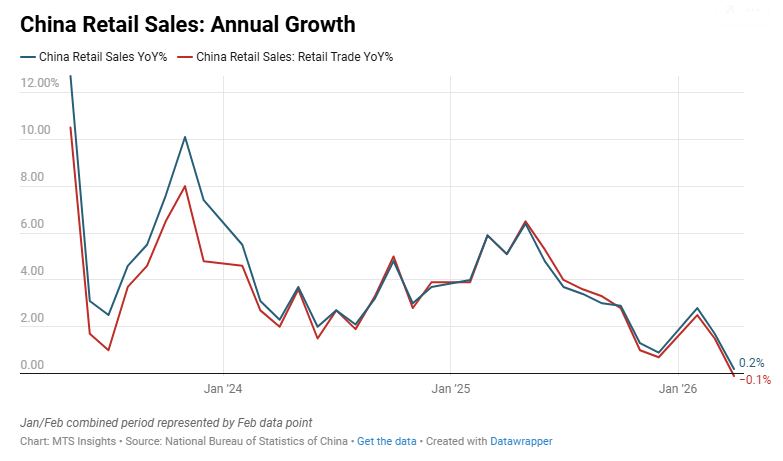
China’s retail sales growth weakened sharply in April, with total retail sales rising just 0.2% YoY after stronger gains earlier in the year, pointing to ongoing softness in household demand and discretionary spending.
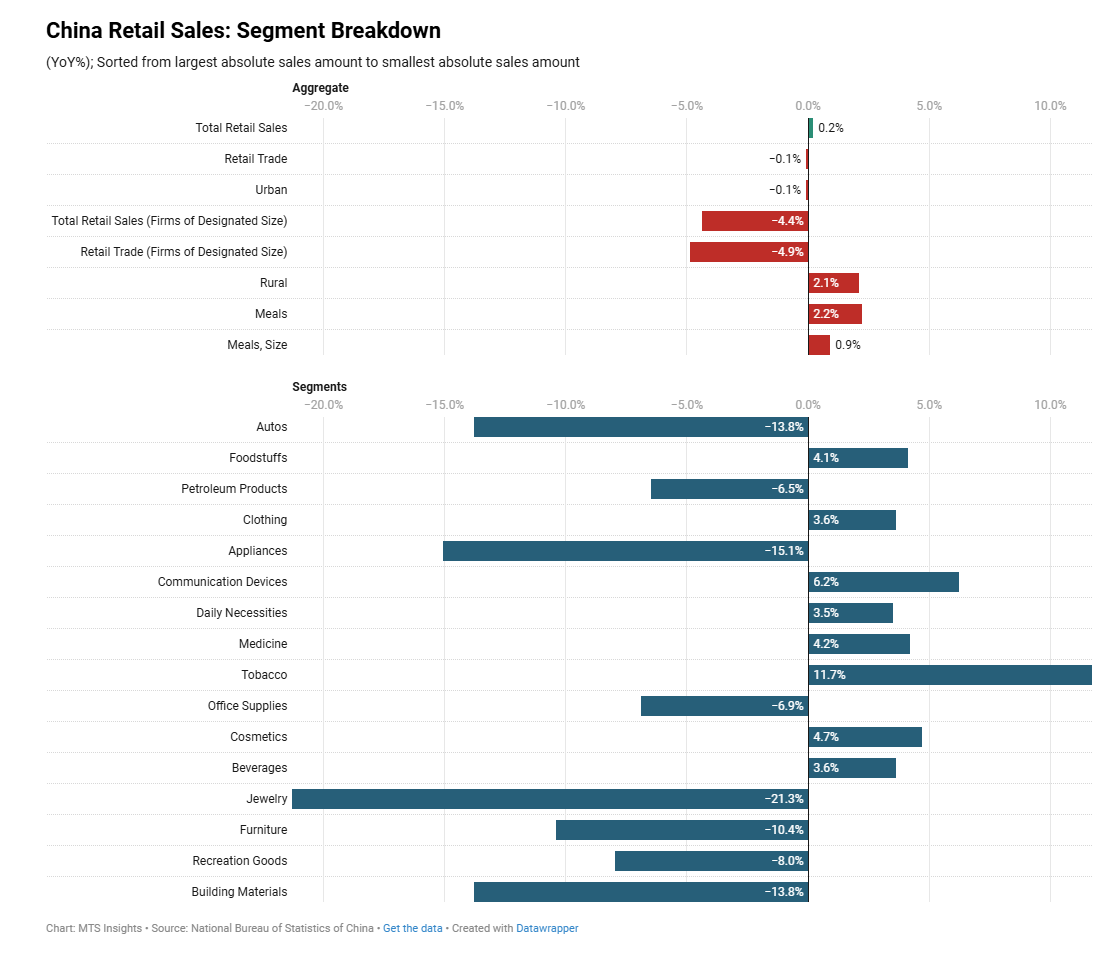
- Retail sales excluding automobiles increased 1.8% YoY, while overall goods retail sales fell -0.1%. Auto sales dropped -15.3% YoY, continuing to weigh heavily on headline consumption trends.
- Several discretionary and housing-related categories remained notably weak. Household appliances fell -15.1%, furniture declined -10.4%, construction and decoration materials dropped -13.8%, and sports and entertainment products fell -8.0%.
- Urban retail sales contracted -0.1% YoY in April, while rural sales rose 2.1%, suggesting consumption softness was concentrated more heavily in cities.
- Some categories still showed resilience, including communication equipment (+6.2%), cosmetics (+4.7%), food (+4.1%), and tobacco and alcohol (+11.7%), though gains were not broad enough to offset weakness elsewhere.
- Online retail sales continued to outperform, rising 6.6% YoY in January-April and accounting for 25% of total retail sales, highlighting the continued shift toward digital consumption channels.


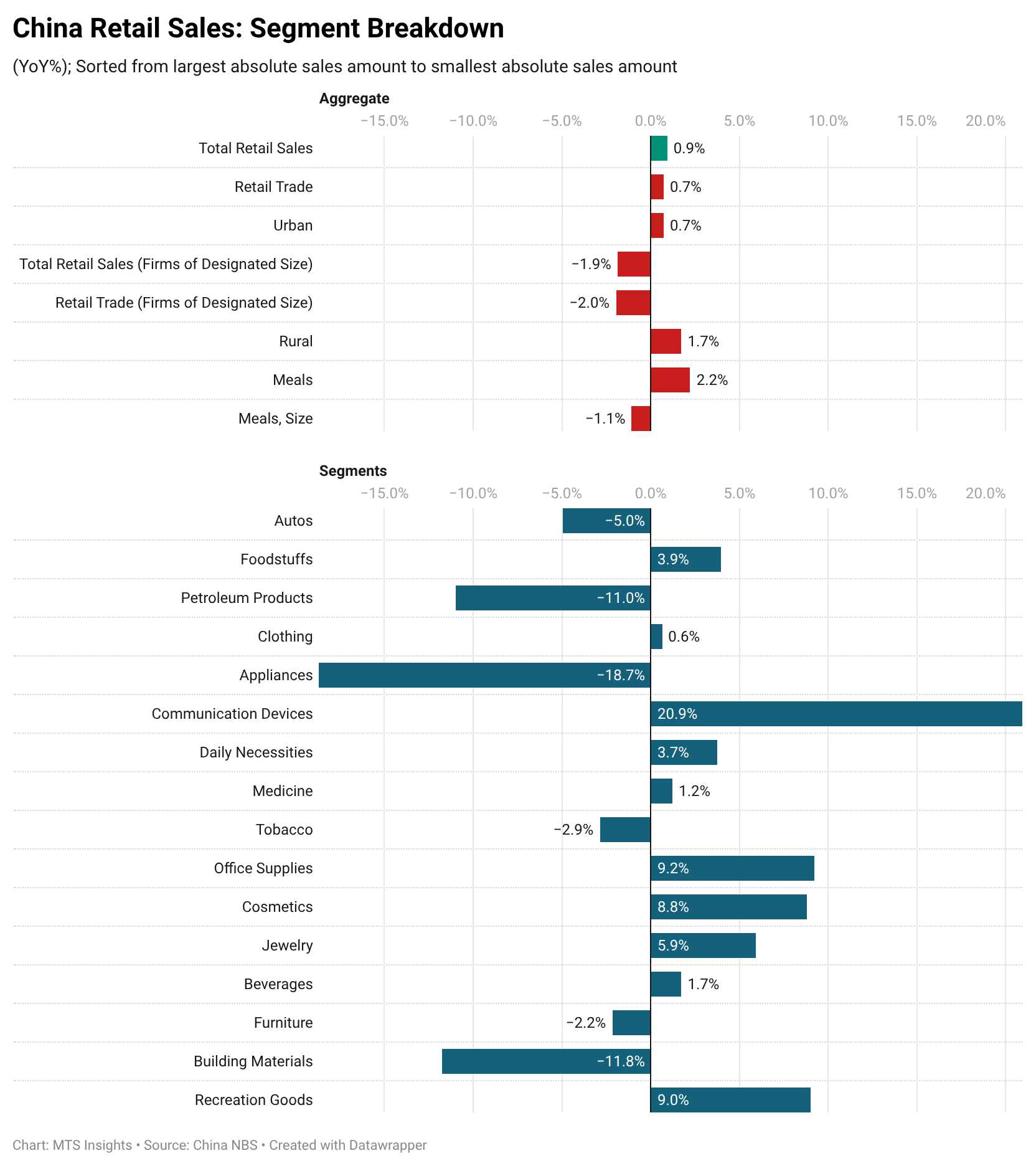
China’s total retail sales fell -0.12% MoM, the second straight monthly decline, but on an annual basis, sales rose +0.9% YoY(vs +1.2% YoY expected) in December 2025. Consumer demand has seen a sharp slowdown in Q4 2025, causing both discretionary and non-discretionary sales growth to slow.
-
Total retail sales of consumer goods were CNY 4,513.6bn in December (+0.9% YoY), while retail sales excluding autos were CNY 3,965.4bn (+1.7% YoY), indicating autos were a drag on the headline growth rate.
-
For full-year 2025, total retail sales reached CNY 5,012.0bn (+3.7% YoY), and retail sales excluding autos totaled CNY 4,514.1bn (+4.4% YoY), showing a firmer underlying pace when autos are excluded.
-
Spending momentum was slightly stronger in rural areas, with December urban retail sales at CNY 3,842.9bn (+0.7% YoY) versus rural retail sales at CNY 670.7bn (+1.7% YoY).
-
Services continued to outperform goods, with catering revenue up +2.2% YoY in December (CNY 573.8bn) versus goods retail sales up +0.7% YoY (CNY 3,939.8bn).
-
Larger retail units weakened in December, as retail sales of consumer goods above designated size fell -1.9% YoY (CNY 1,954.7bn), and goods retail sales at units above designated size fell -2.0% YoY (CNY 1,808.4bn), contrasting with positive growth over the full year (+3.3% and +3.4% YoY, respectively).
-
Category-level performance was mixed in December, with strength in communication equipment (+20.9% YoY), cosmetics (+8.8%), cultural office supplies (+9.2%), sports/entertainment products (+9.0%), and jewelry (+5.9%), while household appliances/audio equipment (-18.7%), petroleum products (-11.0%), construction/decoration materials (-11.8%), and autos (-5.0%) remained notable drags.
-
Online retail sales remained a key support in 2025, rising +8.6% YoY to CNY 1,597.2bn; online retail sales of physical goods increased +5.2% YoY to CNY 1,309.2bn (26.1% of total retail sales), led by food (+14.5% YoY) while clothing (+1.9%) and daily-use goods (+4.1%) grew more modestly.
-
Retail format trends among units above designated size in 2025 showed relatively stronger growth in convenience stores (+5.5% YoY) and supermarkets (+4.3%), while department stores (+0.1%) and specialty stores (+2.6%) were softer, and branded stores declined (-0.6%).

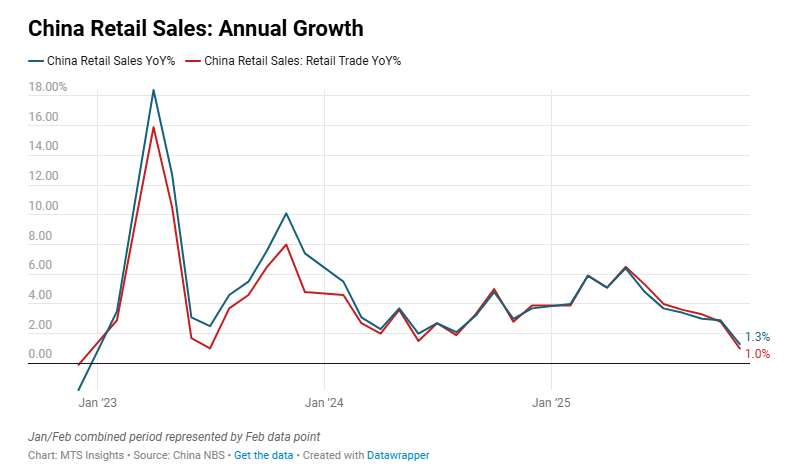
China’s total retail sales of consumer goods fell -0.42% MoM and were up just +1.3% YoY (vs 2.9% YoY expected) in November 2025, the lowest annual growth since July 2023.
-
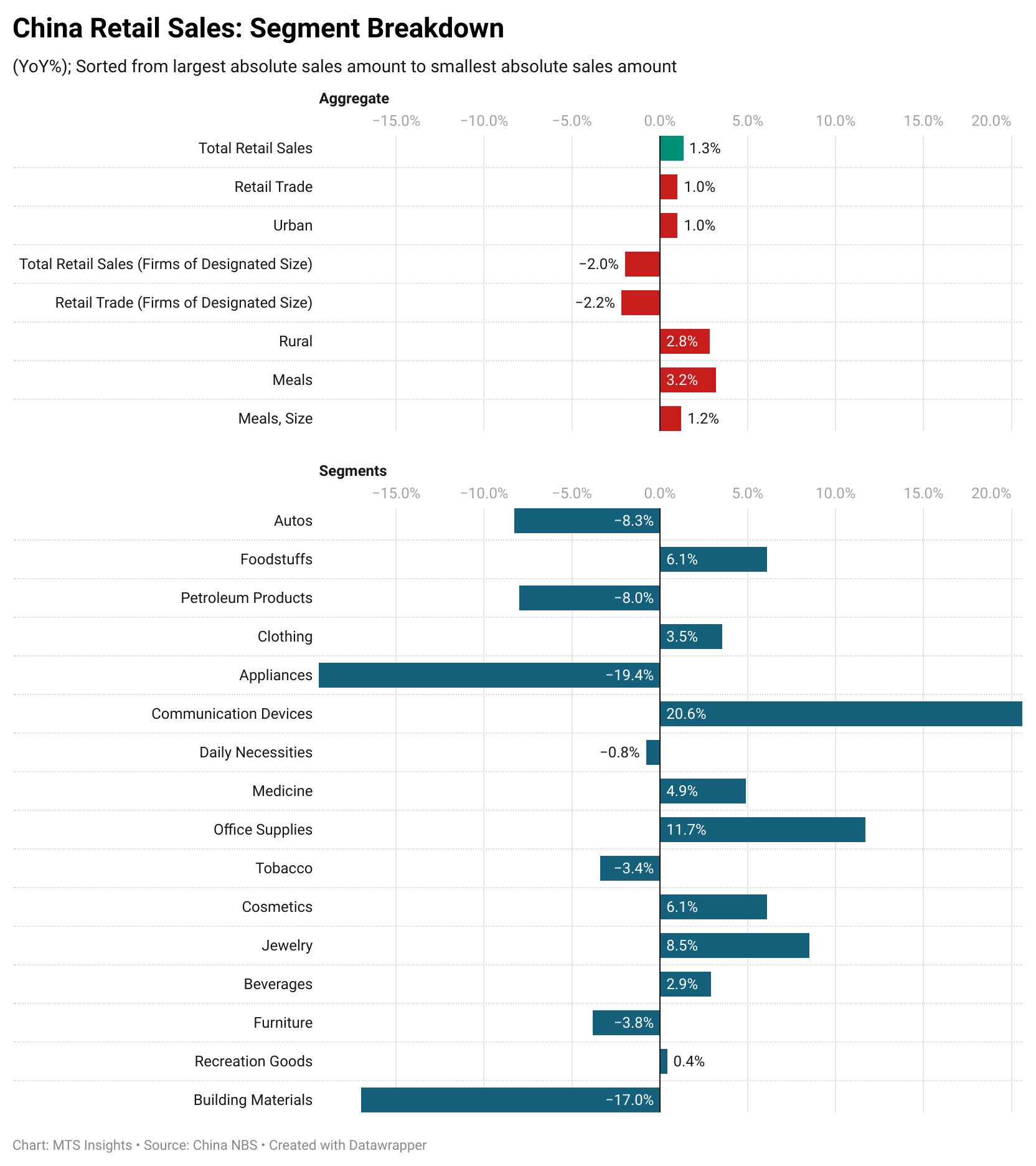
Total retail sales reached ¥4,389.8B (+1.3% YoY), while non-auto retail sales rose faster at ¥3,944.4B (+2.5% YoY), showing autos as a drag on headline growth.
-
From January to November, total retail sales increased +4.0% YoY to ¥456,067B, with non-auto retail up +4.6% YoY, pointing to steadier momentum on a cumulative basis.
-
Urban retail sales grew +1.0% YoY in November to ¥3,768.4B, while rural retail sales rose +2.8% YoY to ¥621.4B, indicating stronger relative growth in rural areas.
-
By consumption type, goods retail sales increased +1.0% YoY, while catering revenue rose +3.2% YoY, showing services outperforming goods consumption.
-
Retail sales of units above designated size declined -2.0% YoY in November, contrasting with +3.8% YoY growth over Jan–Nov, suggesting recent weakness among larger retailers.
-
Online retail sales totaled ¥118,193B in Jan–Nov (+5.7% YoY for physical goods), accounting for 25.9% of total retail sales, with food (+14.9%), clothing (+3.5%), and daily-use goods (+4.4%) contributing.
-
Category-level gains in November were led by communication equipment (+20.6% YoY), cultural office supplies (+11.7%), jewelry (+8.5%), and cosmetics (+6.1%), reflecting strength in selected discretionary items.
-
Weakness persisted in autos (-8.3% YoY), petroleum products (-8.0%), household appliances and audiovisual equipment (-19.4%), and construction materials (-17.0%), weighing on overall retail growth.


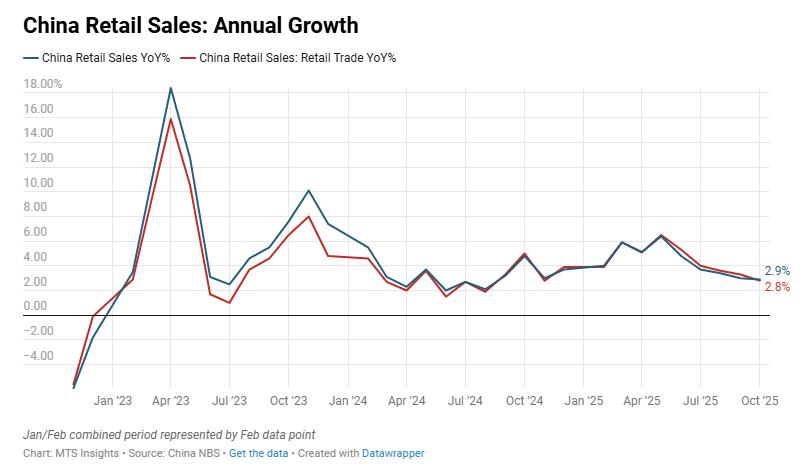
China’s total retail sales of consumer goods rose +2.9% YoY in October 2025, with non-auto retail up +4.0% YoY, reflecting steady but moderate consumption growth across goods and services.
-
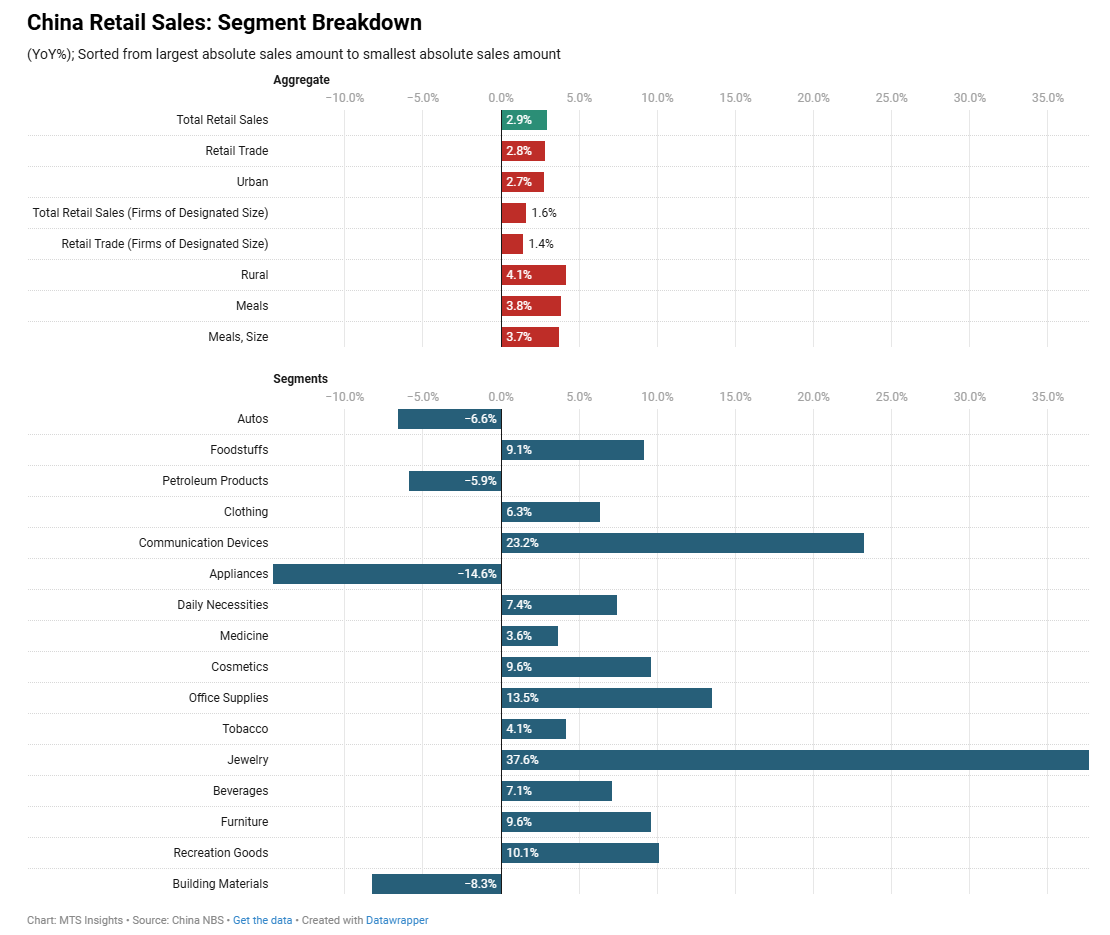
Urban retail sales increased +2.7% YoY to ¥4.00T, while rural retail sales grew a faster +4.1% YoY, showing comparatively stronger momentum in smaller markets.
-
Goods retail sales were up +2.8% YoY to ¥4.11T, and catering revenue rose +3.8% YoY to ¥520B, indicating balanced but modest gains across consumption categories.
-
Retail sales above designated size increased +1.6% YoY, highlighting slower growth among large retail enterprises compared with the broader market.
-
Online retail sales of physical goods rose +6.3% YoY in Jan–Oct and accounted for 25.2% of total retail activity; food (+15.1%), clothing (+3.6%), and daily-use goods (+5.1%) all contributed.
-
Among major goods categories in October, jewelry surged +37.6% YoY, communication equipment grew +23.2%, cosmetics rose +9.6%, and cultural office supplies gained +13.5%, pointing to firm demand in discretionary and technology-related items.
-
Petroleum products fell -5.9% YoY and auto sales declined -6.6% YoY, underscoring continued weakness in energy-related and vehicle categories.
-
Household appliances and audiovisual equipment dropped -14.6% YoY, marking one of the sharpest declines among major retail sectors.
-
Jan–Oct totals showed overall retail sales up +4.3% YoY and non-auto retail up +4.9% YoY, indicating a slightly stronger cumulative pace than October’s monthly reading.


China’s total retail sales of consumer goods rose +3.0% YoY in September 2025, slightly slower than August’s pace, reflecting steady but moderate consumption growth across goods and services.
-
Retail sales excluding autos increased +3.2% YoY, while auto-related sales rose +1.6% YoY, indicating balanced growth between core consumption and vehicle demand.
-
Goods retail sales grew +3.3% YoY, supported by solid gains in furniture (+16.2%), communication equipment (+16.2%), and jewelry (+9.7%), while catering revenue increased just +0.9% YoY, showing weaker momentum in services spending.
-
Urban retail sales were up +2.9% YoY, compared with +4.0% YoY growth in rural areas, suggesting stronger consumption recovery in smaller markets.
-
Online retail sales of physical goods rose +6.5% YoY in Jan–Sep, accounting for 25.0% of total retail sales; food (+15.1%), clothing (+2.8%), and daily-use goods (+5.7%) all contributed to growth.
-
Among goods categories, sports and entertainment products (+11.9%), furniture (+16.2%), and cultural office supplies (+6.2%) saw robust gains, while petroleum products (-7.1%) and beverages (-0.8%) declined.
-
Retail sales by format showed mixed trends in Jan–Sep: convenience stores (+6.4%) and specialty stores (+4.8%) expanded faster, while department stores (+0.9%) and brand stores (+1.5%) grew more slowly.
-
For the first nine months of 2025, total retail sales reached ¥36.59T (+4.5% YoY), with non-auto retail up +4.9% YoY, showing continued, though uneven, consumption recovery.

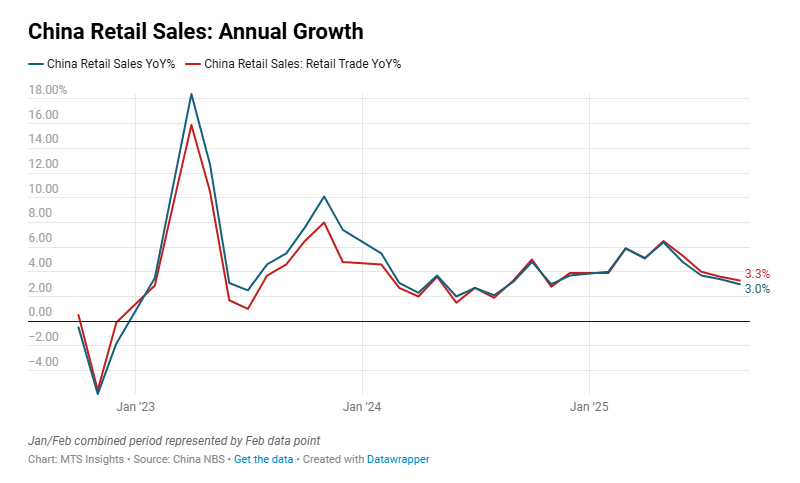
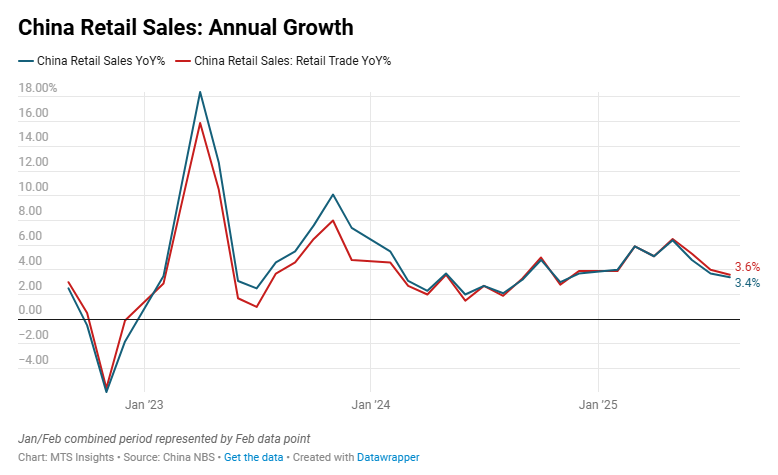
Chinese retail sales increased 0.17% MoM and 3.4% YoY in August, down from 3.7% YoY in July and below expectations of an increase of 3.8% YoY.
- Retail sales (ex autos) were up 3.7% YoY, slowing from the 4.3% YoY increase in the previous month.
- Sales growth was consistently positive across segments with only three segments seeing declines: petroleum products (-8.0% YoY), tobacco (-2.3% YoY), and building materials (-0.7% YoY).
- Food, grain & oil sales were up 5.8% YoY, slowing significantly from 8.6% YoY previously.
- Sales of communication equipment like phones also slowed, from 14.9% YoY in July to 7.3% YoY.

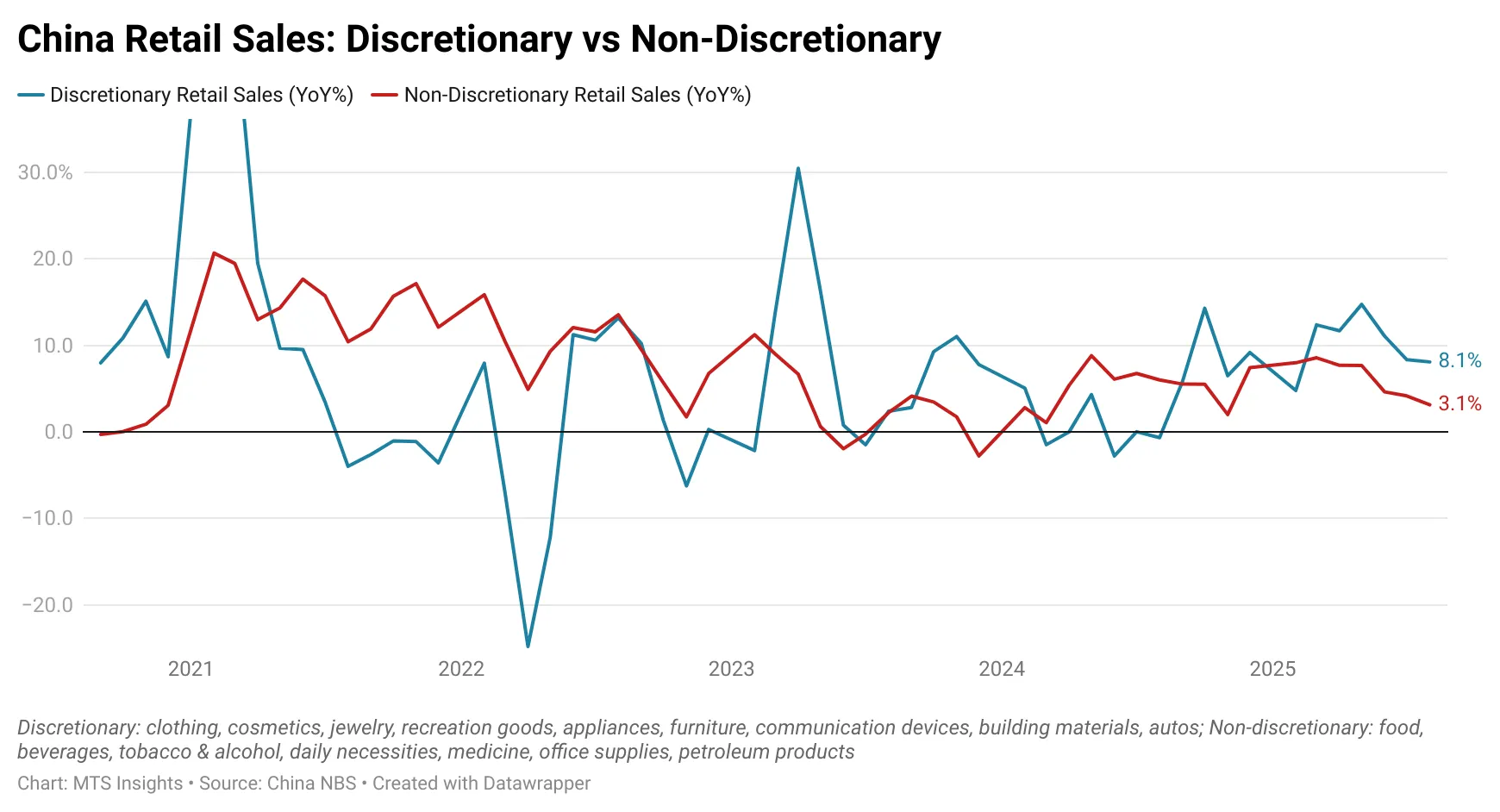
- Sales growth for both discretionary and non-discretionary segments slowed with the former decelerating to 8.1% YoY (down from 8.4% YoY) and the latter decelerating to 3.1% YoY (down from 4.2% YoY).